


Page 13 - N. Metabolism and metabolic diseases
P. 13
Anti-osteoclastogenic activity of hibiscus syriacus
  L. twig extract via inhibition of ERK/Akt-c-Fos-NFATc1 signaling axis

  Shin-Hye Kim , Sik-Won Choi 1,*
            1,2
  1 Forest Biomaterials Research Center, National Institute of Forest Science, jinju 52817, korea
  2 Department of Biological Sciences, College of Natural Science, Chonbuk National University, Jeonbuk 54896, Korea
                                               ABSTRACT
   A decrease of bone mass is a major risk factor for fracture. Several natural products have traditionally been used as herbal
   medicines to prevent and/or treat bone disorders including osteoporosis. Hibiscus syriacus has several biological activities
   including anti-osteoclasts, but its anti-osteoporotic activity has not been fully studied yet. The effect of hibiscus syriacus L.
   cultivars stem with color of flowers on the differentiation of bone marrow-derived macrophages into osteoclasts was examined by
   phenotype assay and confirmed by real-time PCR and immunoblotting. Interestingly, the branch extracts of red flowers with red
   eyes strongly inhibited the RANKL-stimulated osteoclast differentiation compared with other varieties. In mode of action, the red
   flower cultivar, ‘Nanpa’ extracts attenuated the RANKL-induced osteoclast differentiation and induction of c-Fos/NFATc1 such as
   master regulator of osteoclastogenesis. Moreover, ‘Nanpa’ extracts blocked the RANKL-mediated activation of AKT/ERK
   phosphorylation in BMMs. Taken together, our results suggest that the cultivar of red flowers with red eyes, ‘Nanpa’ branch
   extracts could exhibit its anti-osteoclastogenic activity by inhibiting AKT/ERK-c-Fos-NFATc1 signaling molecules.
                                                RESULTS

    A                   B                     A


                                              B


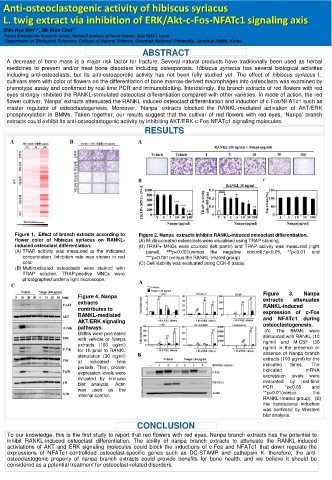
      Figure 1. Effect of branch extracts according to  Figure 2. Nanpa extracts inhibits RANKL-induced osteoclast differentiation.
      flower color of hibiscus syriacus on RANKL-  (A) Multinucleated osteoclasts were visualised using TRAP staining.
      induced osteoclast differentiation.     (B) TRAP+ MNCs were counted (left panel) and TRAP activity was measured (right
      (A) TRAP acitivity was measured at the indicated  panel).  ### p<0.001(versus  the  negative  control);*p<0.05,  **p<0.01  and
        concentration. Inhibition rate was shown in red  ***p<0.001(versus the RANKL-treated group)
        color                                 (C) Cell viability was evaluated using CCK-8 assay.
      (B) Multinucleated osteoclasts were stained with
        TRAP solution. TRAP-positive MNCs were
        photographed under a light microscope.
     C                                        A
                                                                                       Figure  3.   Nanpa
                          Figure 4. Nanpa                                              extracts  attenuates
                          extracts                                                     RANKL-induced
                          contributes to                                               expression of c-Fos
                          RANKL-mediated
                          AKT/ERK signaling                                            and  NFATc1  during
                          pathways.                                                    osteoclastogenesis.
                                                                                               BMMs
                                                                                           The
                                                                                       (A)
                                                                                                      were
                          BMMs were pretreated                                         stimulated with RANKL (10
                          with vehicle or Nanpa                                        ng/ml) and M-CSF (30
                          extracts (100 ug/ml)
                          for 1h prior to RANKL                                        ng/ml) in the presence or
                          stimulation (30 ng/ml)  B                                    absence of Nanpa branch
                          at  indicated  time                                          extracts (100 μg/ml) for the
                                                                                                times.
                                                                                                      The
                                                                                       indicated
                          periods. Then, protein                                       indicated    mRNA
                          expression levels were                                       expression  levels  were
                          evluated by immuno                                           evaluated  by  real-time
                          blot  analysis.  Actin                                       PCR.   *p<0.05  and
                          was  used  as  the
                          internal control.                                            **p<0.01(versus  the
                                                                                       RANKL-treated group). (B)
                                                                                       the translational induction
                                                                                       was confimed by Western
                                                                                       blot analysis.
                                              CONCLUSION
   To our knowledge, this is the first study to report that red flowers with red eyes, Nanpa branch extracts has the potential to
   inhibit RANKL-induced osteoclast differentiation. The ability of nanpa branch extracts to attenuate the RANKL-induced
   activiations of AKT and ERK signaling molecules could block the inductions of c-Fos and NFATc1 that down regulate the
   expressions of NFATc1-controllded osteoclast-specific genes such as DC-STAMP and cathepsin K. therefore, the anti-
   osteoclastogenic property of nanpa branch extracts could provide benefits for bone health, and we believe it should be
   considered as a potential treatment for osteoclast-related disorders.

