


Page 157 - D. Cancer biology
P. 157
Application of methylation sensitive high-resolution melting
                         analysis for prediction of prognosis in liver cancer patients

                                    Si-Cho Kim , Dongwoon Han , Jeongsil Ha and Young-Joon Kim      1,2*
                                                                 3
                                                                              3
                                                1
                         1 Department of Integrated Omics and Biomedical Science, Yonsei University, Seoul 03722, Korea
                         2 Department of Biochemistry, Yonsei University, Seoul 03722, Korea
                         3 Department of Integrative Bioscience & Biotechnology, Sejong University, Seoul 05006, Korea
                                                      Abstract

  Primary liver cancer is the sixth most common cancer and the second leading cause of cancer-related mortality. Most histologic
  types of liver cancer are hepatocellular carcinoma (HCC), accounting for approximately 80% of liver cancer patients. As a cause of
  HCC, various risk factor such as cirrhosis, obesity, viral hepatitis, age, gender and environmental factor exist and the tendency of
  concentration in East Asia and China been confirmed. If liver cancer recurs after surgery, it has been found that the patient survival
  rate is relatively deteriorated. Follow-up and appropriate management of prognosis will help improve the patient survival rate. We
  conducted a study to predict the prognosis of HCC patients by applying methylation sensitive high-resolution melting (MS-HRM)
  analysis based on the prognostic markers found in previous study. As a result, based on the biomarkers we discovered, MS-HRM
  analysis could classify each HCC patient according to recurrence. Moreover, the MS-HRM analysis can perform the inspection in an
  efficient time and cost compared to qMSP and NGS methods and we intend to conduct research related to the mechanisms
  associated with early recurrence of HCC by monitoring many HCC patients through MS-HRM analysis results.

  Introduction
    Studies that various disease can be determined based on changes
    in methylation in CpG present in human genome are being actively
    conducted, and particularly in cancer, it can be used as a powerful
    diagnostic and prognostic marker. The discovery of several
    methylation marker has promoted the development of various
    methods for identifying markers, and among them, the most                                       Figure 2. Melt curve and
    widely used method is a PCR-based method. For PCR-based                                         Difference RFU for
                                                                                                    synthesized oligonucleotide.
    methylation confirmation, there are methylation-specific PCR(MSP)                               The difference RFU value is
    and qMSP that specifically confirm methylated or unmethylated                                   the RFU of each sample
                                                                                                    minus the RFU of the
    template, but also methylation independent PCR(MIP) in which                                    completely unmethylated
    amplification proceeds regardless of methylation status. MS-HRM,                                amplicon
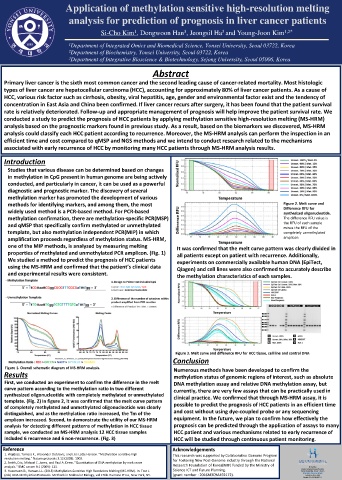
    one of the MIP methods, is analyzed by measuring melting   It was confirmed that the melt curve pattern was clearly divided in
    properties of methylated and unmethylated PCR amplicon. (Fig. 1)   all patients except on patient with recurrence. Additionally,
    We studied a method to predict the prognosis of HCC patients   experiments on commercially available human DNA (EpiTect,
    using the MS-HRM and confirmed that the patient’s clinical data   Qiagen) and cell lines were also confirmed to accurately describe
    and experimental results were consistent.                  the methylation characteristics of each samples.


                                                              Figure 3. Melt curve and difference RFU for HCC tissue, cell line and control DNA
                                                             Conclusion
   Figure 1. Overall schematic diagram of MS-HRM analysis.   Numerous methods have been developed to confirm the
  Results                                                    methylation status of genomic regions of interest, such as absolute
   First, we conducted an experiment to confirm the difference in the melt   DNA methylation assay and relative DNA methylation assay, but
   curve pattern according to the methylation ratio in two different   currently, there are very few assays that can be practically used in
   synthesized oligonucleotide with completely methylated or unmethylated
   template. (Fig. 2) In figure 2, it was confirmed that the melt curve pattern   clinical practice. We confirmed that through MS-HRM assay, it is
   of completely methylated and unmethylated oligonucleotide was clearly   possible to predict the prognosis of HCC patients in an efficient time
   distinguished, and as the methylation ratio increased, the Tm of the   and cost without using dye-coupled probe or any sequencing
   amplicon increased. Second, to demonstrate the utility of our MS-HRM   equipment. In the future, we plan to confirm how effectively the
   analysis for detecting different patterns of methylation in HCC tissue   prognosis can be predicted through the application of assays to many
   sample, we conducted an MS-HRM analysis 12 HCC tissue samples   HCC patient and various mechanisms related to early recurrence of
   included 6 recurrence and 6 non-recurrence. (Fig. 3)      HCC will be studied through continuous patient monitoring.

  Reference                                                  Acknowledgements
   1. Wojdacz, Tomasz K., Alexander Dobrovic, and Lise Lotte Hansen. "Methylation-sensitive high-  This research was supported by Collaborative Genome Program
   resolution melting." Nature protocols 3.12 (2008): 1903.  for Fostering New Post-Genome industry through the National
   2. Smith, Eric, Michael E. Jones, and Paul A. Drew. "Quantitation of DNA methylation by melt curve
   analysis." BMC cancer 9.1 (2009): 123.                    Research Foundation of Korea(NRF) funded by the Ministry of   Si-Cho Kim
   3. Hussmann D., Hansen L.L. (2018) Methylation-Sensitive High Resolution Melting (MS-HRM). In: Tost J.   Science ICT and Future Planning.  Cancer Genome Research Center
                                                                                                          Yonsei University, Seoul, S. Korea
   (eds) DNA Methylation Protocols. Methods in Molecular Biology, vol 1708. Humana Press, New York, NY.   (grant number : 2016M3C9A492172).  http://cgrc.Yonsei.ac.kr/g5/
                                                                                                           Tel: 82+2-2133-7699
                                                                                                           Mobile: 82+10-9040-4257

