


Page 153 - D. Cancer biology
P. 153
Drug-tolerant persister (DTP) cell subpopulations showing Src signaling and
   migration related gene activation is critical in ALK-positive lung cancer (NSCLC)

                                       Yeonju Lee , So-young Kim      1
                                                    1
                 1 Biomedical Research Instutution, Chonnam National University Hwasun Hospital, Jeonnam 58128, Republic of Korea

                      ABSTRACT                                               RESULTS

   Anaplastic lymphoma kinase (ALK) fusion oncogenes occur in approximately
   3-5% of non-small cell lung cancer (NSCLC). The third-generation ALK
   inhibitor lorlatinib has been demonstrated clinical activity. The aim of the
   present study was to clarify the mechanisms underlying drug-tolerance
   cancer cell to ALK inhibitor in NSCLC. SNU-2292 (EML4-ALK, Variant 3a) cells
   were treated with lorlatinib every 3 days with a concentration of 100 nM,
   and cells on day 9, 12 were achieve at ~90% confluence. The correlation
   between gene expression and ALK inhibitor resistance in NSCLC cells were
   determined from Cancer Signaling Phospho AB Array kit (Ebiogen). Result of
   antibody array analyzed by ExDEGA v.2.0. The antibody array results were
   confirmed by western blot. SNU-2292 cell lines treated with the ALK
   inhibitor lorlatinib (100nM), we observed activation of p-Src, p-cRaf, p-MEK
   and p-ERK expression in 9, 12days. Moreover, the pSrc increase was
   associated with cell migration, survival and proliferation effect on SNU-
   2292-DTP (lorlatinib tolerance persister). Our data suggest that Src signaling
   may be an effective approach to the treatment of ALK-NSCLC with drug-
   tolerance to ALK inhibitors (Lorlatinib).
                BACKGROUND & AIM

   Despite efficacy of targeted therapy with tyrosine kinase inhibitors (TKI) in
   ALK-mutant lung adenocarcinoma and other cancers, acquired resistance
   limits durable clinical benefit. An increasingly recognized reason for
   treatment failure involves drug-tolerant persister (DTP) populations of
   cancer cells that survive and rapidly adapt to therapy. Understanding the
   pathways that facilitate DTP emergence is therefore critical to designing
   more effective combination therapies that can achieve cure. To elucidate
   potentially novel pathways that regulate ALK DTP cell survival we performed
   a protein expression screening with the cancer signaling antibody array(E-
   biogen), focusing on pathways that regulates the effect of lorlatinib
   treatment on DTP .
   Aim of this study: In this study, we will examine a cell survival, migration
   signaling pathway for understanding the diverse mechanisms of drug-
   tolerant persister cell at play in Non-small cell lung cancers.

                      METHODS

   Non-small cell lung cancer(NSCLC) cell line : SNU-2292 (EML4-ALK)
                           3
   Drug tolerant persister cells : 6 well/5×10 cells, every 3 days
   Antibody array analysis with ExDEGA
   Lorlatinib is a medication used to treat non-small-cell lung carcinomas
                     HYPOTHESIS


                                                                          CONCLUSION
                     Targeted drugs ramp up cancer mutability.
                     Marco Gerlinger, CANCER, 366; 1452-1453, 2019.
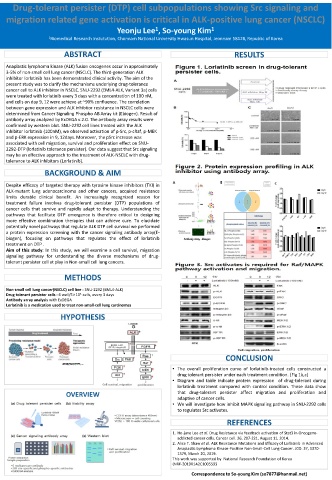
                                                         • The overall proliferation curve of lorlatinib-treated cells constructed a
                                                           drug tolerant persister under each treatment condition. (Fig 1b,c)
                                                         • Diagram and table indicate protein expression of drug-tolerant during
                                                           lorlatinib treatment compared with control condition. These data show
                       OVERVIEW                            that drug-tolerant persister affect migration and proliferation and
                                                           adaptive of cancer cells.
                                                         • We will investigate how inhibit MAPK signaling pathway in SNU-2292 cells
                                                           to regulates Src activates.
                                                                           REFERENCES
                                                         1. Ho-june Lee et al. Drug Resistance via feedback activation of Stat3 in Oncogene-
                                                           addicted cancer cells. Cancer cell. 26, 207-221, August 11, 2014.
                                                         2. Alice T. Shaw et al. ALK Resistance Mutations and Efficacy of Lorlatinib in Advanced
                                                           Anaplastic Lymphoma Kinase-Positive Non-Small-Cell Lung Cancer. JCO. 37, 1370-
                                                           1379, March 20, 2019.
                                                         This work was supported by  National Research Foundation of Korea
                                                         (NRF-2019R1A2C1005593
                                                               Correspondence to So-young Kim (so7877@hanmail.net)

