


Page 151 - D. Cancer biology
P. 151
Quercetin and quercitrin from Agrimonia Pilosa Ledeb inhibit cell migration and
invasion of colon cancer cells through JNK signaling pathway
Nguyet-Tran Trinh and Soo-A Kim*
Department of Biochemistry, Dongguk University College of Oriental Medicine, Gyeongju 780-714,
Republic of Korea
BACKGROUND 0 24 48 72 (h)
Colorectal cancer (CRC) is one of the most common cancers around
the world with high percentage of occurrence and mortality. For CRC, Control ---------- ---------- ---------- ---------- ---------- ---------- ---------- ----------
metastasis is main causes of patient’s death, and nearly 25% of patients
were found with metastasis in the process of initial diagnosis. Therefore,
inhibition of cancer cell invasion and metastasis is considered as an Quercetin ---------- ---------- ---------- ---------- ----------
important target for colon cancer therapy. ---------- ---------- ----------
Agrimonia pilosa Ledeb (AP) is a perennial herbaceous flowering
plant, which is mainly distributed throughout the Asia. Pharmacological
researches have shown that AP extracts possess diverse Quercitrin ---------- ---------- ---------- ---------- ---------- ---------- ---------- ----------
pharmacological properties, such as anti-microbial, anti-inflammatory and
anti-tumor activity. However, molecular action mechanism for its
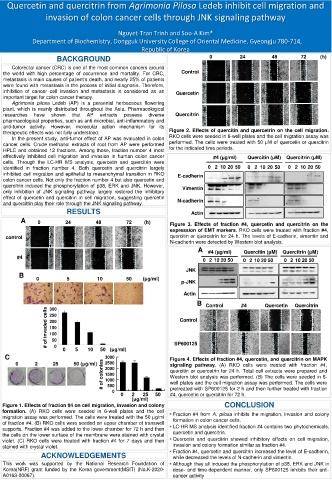
therapeutic effects was not fully understood. Figure 2. Effects of quercitin and quercetrin on the cell migration.
In the present study, anti-tumor effect of AP was evaluated in colon RKO cells were seeded in 6-well plates and the cell migration assay was
cancer cells. Crude methanol extracts of root from AP were performed performed. The cells were treated with 50 μM of quercetin or quercitrin
HPLC and obtained 12 fractions. Among those, fraction number 4 most for the indicated time periods.
effectively inhibited cell migration and invasion in human colon cancer #4 (µg/ml) Quercitin (μM) Quercitrin (μM)
cells. Through the LC-HR MS analysis, quercetin and quercitrin were
identified in fraction number 4. Both quercetin and quercitrin largely 0 2 10 20 50 0 2 10 20 50 0 2 10 20 50
inhibited cell migration and epithelial to mesenchymal transition in RKO E-cadherin
colon cancer cells. Not only the fraction number 4 but also quercetin and
quercitrin induced the phosphorylation of p38, ERK and JNK. However, Vimentin
only inhibition of JNK signaling pathway largely restored the inhibitory
effect of quercetin and quercitrin in cell migration, suggesting quercetin N-cadherin
and quercitrin play their role through the JNK signaling pathway.
RESULTS Actin
A 0 24 48 72 (h) Figure 3. Effects of fraction #4, quercetin and quercitrin on the
---------- ---------- ---------- ---------- ---------- ---------- ---------- ---------- N-cadherin were detected by Western blot analysis.
quercitin or quercetrin for 24 h. The levels of E-cadherin, vimentin and
control expression of EMT markers. RKO cells were treated with fraction #4,
---------- ---------- ---------- ---------- ---------- ---------- ---------- ---------- 0 2 10 20 50 0 2 10 20 50 0 2 10 20 50
#4 A #4 (µg/ml) Quercitin (μM) Quercitrin (μM)
B JNK
0 5 10 50 (μg/ml)
p-JNK
Actin
B Control #4 Quercetin Quercitrin
300
invaded cells 250 Control ---------- ---------- ---------- ---------- ---------- ----------- ---------- ----------
200
150
50
# of 100 0 SP600125 ----------- ----------- ----------- ----------- ----------- ----------- ----------- ----------
0 5 10 50 (μg/ml)
C Figure 4. Effects of fraction #4, quercetin, and quercitrin on MAPK
colonies 3000 quercitin or quercetrin for 24 h. Total cell extracts were prepared and
0 2 25 50 (μg/ml) 2500 signaling pathway. (A) RKO cells were treated with fraction #4,
2000
1500
# of 1000 Western blot analysis was performed. (B) The cells were seeded in 6-
well plates and the cell migration assay was performed. The cells were
500
0 pretreated with SP600125 for 2 h and then further treated with fraction
0 2 25 50 #4, quercetin or quercitrin for 72 h.
(μg/ml)
Figure 1. Effects of fraction #4 on cell migration, invasion and colony CONCLUSION
formation. (A) RKO cells were seeded in 6-well plates and the cell Fraction #4 from A. pilosa inhibits the migration, invasion and colony
migration assay was performed. The cells were treated with the 50 μg/ml formation in colon cancer cells.
of fraction #4. (B) RKO cells were seeded on upper chamber of transwell
supports. Fraction #4 was added to the lower chamber for 72 h and then LC-HR MS analysis identified fraction #4 contains two phytochemicals,
the cells on the lower surface of the membrane were stained with crystal quercetin and quercitrin.
violet. (C) RKO cells were treated with fraction #4 for 7 days and then Quercetin and quercitrin showed inhibitory effects on cell migration,
stained with crystal violet. invasion and colony formation similar as fraction #4.
ACKNOWLEDGEMENTS Fraction #4, quercetin and quercitrin increased the level of E-cadherin,
while decreased the levels of N-cadherin and vimentin.
This work was supported by the National Research Foundation of Although they all induced the phosphorylation of p38, ERK and JNK in
Korea(NRF) grant funded by the Korea government(MSIT) (No.K-2020- dose- and time-dependent manner, only SP600125 inhibits their anti-
A0163-00067). cancer activity

