


Page 149 - D. Cancer biology
P. 149
Effect of hispidulin on TRAIL-induced apoptosis in cancer cells through
  CaMKKβ/AMPK/USP51 axis-mediated Bim stabilization
  Seon Min Woo, Kyoung-jin Min and Taeg Kyu Kwon*

  Department of Immunology, School of Medicine, Keimyung University, Daegu, Korea.
                   BACKGROUND                                                  AIM

    Hispidulin   (4’,5,7-trihydroxy-6-methoxyflavone)  is  To overcome TRAIL resistance, we need more efficient therapeutic strategy,
   natural  compound,    and  has   multiple  functions,  such as combination treatment. Combination treatment might reduce adverse
                                                          effects, and increase anti-cancer effects. Most of sensitizers of cancer cells to
   including anti-inflammation, anti-fungal, anti-epileptic,  anti-cancer drugs modulate apoptosis-related proteins or signaling pathways,
   anti-hypnotic, and anti-osteoclastogenesis. In addition,  which are involved in cell survival and proliferation. Here, we investigate
                                                          whether hispidulin sensitizes cancer cells to TRAIL, and we identify the
   hispidulin has the potential anti-cancer effects.      molecular mechanisms which involved in hispidulin plus TRAIL-induced
                                                          apoptosis.
                                                RESULTS
   Figure 1                           Figure 2                           Figure 3


   Figure 4                           Figure 5                           Figure 6


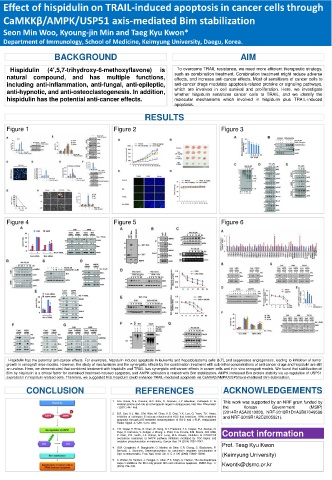
    Hispidulin has the potential anti-cancer effects. For examples, hispidulin induces apoptosis in leukemia and hepatoblastoma cells [6,7], and suppresses angiogenesis, leading to inhibition of tumor
   growth in xenograft mice models. However, the study of mechanisms and the synergistic effects by the combination treatment with sub-lethal concentrations of anti-cancer drugs and hispidulin are still
   an unclear. Here, we demonstrated that combined treatment with hispidulin and TRAIL has synergistic anti-cancer effects in cancer cells and in in vivo xenograft models. We found that stabilization of
   Bim by hispidulin is a critical factor for combined treatment-induced apoptosis, and AMPK activation is related with Bim stabilization. AMPK increased Bim protein stability via up-regulation of USP51
   expression in hispidulin-treated cells. Therefore, we suggested that hispidulin could enhance TRAIL-mediated apoptosis via CaMKKβ/AMPK/USP51axis-mediated Bim stabilization.
          CONCLUSION                         REFERENCES                   ACKNOWLEDGEMENTS

                                      1. A.G. Costa, N.E. Cusano, B.C. Silva, S. Cremers, J.P. Bilezikian, Cathepsin K: its  This work was supported by an NRF grant funded by
                                       skeletal actions and role as a therapeutic target in osteoporosis, Nat. Rev. Rheumatol.
                                       7 (2011) 447–456.                  the   Korean   Government   (MSIP)
                                                                          (2014R1A5A2010008, NRF-2018R1D1A3B07049596
                                      2. B.R. Seo, K.J. Min, S.M. Woo, M. Choe, K.S. Choi, Y.K. Lee, G. Yoon, T.K. Kwon,
                                       Inhibition of cathepsin S induces mitochondrial ROS that sensitizes TRAIL-mediated  and NRF-2019R1A2C2005921).
                                       apoptosis through p53-mediated downregulation of Bcl-2 and c-FLIP, Antioxidants
                                       Redox Signal. 27 (2017) 215–233.
                                       P. Ram, P.D. Smith, J.A. Wargo, G.V. Long, M.A. Davies, Inhibition of mTORC1/2 Contact information
                                      3. Y.N. Gopal, H. Rizos, G. Chen, W. Deng, D.T. Frederick, Z.A. Cooper, R.A. Scolyer, G.
                                       Pupo, K. Komurov, V. Sehgal, J. Zhang, L. Patel, C.G. Pereira, B.M. Broom, G.B. Mills,
                                       overcomes resistance to MAPK pathway inhibitors mediated by PGC1alpha and
                                       oxidative phosphorylation in melanoma, Cancer Res. 74 (2014) 7037–7047.
                                      4. G.M. Cereghetti, A. Stangherlin, O. Martins de Brito, C.R. Chang, C. Blackstone, P.  Prof. Teag Kyu Kwon
                                       Bernardi, L. Scorrano, Dephosphorylation by calcineurin regulates translocation of
                                       Drp1 to mitochondria, Proc. Natl. Acad. Sci. U. S. A 105 (2008) 15803–15808.  (Keimyung University)
                                      5. A. Weber, M. Heinlein, J. Dengjel, C. Alber, P.K. Singh, G. Hacker, The deubiquitinase
                                       Usp27x stabilizes the BH3-only protein Bim and enhances apoptosis, EMBO Rep. 17  Kwontk@dsmc.or.kr
                                       (2016) 724–738.

