


Page 147 - D. Cancer biology
P. 147
Inhibition of cathepsin K sensitizes anti-cancer drugs-induced cancer
  cell death through USP27x-mediated Bim Protein stabilization
  Seung Un Seo, Kyoung-jin Min and Taeg Kyu Kwon*

  Department of Immunology, School of Medicine, Keimyung University, Daegu, Korea.
                   BACKGROUND                                                  AIM

    Cathepsin (Cat) K belongs to the papain-like cysteine  Increased expression of Cats makes cancer cells more sensitive to
   proteases and is mainly located in the lysosomes. Cat K  cathepsin inhibitors. Although it is known that Cat K modulates invasion
   was originally considered to regulate bone homeostasis in  and metastasis through degradation of matrix proteins in melanoma, it is
                                                          still unclear whether Cat K plays additional roles in cancer cells. In view
   osteoclasts. However, Cat K is also detected in other cells,  of this evidence, in this study, we investigated the effect of Cat K
   such as fibroblasts, chondrocytes, neurons, and astrocytes,  inhibition on cell death, and the related molecular mechanisms were
   and its expression increases in cancers.               evaluated in human renal carcinoma Caki cells.

                                                RESULTS
   Figure 1                           Figure 2                           Figure 3


   Figure 4                           Figure 5                           Figure 6


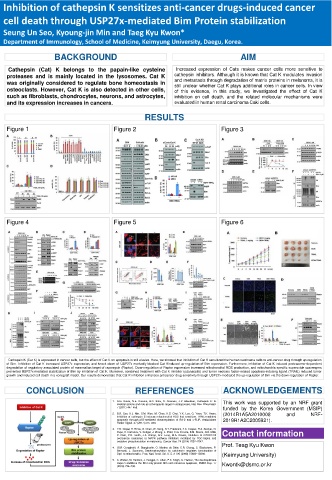
    Cathepsin K (Cat K) is expressed in cancer cells, but the effect of Cat K on apoptosis is still elusive. Here, we showed that inhibition of Cat K sensitized the human carcinoma cells to anti-cancer drug through up-regulation
   of Bim. Inhibition of Cat K increased USP27x expression, and knock down of USP27x markedly blocked Cat Kinduced up-regulation of Bim expression. Furthermore, inhibition of Cat K induced proteasome-dependent
   degradation of regulatory associated protein of mammalian target of rapamycin (Raptor). Down-regulation of Raptor expression increased mitochondrial ROS production, and mitochondria specific superoxide scavengers
   prevented USP27x-mediated stabilization of Bim by inhibition of Cat K. Moreover, combined treatment with Cat K inhibitor (odanacatib) and tumor necrosis factor-related apoptosis-inducing ligand (TRAIL) reduced tumor
   growth and induced cell death in a xenograft model. Our results demonstrate that Cat K inhibition enhances anticancer drug sensitivity through USP27x-mediated the up-regulation of Bim via the down-regulation of Raptor.
          CONCLUSION                         REFERENCES                   ACKNOWLEDGEMENTS

                                      1. A.G. Costa, N.E. Cusano, B.C. Silva, S. Cremers, J.P. Bilezikian, Cathepsin K: its  This work was supported by an NRF grant
                                       skeletal actions and role as a therapeutic target in osteoporosis, Nat. Rev. Rheumatol.
                                       7 (2011) 447–456.                  funded by the Korea Government (MSIP)
                                      2. B.R. Seo, K.J. Min, S.M. Woo, M. Choe, K.S. Choi, Y.K. Lee, G. Yoon, T.K. Kwon,  (2014R1A5A2010008  and  NRF-
                                       Inhibition of cathepsin S induces mitochondrial ROS that sensitizes TRAIL-mediated
                                       apoptosis through p53-mediated downregulation of Bcl-2 and c-FLIP, Antioxidants  2019R1A2C2005921).
                                       Redox Signal. 27 (2017) 215–233.
                                       P. Ram, P.D. Smith, J.A. Wargo, G.V. Long, M.A. Davies, Inhibition of mTORC1/2 Contact information
                                      3. Y.N. Gopal, H. Rizos, G. Chen, W. Deng, D.T. Frederick, Z.A. Cooper, R.A. Scolyer, G.
                                       Pupo, K. Komurov, V. Sehgal, J. Zhang, L. Patel, C.G. Pereira, B.M. Broom, G.B. Mills,
                                       overcomes resistance to MAPK pathway inhibitors mediated by PGC1alpha and
                                       oxidative phosphorylation in melanoma, Cancer Res. 74 (2014) 7037–7047.
                                      4. G.M. Cereghetti, A. Stangherlin, O. Martins de Brito, C.R. Chang, C. Blackstone, P.  Prof. Teag Kyu Kwon
                                       Bernardi, L. Scorrano, Dephosphorylation by calcineurin regulates translocation of
                                       Drp1 to mitochondria, Proc. Natl. Acad. Sci. U. S. A 105 (2008) 15803–15808.  (Keimyung University)
                                      5. A. Weber, M. Heinlein, J. Dengjel, C. Alber, P.K. Singh, G. Hacker, The deubiquitinase
                                       Usp27x stabilizes the BH3-only protein Bim and enhances apoptosis, EMBO Rep. 17  Kwontk@dsmc.or.kr
                                       (2016) 724–738.

