


Page 155 - D. Cancer biology
P. 155
GPR110 PLAYS A CRITICAL ROLE IN REGULATION OF TRIPLE-
NEGATIVE BREAST CANCER PROGRESSION
1
1
Hye-Jung Nam , Eun-Ji Lim , Yi Zhao , Su-Jae Lee 1
1
1 Department of Life Science, Research Institute for Natural Sciences, Hanyang University, Seoul 04763, Republic of Korea
BACKGROUND AIM
Triple negative breast cancer (TNBC) which is a group Adhesion GPCRs(aGPCRs) have been reported to play
of breast cancer correlates with aggressive behaviors an important role in biological processes and cancer
and poor clinical outcomes. TNBC remains intractable progression in various cancers. However, aGPCR
to targeted therapies because lacking of estrogen mechanism of action remain unclear in breast cancer.
receptor (ER), progesterone receptor (PR) and human Therefore, In this study we aim to explore the
epidermal growth factor receptor2 (HER2) expression. functional role and mechanism of GPR110, as a
Thus, development of targeted therapies becomes a member of aGPCR, in TNBC.
significant issue in the treatment of TNBC.
METHODS
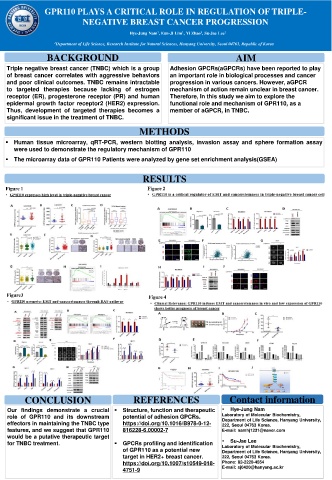
Human tissue microarray, qRT-PCR, western blotting analysis, invasion assay and sphere formation assay
were used to demonstrate the regulatory mechanism of GPR110
The microarray data of GPR110 Patients were analyzed by gene set enrichment analysis(GSEA)
RESULTS
Figure 1 Figure 2
Figure3 Figure 4
CONCLUSION REFERENCES Contact information
Our findings demonstrate a crucial Structure, function and therapeutic Hye-Jung Nam
role of GPR110 and its downstream potential of adhesion GPCRs. Laboratory of Molecular Biochemistry,
effectors in maintaining the TNBC type https://doi.org/10.1016/B978-0-12- Department of Life Science, Hanyang University,
222, Seoul 04763 Korea.
features, and we suggest that GPR110 816228-6.00002-7 E-mail: namhj1231@naver.com
would be a putative therapeutic target
for TNBC treatment. GPCRs profiling and identification Su-Jae Lee
of GPR110 as a potential new Laboratory of Molecular Biochemistry,
Department of Life Science, Hanyang University,
target in HER2+ breast cancer. 222, Seoul 04763 Korea.
https://doi.org/10.1007/s10549-018- Phone: 82-2220-4554
4751-9 E-mail: sj0420@hanyang.ac.kr

