


Page 141 - D. Cancer biology
P. 141
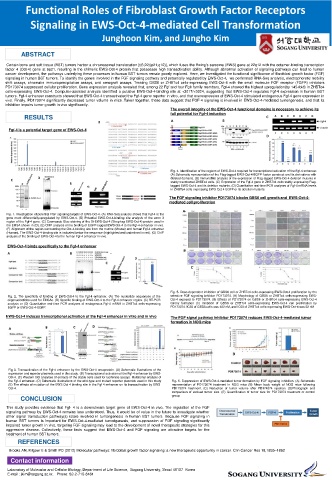
Functional Roles of Fibroblast Growth Factor Receptors
           Signaling in EWS-Oct-4-mediated Cell Transformation

                                  Junghoon Kim, and Jungho Kim


        ABSTRACT

   Certain bone and soft tissue (BST) tumors harbor a chromosomal translocation [t(6;22)(p21;q12)], which fuses the Ewing’s sarcoma (EWS) gene at 22q12 with the octamer-binding transcription
   factor 4 (Oct-4) gene at 6p21, resulting in the chimeric EWS-Oct-4 protein that possesses high transactivation ability. Although abnormal activation of signaling pathways can lead to human
   cancer development, the pathways underlying these processes in human BST tumors remain poorly explored. Here, we investigated the functional significance of fibroblast growth factor (FGF)
   signaling in human BST tumors. To identify the genes involved in the FGF signaling pathway and potentially regulated by EWS-Oct-4, we performed RNA-Seq analysis, electrophoretic mobility
   shift assays, chromatin immunoprecipitation assays, and xenograft assays. Treating GBS6 or ZHBTc4 cells-expressing EWS-Oct-4 with the small molecule FGF receptor (FGFR) inhibitors
   PD173074 suppressed cellular proliferation. Gene expression analysis revealed that, among 22 Fgf and four Fgfr family members, Fgf-4 showed the highest upregulation(by 145-fold) in ZHBTc4
   cells-expressing EWS-Oct-4. Computer-assisted analysis identified a putative EWS-Oct-4-binding site at +3017/+3024, suggesting that EWS-Oct-4 regulates Fgf-4 expression in human BST
   tumors. Fgf-4 enhancer constructs showed that EWS-Oct-4 transactivated the Fgf-4 gene reporter in vitro, and that overexpression of EWS-Oct-4 stimulated endogenous Fgf-4 gene expression in
   vivo. Finally, PD173074 significantly decreased tumor volume in mice..Taken together, these data suggest that FGF-4 signaling is involved in EWS-Oct-4-mediated tumorigenesis, and that its
   inhibition impairs tumor growth in vivo significantly.
                                                        The overall integrity of the EWS-Oct-4 functional domains is necessary to achieve its
                                                        full potential for Fgf-4 induction
         RESULTS                                                                        C
                                 B                       A               B
    Fgf-4 is a potential target gene of EWS-Oct-4
                                                                                        D


                                                         Fig. 4. Identification of the regions of EWS-Oct-4 required for transcriptional activation of the Fgf-4 enhancer.
                                                         (A) Schematic representation of the Flag-tagged EWS-Oct-4-EGFP fusion construct and its derivatives with
     C       D                                           deleted domains. (B) Immunoblot analysis of the expression of Flag-tagged EWS-Oct-4 deletion mutants in
                                                         stably transfected ZHBTc4 cells. (C) Expression of the Fgf-4 gene in ZHBTc4 cells stably expressing Flag-
                        E
                                                         tagged EWS-Oct-4 and its deletion mutants. (D) Quantitative real-time PCR analyses of Fgf-4 mRNA levels
                                                         in ZHBTc4 cells-expressing EWS-Oct-4-EGFP or its deletion mutants.
                                                        The FGF signaling inhibitor PD173074 blocks GBS6 cell growth and  EWS-Oct-4-
                                                        mediated cell proliferation
                                                             A
   Fig. 1. Investigation of potential FGF signaling targets of EWS-Oct-4. (A) RNA-Seq analysis shows that Fgf-4 is the
   gene most differentiallyupregulated by EWS-Oct-4. (B) Potential EWS-Oct-4-binding site analysis of the exon 3
   region of the Fgf-4 gene. (C) Coomassie Blue staining of the St-EWS-Oct-4 (Strep-tag EWS-Oct-4) protein used in
   the EMSA shown in (D). (E) ChIP analysis of the binding of EGFP-tagged EWS-Oct-4 to the Fgf-4 enhancer in vivo.
   (F) Alignment of the region surrounding the Oct-4-binding site from the murine (Mouse) and human Fgf-4 enhancer
   (Human). The EWS-Oct-4-binding site is indicated below the sequence (highlighted and underlined in red). (G) ChIP
   analysis of the binding of EWS-Oct-4 to the human Fgf-4 enhancer in vivo.
   EWS-Oct-4 binds specifically to the Fgf-4 enhancer
                                                             B
    A                   B
                                             D
                                   C
                                                               C

                                                        Fig. 5. Dose-dependent inhibition of GBS6 cell or ZHBTc4 cells-expressing EWS-Oct-4 proliferation by the
    Fig. 2. The specificity of binding of EWS-Oct-4 to the Fgf-4 enhancer. (A) The nucleotide sequences of the  selective FGF signaling inhibitor PD173074. (A) Morphology of GBS6 or ZHBTc4 cells-expressing EWS-
    oligonucleotides used for EMSAs. (B) Specific binding of EWS-Oct-4 to the Fgf-4 enhancer region. (C) RT-PCR  Oct-4 exposed to PD173074. (B) Effects of PD173074 on GBS6 or ZHBTc4 cells-expressing EWS-Oct-4
    analysis or (D) Quantitative real-time PCR analyses of endogenous Fgf-4 mRNA in ZHBTc4 cells-expressing  colony formation (C) Inhibition of GBS6 or ZHBTc4 cells-expressing EWS-Oct-4 cell proliferation by
    EGFP or EWS-Oct-4-EGFP.                             PD173074. IC50 of GBS6 cells was 482 nM, and IC50 of ZHBTc4 cells-expressing EWS-Oct-4 was 52 nM
   EWS-Oct-4 induces transcriptional activation of the Fgf-4 enhancer in vitro and in vivo  The FGF signal pathway inhibitor PD173074 reduces EWS-Oct-4-mediated tumor
                                                         formation in NOG mice
    A           B        C     D


    Fig 3. Transactivation of the Fgf-4 enhancer by the EWS-Oct-4 oncoprotein. (A) Schematic illustrations of the
    expression and reporter plasmids used in this study. (B) Transcriptional activation of the Fgf-4 enhancer by EWS-
    Oct-4. (C) Western blot analyses of extracts of the stable cells used for luciferase assays. Mutational analysis of
    the Fgf-4 enhancer. (D) Schematic illustrations of the wild-type and mutant reporter plasmids used in this study  Fig. 6. Suppression of EWS-Oct-4-mediated tumor formation by FGF signaling inhibition. (A) Schematic
    (E) The effects of mutation of the EWS-Oct-4-binding site in the Fgf-4 enhancer on its transactivation by EWS-  representation of PD173074 treatment in NOG mice (B) Mean body weight of NOG mice following
    Oct-4.                                               PD173074 treatment. (C) Reduction of tumor volume after PD174074 injection. (D)Photograph and
                                                         comparison of excised tumor size. (E) Quantification of tumor size for PD173074 treatment or control
        CONCLUSION                                       group
   This study provides evidence that Fgf- 4 is a downstream target gene of EWS-Oct-4 in vivo. The regulation of the FGF
   signaling pathway by EWS-Oct-4 remains less understood. Thus, it would be of value in the future to investigate whether
   other signal transduction pathway(s) is/are involved in tumorigenesis in human BST tumors. Because FGF signaling in
   human BST tumors is important for EWS-Oct-4-mediated tumorigenesis, and suppression of FGF signaling significantly
   impaired tumor growth in vivo, targeting FGF signaling may lead to the development of novel therapeutic strategies for this
   aggressive disease. Collectively, these facts suggest that EWS-Oct-4 and FGF signaling are attractive targets for the
   treatment of human BST tumors.
       REFERENCES
    Brooks AN, Kilgour E & Smith PD (2012) Molecular pathways: fibroblast growth factor signaling: a new therapeutic opportunity in cancer. Clin Cancer Res 18,1855–1862
    Contact information
   Laboratory of Molecular and Cellular Biology, Department of Life Science, Sogang University, Seoul 40107, Korea
   E-mail : jkim@sogang.ac.kr, Phone: 82-2-715-8461

