


Page 139 - D. Cancer biology
P. 139
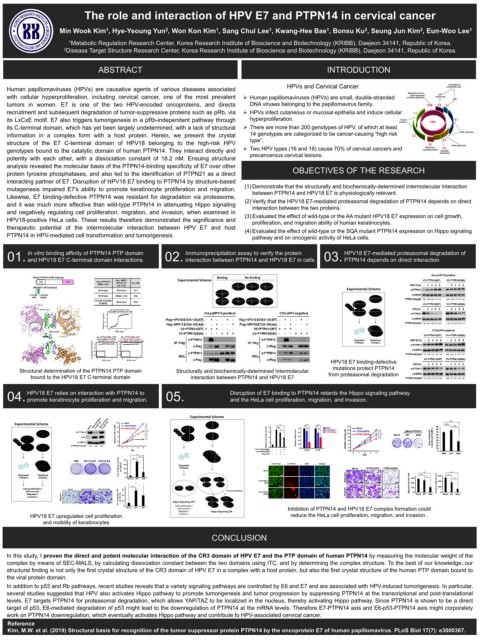
The role and interaction of HPV E7 and PTPN14 in cervical cancer
Min Wook Kim , Hye-Yeoung Yun , Won Kon Kim , Sang Chul Lee , Kwang-Hee Bae , Bonsu Ku , Seung Jun Kim , Eun-Woo Lee 1
1
2
1
1
2
2
1
1 Metabolic Regulation Research Center, Korea Research Institute of Bioscience and Biotechnology (KRIBB), Daejeon 34141, Republic of Korea.
2 Disease Target Structure Research Center, Korea Research Institute of Bioscience and Biotechnology (KRIBB), Daejeon 34141, Republic of Korea.
ABSTRACT INTRODUCTION
Human papillomaviruses (HPVs) are causative agents of various diseases associated HPVs and Cervical Cancer
with cellular hyperproliferation, including cervical cancer, one of the most prevalent Human papillomaviruses (HPVs) are small, double-stranded
tumors in women. E7 is one of the two HPV-encoded oncoproteins, and directs DNA viruses belonging to the papillomavirus family.
recruitment and subsequent degradation of tumor-suppressive proteins such as pRb, via HPVs infect cutaneous or mucosal epithelia and induce cellular
its LxCxE motif. E7 also triggers tumorigenesis in a pRb-independent pathway through hyperproliferation.
its C-terminal domain, which has yet been largely undetermined, with a lack of structural There are more than 200 genotypes of HPV, of which at least
information in a complex form with a host protein. Herein, we present the crystal 14 genotypes are categorized to be cancer-causing “high risk
structure of the E7 C-terminal domain of HPV18 belonging to the high-risk HPV type”.
genotypes bound to the catalytic domain of human PTPN14. They interact directly and Two HPV types (16 and 18) cause 70% of cervical cancers and
potently with each other, with a dissociation constant of 18.2 nM. Ensuing structural precancerous cervical lesions.
analysis revealed the molecular basis of the PTPN14-binding specificity of E7 over other
protein tyrosine phosphatases, and also led to the identification of PTPN21 as a direct OBJECTIVES OF THE RESEARCH
interacting partner of E7. Disruption of HPV18 E7 binding to PTPN14 by structure-based
mutagenesis impaired E7’s ability to promote keratinocyte proliferation and migration. (1) Demonstrate that the structurally and biochemically-determined intermolecular interaction
Likewise, E7 binding-defective PTPN14 was resistant for degradation via proteasome, between PTPN14 and HPV18 E7 is physiologically relevant.
and it was much more effective than wild-type PTPN14 in attenuating Hippo signaling (2) Verify that the HPV18 E7-mediated proteasomal degradation of PTPN14 depends on direct
interaction between the two proteins.
and negatively regulating cell proliferation, migration, and invasion, when examined in
HPV18-positive HeLa cells. These results therefore demonstrated the significance and (3) Evaluated the effect of wild-type or the AA mutant HPV18 E7 expression on cell growth,
proliferation, and migration ability of human keratinocytes.
therapeutic potential of the intermolecular interaction between HPV E7 and host (4) Evaluated the effect of wild-type or the SQA mutant PTPN14 expression on Hippo signaling
PTPN14 in HPV-mediated cell transformation and tumorigenesis. pathway and on oncogenic activity of HeLa cells.
01. In vitro binding affinity of PTPN14 PTP domain 02. Immunoprecipitation assay to verify the protein 03. HPV18 E7-mediated proteasomal degradation of
interaction between PTPN14 and HPV18 E7 in cells.
PTPN14 depends on direct interaction
and HPV18 E7 C-terminal domain interactions.
Binding No binding
Experimental Scheme
HPV E7 HPV E7 HPV E7
AA WT AA Experimental Scheme
HPV E7
WT
HPV E7
PTPN14 PTPN14 PTPN14 PTPN14 WT
WT WT SQA SQA HPV E7
Ub WT
Ub
Ub
PTPN14 PTPN14
WT SQA
PTPN14
PTPN14
WT
PTPN14
WT
WT
Degraded Stabilized
PTPN14 PTPN14
HPV18 E7 binding-defective
Structural determination of the PTPN14 PTP domain Structurally and biochemically-determined intermolecular mutations protect PTPN14
bound to the HPV18 E7 C-terminal domain interaction between PTPN14 and HPV18 E7 from proteasomal degradation
04. HPV18 E7 relies on interaction with PTPN14 to 05. Disruption of E7 binding to PTPN14 retards the Hippo signaling pathway
and the HeLa cell proliferation, migration, and invasion.
promote keratinocyte proliferation and migration.
Experimental Scheme
Experimental Scheme HPV E7
WT
HPV E7
Ub WT
HPV E7 Ub
AA Ub PTPN14 PTPN14
HPV E7 WT SQA
Ub WT
Ub
Ub
PTPN14 PTPN14
WT WT
PTPN14
PTPN14
SQA
PTPN14
SQA
SQA
PTPN14
PTPN14 Degraded
WT
PTPN14
WT
WT PTPN14
Degraded Stabilized
PTPN14 PTPN14 PTPN14 PTPN14
SQA SQA
YAP LATS
Cell proliferation ↑ YAP LATS
Cell survival ↑ Translocalization
Migration ↑
Invasion ↑ PTPN14 PTPN14
PTPN14
PTPN14
SQA SQA
Hippo Signaling OFF SQA SQA
YAP LATS
Cell proliferation ↑ YAP LATS
Cell survival ↑ Inhibition of PTPN14 and HPV18 E7 complex formation could
Migration ↑ Hippo Signaling ON
HPV18 E7 upregulates cell proliferation Invasion ↑ reduce the HeLa cell proliferation, migration, and invasion .
and mobility of keratinocytes
CONCLUSION
In this study, I proven the direct and potent molecular interaction of the CR3 domain of HPV E7 and the PTP domain of human PTPN14 by measuring the molecular weight of the
complex by means of SEC-MALS, by calculating dissociation constant between the two domains using ITC, and by determining the complex structure. To the best of our knowledge, our
structural finding is not only the first crystal structure of the CR3 domain of HPV E7 in a complex with a host protein, but also the first crystal structure of the human PTP domain bound to
the viral protein domain.
In addition to p53 and Rb pathways, recent studies reveals that a variety signaling pathways are controlled by E6 and E7 and are associated with HPV-induced tumorigenesis. In particular,
several studies suggested that HPV also activates Hippo pathway to promote tumorigenesis and tumor progression by suppressing PTPN14 at the transcriptional and post-translational
levels. E7 targets PTPN14 for proteasomal degradation, which allows YAP/TAZ to be localized in the nucleus, thereby activating Hippo pathway. Since PTPN14 is shown to be a direct
target of p53, E6-mediated degradation of p53 might lead to the downregulation of PTPN14 at the mRNA levels. Therefore E7-PTPN14 axis and E6-p53-PTPN14 axis might corporately
work on PTPN14 downregulation, which eventually activates Hippo pathway and contribute to HPV-associated cervical cancer.
Reference
Kim, M.W. et al. (2019) Structural basis for recognition of the tumor suppressor protein PTPN14 by the oncoprotein E7 of human papillomavirus. PLoS Biol 17(7): e3000367.

