


Page 35 - Equipment Import Regulations of Viet Nam for K-V Investment Promotion
P. 35
SECTION II. GUIDES BY ARTICLES OF DECISION 18


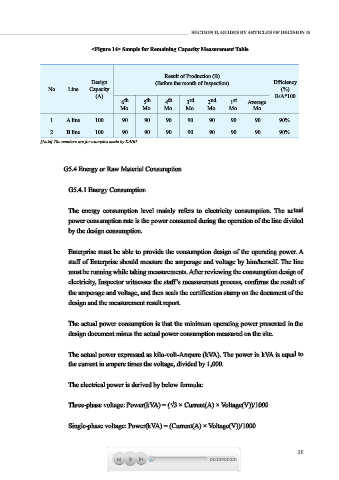
                                 <Figure 14> Sample for Remaining Capacity Measurement Table


                                                           Result of Production (B)
                                 Design                (Before the month of Inspection)          Efficiency
                  No     Line   Capacity                                                           (%)
                                  (A)                                                            B/A*100
                                           6 th    5 th    4 th   3 rd    2 nd    1 st  Average
                                           Mo.     Mo.    Mo.     Mo.     Mo.    Mo.      Mo.
                  1     A line    100       90     90      90      90     90      90      90       90%

                  2     B line    100       90     90      90      90     90      90      90       90%
               [Note] The numbers are for examples made by KAIRI.


                       G5.4 Energy or Raw Material Consumption


                         G5.4.1 Energy Consumption


                         The energy consumption level mainly refers to electricity consumption.  The actual
                         power consumption rate is the power consumed during the operation of the line divided

                         by the design consumption.


                         Enterprise must be able to provide the consumption design of the operating power. A
                         staff of Enterprise should measure the amperage and voltage by him/herself. The line
                         must be running while taking measurements. After reviewing the consumption design of

                         electricity, Inspector witnesses the staff’s measurement process, confirms the result of
                         the amperage and voltage, and then seals the certification stamp on the document of the
                         design and the measurement result report.


                         The actual power consumption is that the minimum operating power presented in the
                         design document minus the actual power consumption measured on the site.


                         The actual power expressed as kilo-volt-Ampere (kVA). The power in kVA is equal to

                         the current in ampere times the voltage, divided by 1,000.


                         The electrical power is derived by below formula:


                         Three-phase voltage: Power(kVA) = (√3 × Current(A) × Voltage(V))/1000


                         Single-phase voltage: Power(kVA) = (Current(A) × Voltage(V))/1000


                                                                                                         25

