


Page 7 - O. Microbiology
P. 7
Production of recombinant alcohol dehydrogenase from transformed Escherichia coli

                                               Minhye Kim, Eunju Im, Yeh-Jin Ahn*
                                    Department of Biotechnology, Sangmyung University, Jongno-gu, Seoul 03016, Korea
                                                     E-mail: yjahn@smu.ac.kr

                                                 BACKGROUND
      Upon high cell-density culture, the growth conditions can be altered from the optimum condition. For example, acetate can
                                        1
     accumulate as a by-product of carbon source in the medium . In other cases, we often lower growth temperature and/or treat with
     Isopropyl β- D -1-thiogalactopyranoside (IPTG) to increase recombinant protein production, which can also result in growth
     inhibition . Heat shock proteins can be used to reduce the reduction in E. coli growth and protein production due to changes in the
           2
     optimal growth conditions of E. coli. Hsps are molecular chaperones that can prevent denaturation of substrates and furthermore
     correct the folding of the substrate . There are 5 classed, Hsp100, Hsp70, Hsp60, and small Hsps (12-42 kDa) with unique structures
                          3
     and functions During heat stress and other environmental stresses, they protect proteins from misfording and inactivation and
             4.
                                       5
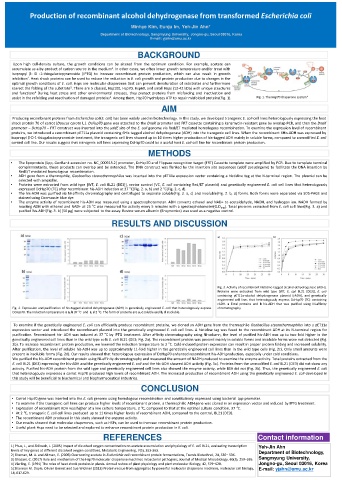
     assist in the refolding and reactivation of damaged proteins . Among them, Hsp70 hydrolyzes ATP to repair misfolded proteins(Fig. 1).  Fig. 1. The Hsp70 chaperone system 5
                                                         AIM
     Producing recombinant proteins from Escherichia coli(E. coli) has been widely used in biotechnology. In this study, we developed transgenic E. coli cell lines heterologously expressing the heat
     shock protein 70 of carrot (Daucus carota L.). DcHsp70 gene was attached to the DnaK promoter and FRT cassette containing a kanamycin-resistant gene by overlap PCR, and then the DnaK
     promoter – DcHsp70 – FRT construct was inserted into the yddE site of the E. coli genome via Red/ET mediated homologous recombination. To examine the expression level of recombinant
     proteins, we introduced a recombinant pET11a plasmid containing 6His tagged alcohol dehydrogenase (ADH) into the transgenic cell lines. When the recombinant 6His-ADH was expressed by
     isopropyl β-D-1-thiogalactopyranoside treatment, the transgenic cell lines showed up to 10 times higher production of his-tagged ADH mainly in soluble forms, compared to unmodified E. coli
     control cell line. Our results suggest that transgenic cell lines expressing DcHsp70 could be a useful host E. coli cell line for recombinant protein production.
                                                     METHODS
     •  The lipoprotein (Lpp, GenBank accession no. NC_000913.2) promoter, DcHsp70 and Flippase recognition target (FRT) Cassette template were amplified by PCR. Due to template terminal
        complementarity, these products can overlap and be extended. The DNA construct was flanked by the insertion site sequences (yddE pseudogene) to facilitate the DNA insertion by
        RedE/T mediated homologous recombination.
     •  ADH gene from a thermophile, Geobacillus stearothermophilus was inserted into the pET11a expression vector containing a histidine tag at the N-terminal region. The plasmid can be
        selected with ampicillin.
     •  Proteins were extracted from wild type [WT, E. coli BL21 (DE3)], vector control (VC, E. coli containing Red/ET plasmid) and genetically engineered E. coli cell lines that heterologously
        expressed DcHsp70 (TC) after recombinant his-ADH induction at 37 °C(Fig. 2. a, b) and 2 °C(Fig. 2. c, d).
     •  The his-ADH was purified via Ni-affinity chromatography and centrifuged to separate soluble(Fig. 2. a, c) and insoluble(Fig. 2. b, d) forms. Both forms were separated via SDS-PAGE and
        stained using Coomassie blue dye
     •  The enzyme activity of recombinant his-ADH was measured using a spectrophotometer. ADH converts ethanol and NAD+ to acetaldehyde, NADH, and hydrogen ion. NADH formed by
        reacting ADH with ethanol and NAD+ at 25 °C was measured for activity every 5 minutes with a spectrophotometer(O.D 340 ). Total proteins extracted from E. coli cell lines(Fig. 3. a) and
        purified his-ADH(Fig. 3. b) (50 μg) were subjected to the assay. Bovine serum albumin (Enzynomics) was used as a negative control.
                                        RESULTS AND DISCUSSION


                                                                             Fig. 3. Activity of recombinant histidine-tagged alcohol dehydrogenase (ADH).
                                                                             Proteins were extracted from wild type [WT, E. coli BL21 (DE3)], E. coli
                                                                             containing pET11a-alcohol dehydrogenase plasmid (rADH), and genetically
                                                                             engineered cell lines that heterologously express DcHsp70 (TC) containing
                                                                             rADH. a Total proteins and b his-ADH that was purified using Ni-affinity
     Fig. 2. Expression and purification of his-tagged alcohol dehydrogenase (ADH) in genetically engineered E. coli that heterologously express  chromatography
     DcHsp70. The induction temperature is a, b 37 °C and c, d 2 °C. The form of proteins are a, c soluble and b, d insoluble.
      To examine if the genetically engineered E. coli can efficiently produce recombinant proteins, we cloned an ADH gene from the thermophile Geobacillus stearothermophilus into a pET11a
     expression vector and introduced the recombinant plasmid into the genetically engineered E. coli cell lines. A histidine tag was fused to the recombinant ADH at its N-terminal region for
     purification. Recombinant his- ADH was induced at 37 °C by IPTG treatment. After affinity chromatography using Ni-column, the level of purified his-ADH was up to two fold higher in the
     genetically engineered cell lines than in the wild type cells E. coli BL21 (DE3; Fig. 2a). The recombinant protein was present mainly in soluble forms and insoluble forms were not detected (Fig.
     2b). To increase recombinant protein production, we lowered the induction temperature to 2 °C. Cold-induced protein expression can result in proper protein folding and increased solubility.
     After purification, the level of soluble his-ADH was up to approximately 11-fold higher in the genetically engineered cell lines than in the wild type cells (Fig. 2c). Only small amounts were
     present in insoluble forms (Fig. 2d). Our results showed that heterologous expression of DcHsp70 enhanced recombinant his-ADH production, especially under cold conditions.
     We purified the his-ADH recombinant protein using Ni-affinity chromatography and measured the amount of NADH produced to examine the enzyme activity. Total proteins extracted from the
     E. coli BL21 (DE3) expressing the his-ADH and the genetically engineered E. coli and the his-ADH showed ADH activity (Fig. 3a). Proteins from the unmodified E. coli BL21 (DE3) did not show any
     activity. Purified his-ADH protein from the wild type and genetically engineered cell lines also showed the enzyme activity, while BSA did not (Fig. 3b). Thus, the genetically engineered E. coli
     that heterologously expresses a carrot Hsp70 produced high levels of recombinant ADH. The increased production of recombinant ADH using the genetically engineered E. coli developed in
     this study will be beneficial to biochemical and biopharmaceutical industries.
                                                  CONCLUSION

     • Carrot Hsp70 gene was inserted into the E. coli genome using homologous recombination and constitutively expressed using bacterial Lpp promoter.
     • To examine if the transgenic cell lines can produce higher levels of recombinant protein, a thermophilic ADH gene was cloned in an expression vector and induced by IPTG treatment.
     • Expression of recombinant ADH was higher at a low culture temperature, 2 °C, compared to that at the optimal culture condition, 37 °C.
     • At 2 °C, transgenic E. coli cell lines produced up to 11 times higher levels of recombinant ADH, compared to the control, BL21 (DE3).
     • The recombinant ADH produced in this study showed the enzyme activity.
     • Our results showed that molecular chaperones, such as HSPs, can be used to increase recombinant protein production.
     • Useful plant Hsps need to be selected and explored to enhance recombinant protein production in E. coli.
                                     REFERENCES                                            Contact information
     1) Phue, J., and Shiloach, J. (2005) Impact of dissolved oxygen concentration on acetate accumulation and physiology of E. coli BL21, evaluating transcription   Yeh-Jin Ahn
     levels of key genes at different dissolved oxygen conditions, Metabolic Engineering, 7(5), 353-363.  Department of Biotechnology,
     2) Eiteman, M. A. and Altman, E. (2006) Overcoming acetate in Escherichia coli recombinant protein fermentations, Trends Biotechnol, 24, 530– 536.
     3) Ghazaei, C. (2017) Role and mechanism of the Hsp70 molecular chaperone machines in bacterial pathogens, Journal of Medical Microbiology, 66(3), 259–265.  Sangmyung University,
     4) Vierling, E. (1991) The roles of heat shock proteins in plants. Annual review of plant physiology and plant molecular Biology, 42, 579–620.  Jongno-gu, Seoul 03016, Korea
     5) Shannon M. Doyle, Olivier Genest and Sue Wickner (2013) Protein rescue from aggregates by powerful molecular chaperone machines, molecular cell biology,  E-mail: yjahn@smu.ac.kr
     14, 617-629.

