


Page 7 - M. Immunology
P. 7
The function of INHBB with regard to pregnancy disorder, preeclampsia in
  human trophoblast cell line, Swan71cell.

  Hee-Na Jeong1,#, Eun-Bee Jeong1,#, Se-Jin Ahn1, Ga-Eun Yoo1 , Hae-Ryeong Lim1,** and Deug-Chan Lee1,*
  1Department of Biomedical technology, College of Biomedical Science, Kangwon National University, Republic of Korea


        BACKGROUND                                                  AIM
                                    Pregnancy is needed tight control between mother and fetus. During human placental development, trophoblast cells surrounding blastocysts attach to the
   Preeclampsia is a serious pregnancy disorder characterized by  uterine epithelium and differentiate into cyto trophoblasts (CTBs) for invasion. Invading trophoblasts subsequently conduct spiral artery remodeling, which is
   gestational hypertension and proteinuria. During the early stage of  necessary for the fetus to be supplied with sufficient nutrition. During spiral artery remodeling, oxygen tension plays a critical role in CTB proliferation and
   pregnancy, trophoblast surrounding the embryo attach to and invade  invasion, and is thus considered a key factor for preeclampsia.
   the uterus. Trophoblasts subsequently perform spiral artery
   remodeling by interacting with a variety off actors such as hormones,  Recently, many researchers have performed miRNA profiling studies in placenta from normal and compromised pregnancies. Therefore, a number of studies
   cytokines, and growth factors. MicroRNAs are small(21-to 23-  have focused on the relation between miRNA expression and preeclampsia pathogenesis. In our previous study, we conducted a microarray analysis to
   nucleotide),  single-stranded  RNA  molecules.  They  bind  to  investigate transcript to mes affected by miR-210 in a human first-trimester trophoblast cell line. We identified 408 differentially expressed genes (DEGs),
   messenger RNA which has complementary sequences and regulate  including 261 down-regulated and 147 up-regulated genes. In the present study, we focused on INHBB, a previously identified DEG.
   gene expression at the post-transcription level. In preeclampsia
   patents over express the miR-210 more than normal pregnancy, we  Inhibins and activins are dimeric glycoproteins linked by disulfide-bonding, and belong to the transforming growth factor (TGF)-β superfamily. A well known
   identified that regulated genes by miR-210 in human first-trimester  function of inhibin and activin is the control of pituitary follicle stimulating hormone (FSH), which is activated by activins and inhibited by inhibins. In the
   trophoblast cell line. In present study, we focused on inhibin beta B  placenta, inhibin and activin work as growth factors, as well as TGFs. It has been reported that inhibin and activin levels increase during normal pregnancy, but
   (INHBB) which is one of the down-regulated genes by miR-210.  are dysregulated in pathological pregnancy. Therefore, in this study, we examined whether INHBB is a direct miR-210 target, in addition to identifying its
                                    function in trophoblasts.
                                               METHODS
   <Microarray data analysis> In our previous study, we identified 408 DEGs, including 261 down-regulated genes and 147 up-regulated genes. Using our DEG data, we conducted a Gene Ontology (GO) analysis Among the related biological function terms,
   results with p < 0.05 were considered to be meaningful. <Cell culture> The human first-trimester trophoblast cell line, Swan 71 Cells were cultured in Dulbecco’s modified Eagle’s medium (DMEM) supplemented with 10% fetalbovineserum (FBS) and 1%
   penicillin streptomycin. Cells were incubated at 37°C in 5% CO2. <Transfection> Swan 71 cells (1.5 × 10⁶cells) were transfected with 25 pmole of hsa-miR-210-3p or 25pmole of INHBB siRNA and split into a 60-mm dish for incubation. Transfected cells were
   harvested after 48 hr for quantitative reverse transcription (qRT)-PCR and immunoblotting, or after 24hr for the Matrigel invasion assay. <Luciferase assay> To assess whether INHBB is a direct binding target of miR-210, the INHBB 3′un translated region
   (UTR) DNA fragment (1550bp) was amplified from Swan 71 cell total RNA using designed primer by PCR and cloned into T-Vector pMD20. cells were harvested and Firefly and Renilla luciferase activities were determined using the Dual-Luciferase Reporter
   Assay System. Renilla luciferase activity was used for normalization. <RNA isolation and qRT-PCR> RNA for qRT-PCR was isolated with total RNA extraction. cDNA was prepared using 500ng of RNA and qPCR RT Master Mix. For detection of INHBB
   mRNA levels, INHBB was used as the target gene probe and 18S rRNA as an internal control. The results were an alyzed using the ΔΔCt method. <Immunoblotting> Harvested cell pellets were lysed with RIPA buffer conntaining protease and phosphatase
   inhibitor. Protein quantification was performed using a BCA assay. In total , 30 µg of cellular protein was loaded and electro phoresed on a 12% SDS-PAGE gel, before transfer to a PVDF membrane. The membrane was blocked with 1% skim milk in TBS-T
   for 1hr, and then incubated with 1st Ab, INHBB or β-actin in 1% skim milk for 16hr at 4°C. After washing thrice with TBS-T, membranes were incubated with horseradish peroxidase (HRP)-conjugated 2nd Ab in 1% skim milk for 1 hr. After an additional three
   washes in TBS-T, signals were visualized using Western Bright Peroxide chemiluminescent detection reagent. <Matrigel invasion assay> Matrigel was diluted to 20µg/ml with cold PBS and added to each insert in stalled in a 24-well plate. Matrigel was
   incubated for 4hr at 37 °C to polymerize and siRNA (INHBB or negative control) transfected cells were harvested after 24hr and seeded (5× 10⁴cells) in Matrigel added insert. After an additional 24-hr incubation at 37°C with 5% CO2, the cells were fixed with
   4% paraform aldehyde (PFA) and stained with 0.5% crystalviolet in 20% methanol. Stained cells were extracted with 30% acetic acid and transferred to a 96-well plate. The absorbance at 590nm. <Statistical analysis> Each experiment was repeated at least
   three times. Result sare shown as mean ± SD. Statistical significance between control groups and sample groups. p < 0.05 were considered statistically significant.
                                                RESULTS
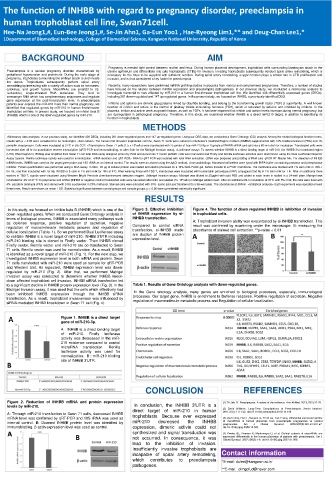
    In this study, we focused on Inhibin beta B (INHBB) which is one of the  Figure 3. Effective inhibition  Figure 4. The function of down regulated INHBB is inhibition of invasion
   down-regulated genes. When we conducted Gene Ontology analysis in  of INHBB expression by si-  in trophoblast cells.
   terms of biological process, INHBB is associated many pathways such  INHBB transfection.  A: Trophoblast invasion ability was exacerbated by si-INHBB transfection. This
   as defense response, positive regulation of secretion, negative  Compared to control siRNA
   regulation of macromolecule metabolic process and regulation of  result was confirmed by examining under the microscope. B: measuring the
   cellular localization (Table. 1). So we performed Dual Luciferase assay  transfection, si-INHBB made  absorbance of stained cell extraction. **p-value < 0.01
   to validate INHBB is a novel target of miR-210. INHBB 3'UTR including  are duction of INHBB protein
   miR-210 binding site is cloned to Firefly vector. Then INHBB cloned  expression level.
   Firefly vector, Renilla vector and miR-210 are co-transfected to Swan
   71 cells. Renilla vector was used for normalization. As a result, INHBB
   is identified as a novel target of miR-210 (Fig. 1). For the next step, we
   investigated INHBB expression level in both mRNA and protein. Swan
   71 cells transfected with miR-210 were used as sample for qRT-PCR
   and Western blot. As expected, INHBB expression level was down-
   regulated by miR-210 (Fig. 2). After that, we performed Matrigel
   invasion assay was conducted to determine whether INHBB knock-
   down affected trophoblast cell invasion. INHBB siRNA transfection led
   to a significant decline in INHBB protein expression level (Fig. 3). In the  Table 1. Results of Gene Ontology analysis with down-regulated genes.
   Matrigel invasion assay, it was used that the cells which effectively had  In the Gene ontology analysis, many genes are enriched to biological processes, especially, immunological
   been  inhibited  INHBB expression  through  the  INHBB siRNA
   transfection. As a result, trophoblast invasiveness was influenced by  processes. Our target gene, INHBB is enrichment to Defense response, Positive regulation of secretion, Negative
   siRNA-mediated INHBB knockdown in Swan 71 cell (Fig. 4).  regulation of macromolecule metabolic process and Regulation of cellular localization.
                     Figure 1. INHBB is a direct target
                     gene of miR-210-3p.
                     A : INHBB is a direct binding target
                     of  miR-210.  Firefly  luciferase
                     activity was decreased in the miR-
                     210 existence compared to control
                     microRNA  transfection.  Renilla
                     luciferase activity was used for
                     normalization. B : miR-210 binding
                     site of INHBB 3'UTR.


                                                CONCLUSION                      REFERENCES

   Figure 2. Reduction of INHBB mRNA and protein expression               [1] TA Jido IY. Preeclampsia: A review of the evidence. Ann AfrMed. 2013;12(2):75-78.
   levels by miR-210.                        In conclusion, the INHBB 3′UTR is a
                                            direct target of miR-210 in human  [2] David Williams. Long-Term Complications of Preeclampsia. Semin Nephrol.
                                                                          2011;31(1):111-122. doi:10.1016/j.semnephrol.2010.10.010
   A: Through miR-210 transfection to Swan 71 cells, decreased INHBB  trophoblasts. Because over expressed
   mRNA level was confirmed by qRT-PCR and 18S rRNA was used as           [3] ZhuX ming, Han T, Sargent IL, Yin G wu, Yao Y qing. Differential expression profile
   internal control. B: Downed INHBB protein level was identified by  miR-210  decreased  the  INHBB  of microRNAs in human placentas from preeclamptic pregnancies vs normal
                                                                          pregnancies.
                                                                                Am
                                                                                          Gynecol.
                                                                                               2009;200(6):661.e1-661.e7.
                                                                                   J
                                                                                      Obstet
   immunoblotting. β-actin expression level was used as control.  expression, dimeric activin could not  doi:10.1016/j.ajog.2008.12.045.
                                            synthesized and signal transduction was  [4] Pineles BL, Romero R, Montenegro D, et al. Distinct subsets of microRNAs are
                                            not occurred. In consequence, it was  expressed differentially in the human placentas of patients with preeclampsia. Am J
                                                                          Obstet Gynecol. 2007;196(3):1-6. doi:10.1016/j.ajog.2007.01.008
                                            lead  to  the  inhibition  of  invasion.
                                            Insufficiently invasive trophoblasts are
                                            incapable of spiral artery remodeling, Contact information
                                            which  contributes  to  preeclampsia  *E-mail: dclee@kangwon.ac.kr
                                            pathogenes.
                                                                         **E-mail: dimgofud@naver.com

