


Page 61 - M. Immunology
P. 61
Inotodiol, a novel lanostane triterpenoid from Chaga mushroom Inonotus Obliquus induces
                               characteristic maturation of dendritic cells
         Perry Ayn Mayson A. Maza , Ji-Hyun Lee , Minsook Ryu , Ludmila P. Ponomarenko , Valentin A. Stonik , Jong-Yong Kwak 1,2,3
                                        1,2
                             1,2
                                                                       4
                                                                                     4
                                                   3
  1  Department of Pharmacology, School of Medicine, Ajou University Suwon 16499, South Korea,   2  Department of Biomedical Sciences, Graduate school, Ajou University Suwon 16499, South Korea ,
    3 Department of Allergy, Ajou University School of Medicine, Suwon 16499, South Korea,  4 G.B. Elyakov Pacific Institute of Bioorganic Chemistry, Far Eastern Branch of the Russian Academy of
                                         Sciences, 690022, Vladivostok, Russian Federation
                     BACKGROUND                                                 AIM
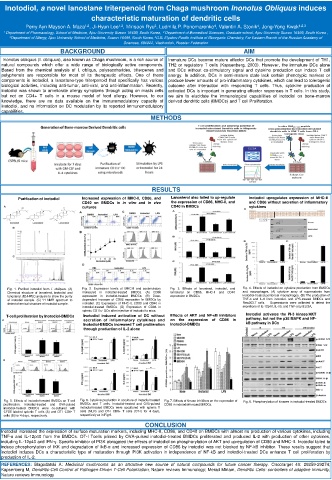
  Inonotus obliquus (I. obliquus), also known as Chaga mushroom, is a rich source of  Immature DCs become mature effector DCs that promote the development of TH1,
  natural compounds which offer a wide range of biologically active components.  TH2 or regulatory T cells (Kapsenberg, 2003). However, the immature DCs alone
  Based from the chemical analysis of I. obliqus, polysaccharides, triterpenes and  and DCs without co-stimulatory signal and cytokine production can induce T cell
  polyphenols are responsible for most of its therapeutic effects. One of these  anergy. In addition, DCs in semi-mature state lack certain phenotypic markers or
  components is inotodiol, a lanostane-type triterpenoid that specifically has various  produce lower amounts of pro-inflammatory cytokines, which can lead to tolerogenic
  biological activities, including anti-tumor, anti-viral, and anti-inflammation. Recently,  outcome after interaction with responding T cells. Thus, cytokine production of
  inotodiol was shown to ameliorate allergy symptoms through acting on masts cells  activated DCs is important in generating effector responses in T cells. In this study,
  but not on CD4+ T cells in a mouse model of food allergy. However, to our  we aim to elucidate the immunological capabilities of inotodiol on bone-marrow
  knowledge, there are no data available on the immunomodulatory capacity of  derived dendritic cells (BMDCs) and T cell Proliferation.
  inotodiol, and no information on DC modulation by its reported immunomodulatory
  capabilities.
                                                  METHODS


                                                  RESULTS
       Purification of inotodiol  Increased expression of MHC-II, CD86, and  Lanosterol also failed to up-regulate  Inotodiol upregulates expression of MHC-II
                            CD40 on BMDCs in in vitro and in vivo  the expression of CD86, MHC-II, and  and CD86 without secretion of inflammatory
                            cultures                     CD40 in BMDCs            cytokines


   Fig. 1. Purified inotodiol from I. obliquus. (A)  Fig. 2. Expression levels of MHC-II and costimulatory  Fig. 3. Effects of lanosterol, inotodiol, and  Fig. 4. Effects of inotodiol on cytokine production from BMDCs
   Chemical structure of lanosterol, inotodiol and  molecules  in  inotodiol-treated  BMDCs.  (A)  CD86  lanosteral  on  CD86,  MHC-II  and  CD40  and macrophages. (A) cytokine array of supernatants from
   lanosteral. (B) HPLC analysis to show the purity  expression  in  inotodiol-treated  BMDCs.  (B)  Dose-  expression in BMDCs.  inotodiol-treated peritoneal macrophages. (B) The production of
   of inotodiol sample. (C) 1 H NMR spectrum to  dependent increase of CD86 expression in BMDCs by  TNF-α and IL-6 from inotodiol- and LPS-treated BMDCs and
   detect chemical structure of inotodiol sample.  inotodiol. (C) Expression of MHC-II, CD80 and CD40 in  Raw263.7 cells.  Supernatants were collected to detect the
                            inotodiol-treated BMDCs. (D) Expression of CD86 in  secretions of IL-12p40, IL-10, and TNF-α by ELISA.
                            splenic CD11c + DCs after injection of inotodiol to mice.
   T-cell proliferation by Inotodiol-BMDCs  Inotodiol induced activation of DC without  Effects of AKT and NF-κB inhibitors  Inotodiol activates the PI-3 kinase/AKT
                            secretion of inflammatory cytokines and  on  the  expression  of  CD86  in  pathway, but not the p38 MAPK and NF-
                            Inotodiol-BMDCs increased T cell proliferation  Inotodiol-BMDCs  kB pathway in DCs
                            through production of IL-2 alone


  Fig. 5. Effects of inotodiol-treated BMDCs on T cell  Fig. 6. Cytokine production in coculture of inotodiol-treated  Fig. 7. Effects of kinase inhibitors on the expression of   Fig. 8. Phosphorylation of kinases in inotodiol-treated BMDCs
  proliferation.  Inotodiol-treated  and  OVA-pulsed  BMDCs and T cells. Inotodiol-treated and OVA-pulsed  CD86 in indotodiol-treated BMDCs.
  inotodiol-treated BMDCs were co-cultured with  inotodiol-treated BMDCs were cocultured with splenic T
  CFSE-labeled splenic T cells (A) and OT-I CD8 + T  cells (MLR) and OT-I CD8+ T cells (OT-I) for 4 days,
  cells (B) for 4 days, respectively.  respectively as in Fig 6.
                                                CONCLUSION
  Inotodiol increased the expression of surface maturation markers, including MHC-II, CD86, and CD40 on BMDCs with almost no production of various cytokines, including
  TNF-α and IL-12p40 from the BMDCs. OT-I Tcells primed by OVA-pulsed inotodiol-treated BMDCs proliferated and produced IL-2 with production of other cytokines,
  including IL-12p40 and IFN-γ. Specific inhibitor of PI3K abrogated the effects of inotodiol on phosphorylation of AKT and upregulation of CD86 and MHC-II. Inotodiol failed to
  induce phosphorylation of IKK and degradation of IkB-α and increased expression of CD86 by inotodiol was not blocked by NF-kB inhibitor. These results suggest that
  inotodiol induces DCs a characteristic type of maturation through PI3K activation in independence of NF-kB and inotodiol-treated DCs enhance T cell proliferation by
  production of IL-2.
  REFERENCES: Blagodatski A: Medicinal mushrooms as an attractive new source of natural compounds for future cancer therapy. Oncotarget 49: 29259-29274;
  Kapsenberg M, Dendritic-Cell Control of Pathogen-Driven T-Cell Polarization, Nature reviews Immunology; Merad Miriam, Dendritic Cells: controllers of adaptive immunity,
  Nature reviews Immunology

