


Page 59 - M. Immunology
P. 59
PPARα Activation Leads to Antimicrobial Responses and Inhibits

             Pathologic Inflammation during Mycobacterium abscessus Infection


                             1,2
                  1,2
     Cho Rong Park , Yi Sak Kim , Jin Kyung Kim , Hyeon Ji Kim , Young Jae Kim , Sang Min Jeon , Jin-Man Kim , and Eun-Kyeong
                                                                                        1,2
                                                                                                     4
                                                                         1,2
                                            1,2
                                                          1,2
     Jo 1,2,3,*
     1 Department of Microbiology, Chungnam National University School of Medicine, Daejeon 35015, Republic of Korea
     2 Department of Medical Science, Chungnam National University School of Medicine, Daejeon 35015, Republic of Korea
     3 Infection Control Convergence Research Center, Chungnam National University, Daejeon 35015, Republic of Korea
     4 Department of Pathology, Chungnam National University School of Medicine, Daejeon 35015, Republic of Korea
    ABSTRACT                                                    BACKGROUND
     Peroxisome proliferator-activated receptor α (PPARα) is an attractive target  Non-tuberculous mycobacteria (NTM)  • Found in nature’s water and soil
     for host-directed therapeutics Mycobacterium tuberculosis infection. In this            • Most do not cause disease except in
     study, we found that administration of gemfibrozil (GEM), a PPARα                        people with a weak immune system
     activator, significantly reduced the in vivo M. abscessus (Mabc) load and               • People at risk breath in the organisms
     inflammatory response in mice. We examined the effects of PPARα agonist                  from misty water (for example, in a
     GEM on Mabc infection in macrophages and in vivo. GEM showed an                          shower or hot tub) or from soil. If not
     inhibitory effect upon the intracellular growth of Mabc in bone marrow-                  treated, many people may get a
                                                                                              worsening lung infection
     derived  macrophages  (BMDMs)  and  human  monocyte-derived                             • Mycobacterium abscessus complex is
     macrophages (MDMs). Notably, GEM (100 μM) treatment of BMDMs and                         rapidly  growing,  multidrug-resistant,
     human MDMs resulted in significant inhibition of the intracellular growth of             nontuberculous mycobacteria
     Mabc. As a positive control, treatment of Mabc-infected BMDMs with
     clarithromycin resulted in a marked inhibitory effect on intracellular growth    • Nuclear receptor peroxisome proliferator–activated
     of Mabc. GEM-mediated antimicrobial activity was mediated through                  receptor α (PPAR-α) regulates the expression of
     PPARα, since the GEM-induced suppressive effect on intracellular growth            genes involved in glucose and lipid metabolism as
                                                                                        well as inflammatory processes.
     of Mabc in Ppara+/+ BMDMs was significantly abrogated in Ppara-/-
                                                                                        PPARα has been reported to control the duration
     BMDMs. We also showed that GEM treatment inhibited Mabc-induced                  •  and magnitude of the inflammatory response
     inflammatory responses in macrophages through PPARα. The inhibitory                through its ability to induce expression of genes
     effects of GEM on Mabc-mediated Il6 and Ilb expression in Ppara+/+                 encoding  proteins  that  are  involved  in  the
     BMDMs were significantly abrogated in Ppara-/- BMDMs. Therefore, GEM               catabolism of pro-inflammatory lipid mediators.
     treatment suppressed Mabc-induced inflammatory response depending on             • Through transcriptional control, PPAR-α acts as a
     PPARα. These data suggest that GEM treatment increased the                         key  regulator  of  energy  metabolism,  and
     antimicrobial activity and inhibited pathologic inflammation against               mitochondrial and peroxisomal function. However,
                                                                                                       in innate host defense
                                                                                        the function of PPAR-α
     intracellular Mabc through PPARα.                                                  during mycobacterial infection is largely unknown.
    RESULTS
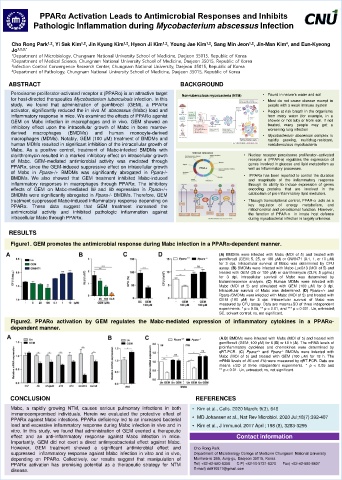
     Figure1. GEM promotes the antimicrobial response during Mabc infection in a PPARα-dependent manner.

                                                                             (A) BMDMs were infected with Mabc (MOI of 5) and treated with
                                                                             gemfibrozil (GEM; 5, 25, or 100 µM) or GW6471 (0.1, 1, or 10 µM)
                                                                             for 3 dpi. Intracellular survival of Mabc was determined by CFU
                                                                             assay. (B) BMDMs were infected with Mabc-LuxG13 (MOI of 5) and
                                                                             treated with GEM (25 or 100 µM) or clarithromycin (CLR; 5 µg/mL)
                                                                             for 3 dpi. Intracellular survival of Mabc was determined by
                                                                             bioluminescence analysis. (C) Human MDMs were infected with
                                                                             Mabc (MOI of 5) and stimulated with GEM (100 µM) for 3 dpi.
                                                                             Intracellular survival of Mabc was determined. (D) Ppara+/+ and
                                                                             Ppara-/BMDMs were infected with Mabc (MOI of 5) and treated with
                                                                             GEM (100 µM) for 3 dpi. Intracellular survival of Mabc was
                                                                             measured by CFU assay. Data are means±SD of three independent
                                                                             experiments. * p < 0.05, ** p < 0.01, and *** p < 0.001. Un, untreated;
                                                                             SC, solvent control; ns, not significant.
     Figure2. PPARα activation by GEM regulates the Mabc-mediated expression of inflammatory cytokines in a PPARα-
     dependent manner.

                                                                             (A,B) BMDMs were infected with Mabc (MOI of 5) and treated with
                                                                             gemfibrozil (GEM; 100 μM) for 6 (B) or 18 h (A). The mRNA levels of
                                                                             proinflammatory cytokines and chemokines were determined by
                                                                             qRT-PCR. (C) Ppara +/+ and Ppara -/- BMDMs were infected with
                                                                             Mabc (MOI of 5) and treated with GEM (100 μM) for 18 h. The
                                                                             mRNA levels of Il6 and Il1b were measured by qRT-PCR. Data are
                                                                             means ±SD of three independent experiments. * p < 0.05 and
                                                                             ** p < 0.01. Un, untreated; ns, not significant.


     CONCLUSION                                                      REFERENCES
     Mabc, a rapidly growing NTM, causes serious pulmonary infections in both  • Kim et al., Cells. 2020 March; 9(3), 648
     immunocompromised individuals. Herein we evaluated the protective effect of
     PPARα against Mabc infections. PPARα deficiency led to an increased bacterial  • MD Johansen et al., Nat Rev Microbiol. 2020 Jul;18(7):392-407
     load and excessive inflammatory response during Mabc infection in vivo and in  • Kim et al., J Immunol. 2017 April; 198 (8), 3283-3295
     vitro. In this study, we found that administration of GEM exerted a therapeutic
     effect and an anti-inflammatory response against Mabc infection in mice.      Contact information
     Importantly, GEM did not exert a direct antimycobacterial effect against Mabc.
     However, GEM treatment showed a significant antimicrobial effect and  Cho Rong Park
     suppressed inflammatory response against Mabc infection in vitro and in vivo,  Department of Microbiology College of Medicine Chungnam National University
     depending on PPARα. Collectively, our results suggest that manipulation of  Munhwa-ro 266, Jung-gu, Daejeon 35015, Korea
     PPARα activation has promising potential as a therapeutic strategy for NTM  Tel) +82-42-580-8358  C.P) +82-10-5731-8370  Fax) +82-42-580-8437
     disease.                                                        E-mail) dd910817@gmail.com

