


Page 57 - M. Immunology
P. 57
GABAergic activation enhances autophagy and phagosomal
maturation in macrophages during mycobacterial infection
Seul Gi Shin 1,2,3 , Jin Kyung Kim 1,2,3 , Yi Sak Kim 1,2,3 , Hyun-Woo Suh 1,2,3 and Eun-Kyeong Jo 1,2,3*
1 Department of Microbiology, Department of Medical Science, Infection Control Convergence Research Center, Chungnam National University School
3
2
of Medicine, Daejeon 35015, Republic of Korea.
ABSTRACT
Gamma-aminobutyric acid (GABA) is the major inhibitory neurotransmitter within the central nervous system and has been extensively studied in neurological disorders,
such as epilepsy, anxiety disorders, and schizophrenia. However, the roles of GABA in antimicrobial host defenses are largely unknown. To define the mechanism by
which GABA triggers the antimicrobial host defense system during intracellular bacterial infection, we used RNA sequencing to analyze the GABA-mediated, genome-
wide transcriptional changes in bone marrow-derived macrophages (BMDMs). GABA treatment led to an upregulation of numerous genes involved in autophagy in
BMDMs. When we next explored whether GABA activated autophagy, we found that GABA significantly increased the mRNA expression levels of autophagy-related
genes involved in autophagosome formation and autolysosome maturation in BMDMs. We further showed that treatment of BMDMs with GABA or GABAAR agonists
robustly increased the autophagosomal membrane-associated LC3-II fractions and autophagic flux. In addition, we showed that GABA-induced autophagy activation
was required for phagosomal maturation during Mtb infection. Taken together, both GABA and GABAergic activation enhanced activation of autophagy and
phagosomal maturation during Mtb infection.
INTRODUCTION
• Gamma-aminobutyric acid (GABA) is the major inhibitory
neurotransmitter within the central nervous system and has
been extensively studied in neurological disorders.
• Preclinical studies suggest the potential application of GABA
or GABAergic (agonistic) drugs as new therapeutics against
autoimmune and inflammatory diseases.
• As a crucial innate immune arm, the autophagy pathway
provides a protective role against a variety of intracellular
bacterial pathogens, including Mycobacterium tuberculosis
(Mtb).
• Nonetheless, it is poorly understood whether and how
GABAergic signaling regulates antimicrobial host defenses in
the context of bacterial infections.
RESULT
GABAergic activation enhances autophagy in macrophages. GABAergic autophagy promotes Mtb phagosomal maturation.
a b
a b
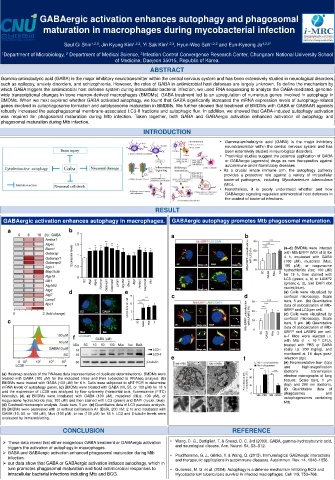
(a–d) BMDMs were infected
with Mtb-ERFP (MOI of 5) for
4 h, incubated with GABA
(100 μM), muscimol (Mus;
100 μM), or isoguvacine
hydrochloride (Iso; 100 μM)
for 18 h, then stained with
LC3 (green; a, b) or LAMP2
(green; c, d), and DAPI (for
nuclei; blue).
d e (a) Cells were visualized by
c d confocal microscopy. Scale
bars, 5 μm. (b) Quantitative
data of colocalization of Mtb-
ERFP and LC3 per cell.
(c) Cells were visualized by
confocal microscopy. Scale
c bars, 5 μm. (d) Quantitative
data of colocalization of Mtb-
ERFP and LAMP2 per cell.
f e–f Mice were injected i.v.
with Mtb (1 × 10 6 CFU),
treated with PBS or GABA
(daily i.p. 200 mg/kg), and
monitored at 14 days post-
e f infection (dpi).
(e) Representative low- (top)
and high-magnification
(bottom) transmission
(a) Heatmap analysis of the RNAseq data (representative of duplicate determinations). BMDMs were electron micrographs of lung
treated with GABA (100 μM) for the indicated times and then subjected to RNAseq analysis. (b) tissues. Scale bars, 1 μm
BMDMs were treated with GABA (100 μM) for 6 h. Cells were subjected to qRT-PCR to determine (top) and 200 nm (bottom).
mRNA levels of autophagy genes. (c) BMDMs were treated with GABA (10, 50, or 100 μM) for 18 h (f) Quantitative data of
and the expression of LC3B was analyzed by flow cytometry (horizontal axis, fluorescence (FITC) phagosomes and
intensity). (d, e) BMDMs were incubated with GABA (100 μM), muscimol (Mus; 100 μM), or autophagosomes containing
isoguvacine hydrochloride (Iso; 100 μM) and then stained with LC3 (green) and DAPI (nuclei; blue). Mtb.
(d) Confocal microscopic analysis. Scale bars, 5 μm. (e) Quantitative data of LC3 punctate analysis.
(f) BMDMs were pretreated with or without bafilomycin A1 (BafA, 200 nM; 2 h) and incubated with
GABA (10, 50, or 100 μM), Mus (100 μM), or Iso (100 μM) for 18 h. LC3 and β-tubulin levels were
evaluated by immunoblotting.
CONCLUSION REFERENCE
These data reveal that either exogenous GABA treatment or GABAergic activation • Wong, C. G., Bottiglieri, T. & Snead, O. C. 3rd (2003). GABA, gamma-hydroxybutyric acid,
triggers the activation of autophagy in macrophages. and neurological disease. Ann. Neurol. 54, S3–S12.
GABA and GABAergic activation enhanced phagosomal maturation during Mtb • Prud’homme, G. J., Glinka, Y. & Wang, Q. (2015). Immunological GABAergic interactions
infection. and therapeutic applications in autoimmune diseases. Autoimmun. Rev. 14, 1048–1056.
our data show that GABA or GABAergic activation induces autophagy, which in
turn promotes phagosomal maturation and host antimicrobial responses to • Gutierrez, M. G. et al. (2004). Autophagy is a defense mechanism inhibiting BCG and
intracellular bacterial infections including Mtb and BCG. Mycobacterium tuberculosis survival in infected macrophages. Cell 119, 753–766.

