


Page 55 - M. Immunology
P. 55
Overexpression of p190RhoGEF in macrophage enhances the formation of atherosclerotic plaques
                                               in mouse aorta

                                                     1
                                          Eun Bi Lee, Jong Ran Lee 2
     ¹Department of Bioinspired Science, The Graduate School, Ewha Womans University, Seoul 03760, South Korea,
      ²Department of Life Science, College of Natural Sciences, Ewha Womans University, Seoul 03760, South Korea

  0000000                                           AIM
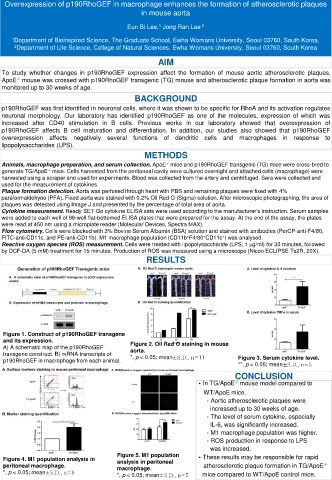
  To study whether changes in p190RhoGEF expression affect the formation of mouse aortic atherosclerotic plaques,
  ApoE mouse was crossed with p190RhoGEF transgenic (TG) mouse and atherosclerotic plaque formation in aorta was
      -/-
  monitored up to 30 weeks of age.
                                             BACKGROUND
  p190RhoGEF was first identified in neuronal cells, where it was shown to be specific for RhoA and its activation regulates
  neuronal morphology. Our laboratory has identified p190RhoGEF as one of the molecules, expression of which was
  increased after CD40 stimulation in B cells. Previous works in our laboratory showed that overexpression of
  p190RhoGEF affects B cell maturation and differentiation. In addition, our studies also showed that p190RhoGEF
  overexpression  affects  negatively  several  functions  of  dendritic  cells  and  macrophages  in  response  to
  lipopolysaccharides (LPS).
                                                METHODS

                                                       -/-
  Animals, macrophage preparation, and serum collection. ApoE mice and p190RhoGEF transgenic (TG) mice were cross-bred to
                 -/-
  generate TG/ApoE mice. Cells harvested from the peritoneal cavity were cultured overnight and attached cells (macrophage) were
  harvested using a scraper and used for experiments. Blood was collected from the artery and centrifuged. Sera were collected and
  used for the measurement of cytokines.
  Plaque formation detection. Aorta was perfused through heart with PBS and remaining plaques were fixed with 4%
  paraformaldehyde (PFA). Fixed aorta was stained with 0.2% Oil Red O (Sigma) solution. After microscopic photographing, the area of
  plaques was detected using Image J and presented by the percentage of total area of aorta.
  Cytokine measurement. Ready-SET-Go cytokine ELISA sets were used according to the manufacturer’s instruction. Serum samples
  were added to each well of 96-well flat-bottomed ELISA plates that were prepared for the assay. At the end of the assay, the plates
  were read at 450 nm using a microplate reader (Molecular Devices, Spectra MAX).
  Flow cytometry. Cells were blocked with 3% Bovine Serum Albumin (BSA) solution and stained with antibodies (PerCP-anti-F4/80,
                                                              +
                                                                   +
                                                                         +
  FITC-anti-CD11c, and PE-anti-CD11b). M1 macrophage population (CD11b F4/80 CD11c ) was analysed.
  Reactive oxygen species (ROS) measurement. Cells were treated with lipopolysaccharide (LPS; 1 µg/ml) for 30 minutes, followed
  by DCF-DA (5 mM) treatment for 15 minutes. Production of ROS was measured using a microscope (Nicon ECLIPSE Ts2R, 20X).
                                                 RESULTS


  Figure 1. Construct of p190RhoGEF transgene
  and its expression.
  A) A schematic map of the p190RhoGEF     Figure 2. Oil Red O staining in mouse
  transgene construct. B) mRNA transcripts of   aorta.
  p190RhoGEF in macrophage from each animal.  *, p < 0.05; mean±S.D., n=11     Figure 3. Serum cytokine level.
                                                                               **, p < 0.05; mean±S.D., n=5
                                                                             CONCLUSION
                                                                 ∙In TG/ApoE mouse model compared to
                                                                             -/-
                                                                   WT/ApoE mice,
                                                                    - Aortic atherosclerotic plaques were
                                                                     increased up to 30 weeks of age.
                                                                    - The level of serum cytokine, especially
                                                                     IL-6, was significantly increased.
                                                                    - M1 macrophage population was higher.
                                                                    - ROS production in response to LPS
                                                                     was increased.
                                       Figure 5. M1 population   ∙These results may be responsible for rapid
  Figure 4. M1 population analysis in   analysis in peritoneal
  peritoneal macrophage.               macrophage.                 atherosclerotic plaque formation in TG/ApoE -/-
  *, p < 0.05; mean±S.D., n=6                                      mice compared to WT/ApoE control mice.
                                       *, p < 0.05; mean±S.D., n=5

