


Page 37 - M. Immunology
P. 37
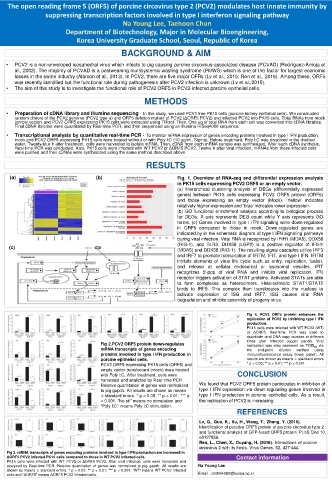
The open reading frame 5 (ORF5) of porcine circovirus type 2 (PCV2) modulates host innate immunity by
                suppressing transcription factors involved in type I interferon signaling pathway
                                         Na Young Lee, Taehoon Chun
                      Department of Biotechnology, Major in Molecular Bioengineering,
                          Korea University Graduate School, Seoul, Republic of Korea

                                        BACKGROUND & AIM
   •  PCV2 is a non-enveloped icosahedral virus which infects to pig causing porcine circovirus-associated disease (PCVAD) (Rodríguez-Arrioja et
      al., 2002). The majority of PCVAD is a postweaning multisystemic wasting syndrome (PMWS) which is one of the factor for largest economic
      losses in the swine industry (Alarcon et al., 2013). In PCV2, there are five major OFRs (Lv et al., 2015; Ren et al., 2016). Among these, ORF5
      was recently identified but the functional role during pathogenesis after PCV2 infection is unknown (Lv et al.,2015).
   •  The aim of this study is to investigate the functional role of PCV2 ORF5 in PCV2-infected porcine epithelial cells.

                                                METHODS
   •  Preparation of cDNA library and Illumina sequencing - In this study, we used PCV1 free PK15 cells (porcine kidney epithelial cells). We constructed
      tandem dimers of the PCV2 genome (PCV2 type a) and ORF5 deletion mutant of PCV2 (ΔORF5 PCV2) and infected PCV2 into PK15 cells. Total RNAs from mock
      (empty vector) and PCV2 ORF5 expressing PK15 cells were extracted using TRIzol. Then, One μg of total RNA from each cell was converted into cDNA libraries.
      Final cDNA libraries were quantitated by Real-time PCR, and then sequenced using an Illumina HiSeq4000 sequence.
   •  Transcriptional analysis by quantitative real-time PCR - To monitor mRNA expression of genes encoding proteins involved in type I IFN production,
      mock and PCV2 ORF5 expressing PK15 cells were treated without or with Poly I:C (10 μg/ml, Sigma). Before treatment, Poly I:C was dissolved in the distilled
      water. Twenty-four h after treatment, cells were harvested to isolate mRNA. Then, cDNA from each mRNA sample was synthesized. After each cDNA synthesis,
      Real-time PCR was conducted. Also, PK15 cells were infected with WT PCV2 or ΔORF5 PCV2. Twelve h after viral infection, mRNAs from these infected cells
      were purified and their cDNAs were synthesized using the same method described above.
                                                 RESULTS

    (a)                         (b)                        Fig. 1. Overview of RNA-seq and differential expression analysis
                                                           in PK15 cells expressing PCV2 ORF5 or an empty vector.
                                                           (a) Hierarchical clustering analysis of DEGs (differentially expressed
                                                           genes) between PK15 cells expressing PCV2 ORF5 protein (ORF5)
                                                           and those expressing an empty vector (Mock). ‘Yellow’ indicates
                                                           relatively higher expression and ‘blue’ indicates lower expression.
                                                           (b) GO functional enrichment analysis according to biological process
                                                           for DEGs. X axis represents DEG count while Y axis represents GO
                                                           terms. (c) Genes involved in type I IFN signaling were down-regulated
                                                           in ORF5 compared to those in mock. Down-regulated genes are
                                                           indicated by in the schematic diagram of type I IFN signaling pathways
                                                           during viral infection. Viral RNA is recognized by IFIH1 (MDA5), DDX58
                                                           (RIG-1), and TLR3. DHX58 (LGP2) is a positive regulator of IFIH1
    (c)                                                    (MDA5) and DDX58 (RIG-1). The resulting signal cascades utilize IRF3
                                                           and IRF7 to promote transcription of IFITM, IFIT, and type I IFN. IFITM
                                                           inhibits elements of virus life cycle such as entry, replication, fusion,
                                                           and release at cellular endosomal or lysosomal vesicles. IFIT
                                                           recognizes 5′-ppp of viral RNA and inhibits viral replication. IFN
                                                           receptor triggers activation of STAT proteins. Activated STATs are able
                                                           to form complexes as heterodimers. Heterodimeric STAT1/STAT2
                                                           binds to IRF9. This complex then translocates into the nucleus to
                                                           activate expression of ISG and IRF7. ISG causes viral RNA
                                                           degradation and inhibits assembly of progeny virus.


                                                                                 Fig 4. PCV2 ORF5 protein enhances the
                                                                                 replication of PCV2 by inhibiting type I IFN
                                                                                 production.
                                                                                 PK15 cells were infected with WT PCV2 (WT)
                                                                                 or ΔORF5. Real-time PCR was used to
                                                                                 quantitate viral DNA copy number at different
                                                                                 times after infection (upper panel). Viral
                                  Fig 2.PCV2 ORF5 protein down-regulates         replication was also assessed as TCID 50 via
                                  mRNA transcripts of genes encoding             the  end-point  dilution  method  using
                                  proteins involved in type I IFN production in   immunofluorescence assay (lower panel). All
                                  porcine epithelial cells.                      results are shown as means ± standard errors.
                                  PCV2 ORF5 expressing PK15 cells (ORF5) and     * p < 0.05; ** p < 0.01; *** p < 0.001.
                                  empty vector transfectant (mock) were treated
                                  with Poly I:C. After treatment, cells were   CONCLUSION
                                  harvested and analyzed by Real-time PCR.
                                  Relative quantitation of genes was normalized   We found that PCV2 ORF5 protein participates in inhibition of
                                  to pig gapdh. All results are shown as means   type I IFN expression via down-regulating genes involved in
                                  ± standard errors. * p < 0.05; ** p < 0.01; *** p   type I IFN production in porcine epithelial cells. As a result,
                                  < 0.001. “No sti” means no stimulation and   the replication of PCV2 is increasing..
                                  “Poly I:C” means Poly I:C stimulation.
                                                                              REFERENCES
                                                                  Lv, Q., Guo, K., Xu, H., Wang, T., Zhang, Y. (2015).
                                                                  Identification of putative ORF5 protein of porcine circovirus type 2
                                                                  and functional analysis of GFP-fused ORF5 protein. PLoS One 10,
                                                                  e0127859.
                                                                  Ren, L., Chen, X., Ouyang, H. (2016). Interactions of porcine
                                                                  circovirus 2 with its hosts. Virus Genes. 52, 437-444.
   Fig 3. mRNA transcripts of genes encoding proteins involved in type I IFN production are increased in
   ΔORF5 PCV2 infected PK15 cells compared to those in WT PCV2 infected cells.  Contact information
   PK15 cells were infected with WT PCV2 or ΔORF5 PCV2. After viral infection, cells were harvested and
   analyzed by Real-time PCR. Relative quantitation of genes was normalized to pig gapdh. All results are  Na Young Lee
   shown as means ± standard errors. * p < 0.05; ** p < 0.01; *** p < 0.001. “WT” means WT PCV2 infected
   cells and “ΔORF5″ means ΔORF5 PCV2 infected cells.             Email : dmh04062@korea.ac.kr

