


Page 31 - F. Cell biology
P. 31
Effects of PCB19 on Kv1.3 Channel Currents
Jonghui Kim 1, 2 , Su-Hyun Jo 1,2
1 Interdisciplinary Graduate Program for BIT Medical Convergence, Kangwon National University, Chuncheon 200-701, Korea Department of
2
Physiology, School of Medicine, Kangwon National University, Chuncheon 200-701, Korea
A 1.0 [PCB19] (µΜ) B [PCB19] (µΜ)
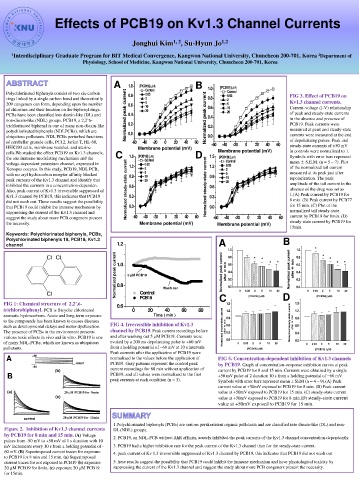
Polychlorinated biphenyls consist of two six-carbon 0.8 Control 1.0 Control FIG 3. Effect of PCB19 on
0.03
0.03
rings linked by a single carbon bond and theoretically 2 0.8 2
209 congeners can form, depending upon the number 0.6 5 5 Kv1.3 channel currents.
10
of chlorines and their location on the biphenyl rings. 20 0.6 10 Current-voltage (I-V) relationship
20
PCBs have been classified into dioxin-like (DL) and Normalized peak current 0.4 0.4 of peak and steady-state currents
non-dioxin-like (NDL) groups. PCB19, a 2,2’6- Normalized peak current in the absence and presence of
trichlorinated biphenyl is one of many non-dioxin-like 0.2 0.2 PCB19. Peak currents were
polychlorinated biphenyls (NDLPCBs), which are 0.0 measured at peak and steady-state
ubiquitous pollutants. NDL PCBs perturbed functions 0.0 currents were measured at the end
of cerebellar granule cells, PC12, Jurkat T, HL-60, -60 -40 -20 0 20 40 60 -60 -40 -20 0 20 40 60 of depolarizing pulses. Peak and
HEK293 cells, membrane vesicles, and uterine Membrane potential (mV) steady-state currents of +50 mV
cells.We studied the effect PCB19 on Kv1.3 channels, C D Membrane potential (mV) in controls were normalized to 1.
the one immune-modulating mechanism and the 1.5 [PCB19] (µΜ) 1.5 [PCB19] (µΜ) Symbols with error bars represent
Control
voltage-dependent potassium channel, expressed in 1.2 0.03 Control mean ± S.E.M. (n = 5 ~ 7). Plot
0.03
Xenopus oocytes. In this study, PCB19, NDL PCB, 2 1.2 2 of the normalized tail current
with no aryl hydrocarbon receptor affinity blocked 0.9 5 0.9 5 measured at its peak just after
10
peak currents of the Kv1.3 channel and identify that 20 10 repolarization. The peak
20
inhibited the currents in a concentration-dependen. 0.6 Normalized steady-state current 0.6 amplitude of the tail current in the
Also, peak current of Kv1.3 irreversible suppressed of Normalized steady-state current absence of the drug was set as
Kv1.3 channel by PCB19, this indicates that PCB19 0.3 0.3 1.(A) Peak current by PCB19 for
did not wash out. These results suggest the possibility 8 min. (B) Peak current by PCB77
that PCB19 could inhibit the immune mechanism by 0.0 0.0 for 15 min. (C) Plot of the
suppressing the current of the Kv1.3 channel and normalized tail steady-state
suggest the study about more PCB congeners present -60 -40 -20 0 20 40 60 -60 -40 -20 0 20 40 60 current by PCB19 for 8min. (D)
the necessity. Membrane potential (mV) Membrane potential (mV) steady-state current by PCB19 for
15min.
Keywords: Polychlorinated biphenyls, PCBs,
Polychlorinated biphenyls 19, PCB19, Kv1.3 A B
channel 1.2
1.0 1.0 *
Normalized peak current
Normalized peak current
0.8 * * 0.8 * *
1.0 min 0.6 * * min 0.6 * *
0.4 Normalized peak current 8 0.4
5 µM PCB19 after
8
after 0.2 0.2
0.8
Wash out 0.0 0.0
Control 0 0.03 2 5 10 20 0 0.03 2 5 10 20
PCB19 C [PCB19] (µM) D [PCB19] (µM)
FIG 1: Chemical structure of 2,2′,6- 0.6 1.5 1.5
trichlorobiphenyl. PCB is Bicyclic chlorinated 0 20 40 60 80 1.2 1.2
aromatic hydrocarbons. Acute and long-term exposure Time ( min ) 0.9
to the compounds has been known to causes diseases min Normalized steady-state current min 8 0.9
such as developmental delays and motor dysfunction. FIG 4. Irreversible inhibition of Kv1.3 Normalized steady-state current 8 0.6 after 0.6
The presence of PCBs in the environment presents channel by PCB19. Peak current recordings before after 0.3 0.3
various toxic effects in vivo and in vitro. PCB19 is one and after washing out 5 µM PCB19. Currents were 0.0
of many NDL-PCBs, which are known as ubiquitous evoked by a 200 ms depolarizing pulse to +60 mV 0 0.03 2 5 10 20 0.0 0 0.03 2 5 10 20
pollutants. from a holding potential of −60 mV at 10 s intervals. [PCB19] (µM) [PCB19] (µM)
Peak currents after the application of PCB19 were
A +50 normalized to the values before the application of FIG 5. Concentration-dependent inhibition of Kv1.3 channels
-60mV PCB19. Gray patterns represent the control peak by PCB19. Graph of concentration–response inhibition curves at peak
-50 current recordings for 80 min without application of
(b) current by PCB19 for 8 and 15 min. Currents were obtained by a single
B PCB19, and all values were normalized to the first +50 mV pulse of 2 duration 10 s from a holding potential of −60 mV.
peak currents at each condition (n = 3). Symbols with error bars represent mean ± SEM (n = 4 – 9).(A) Peak
current value at +50mV exposed to PCB19 for 8 min. (B) Peak current
(a) 20 µM PCB19 for 8min value at +50mV exposed to PCB19 for 15 min. (C) steady-state current
(c) value at +50mV exposed to PCB19 for 8 min.(D) steady-state current
value at +50mV exposed to PCB19 for 15 min.
control 20 µM PCB19 for 15min
1.Polychlorinated biphenyls (PCBs) are serious perskuristent organic pollutants and are classified into dioxin-like (DL) and non-
Figure 2. Inhibition of Kv1.3 channel currents DL (NDL) groups.
by PCB19 for 8 min and 15 min. (A) Voltage 2. PCB19, an NDL-PCB without AhR affinity, acutely inhibited the peak currents of the Kv1.3 channel concentration-dependently.
pulses from -50 mV to +50 mV of 1 s duration with 10
mV increments every 10 s from a holding potential of - 3. PCB19 had a higher inhibition rate for the peak current of the Kv1.3 channel than for the steady-state current.
60 mV. (B) Superimposed current traces for exposure 4. peak current of Kv 1.3 irreversible suppressed of Kv1.3 channel by PCB19, this indicates that PCB19 did not wash out
to PCB19 for 8 min and 15 min. (a) Superimposed
current traces for not exposed to PCB19 (b) exposure 5. hese results suggest the possibility that PCB19 could inhibit the immune mechanism and have physiological toxicity by
20 µM PCB19 for 8min. (c) exposure 20 µM PCB19 suppressing the current of the Kv1.3 channel and suggest the study about more PCB congeners present the necessity.
for 15min.

