


Page 163 - D. Cancer biology
P. 163
NSMF promotes colorectal cancer growth via the protection

  of replication stress
                             1
                                            1
  Kyeong Jin Shin , Yu Jin Lee , Hongtae Kim , Young Chan Chae 1*
                  1
  1 Department of Life Sciences, Ulsan National Institute of Science and Technology (UNIST), Ulsan 44919, Korea
                   BACKGROUND                                                  AIM
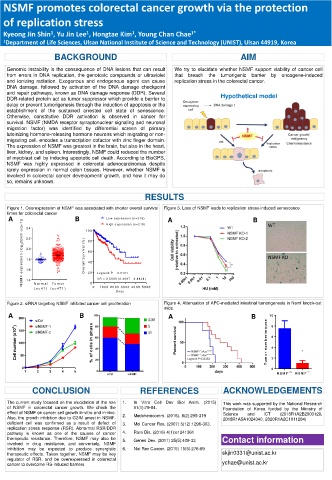
   Genomic instability is the consequence of DNA lesions that can result  We try to elucidate whether NSMF support viability of cancer cell
   from errors in DNA replication, the genotoxic compounds or ultraviolet  that  breach  the  tumorigenic  barrier  by  oncogene-induced
   and ionizing radiation. Exogenous and endogenous agent can cause  replication stress in the colorectal cancer.
   DNA damage, followed by activation of the DNA damage checkpoint
   and repair pathways, known as DNA damage response (DDR). Several      Hypothetical model
   DDR-related protein act as tumor suppressor which provide a barrier to
   delay or prevent tumorigenesis through the induction of apoptosis or the
   establishment of the sustained arrested cell state of senescence.
   Otherwise, constitutive DDR activation is observed in cancer for
   survival. NSMF (NMDA receptor synaptonuclear signaling and neuronal
   migration factor) was identified by differential screen of primary
   luteinizing hormone-releasing hormone neurons which migrating or non-
   migrating cell. encodes a transcription cofactor with zinc finger domain.
   The expression of NSMF was greatest in the brain, but also in the heart,
   liver, kidney, and spleen. Interestingly, NSMF could reduced the number
   of myoblast cell by inducing apoptotic cell death. According to BioGPS,
   NSMF was highly expressed in colorectal adenocarcinomas despite
   rarely expression in normal colon tissues. However, whether NSMF is
   involved in colorectal cancer development/ growth, and how it may do
   so, remains unknown.

                                                RESULTS

   Figure 1. Overexpression of NSMF was associated with shorter overall survival  Figure 3. Loss of NSMF leads to replication stress-induced senescence
   times for colorectal cancer
    A     2 4            B   1 0 0  L o w  e xp re ssio n  (n = 2 1 9 )  A         B
        N S M F  e xp re ssio n  (lo g 2 [fp km -u q + 1 ])  2 2  O v e ra ll S u rv iv a l (% )  8 0
                                    H ig h  e xp re ssio n  (n = 2 1 9 )


          2 0
                              6 0
          1 8
                              4 0
          1 6
                                 H R  =  0 .5 9 0 5  (0 .3 9 9 7  - 0 .8 8 2 8 )
          1 4
            N o rm a l
                  T u m o r
                                 1 0 0 0 2 0 0 0 3 0 0 0 4 0 0 0 5 0 0 0
            (n = 4 1 )  (n = 4 7 1 )  2 0 0 0  L o g ra n k  P  =  0 .0 1 0 1
                                       D a y s
   Figure 2. siRNA targeting NSMF inhibited cancer cell proliferation  Figure 4. Attenuation of APC-mediated intestinal tumorigenesis in Nsmf knock-out
                                                      mice.
    A                      B                            A                          B     1 0
       200
             siCtrl                                                                      8
             siNSMF-1
      Cell number (x10 4 )  100  siNSMF-2                                               T u m o r n u m b e r/m o u s e  6 4  *
       150
        50
        0                                                                                2 0
         1   2   3   4   5                                                                     +/+   - /-
                                                                                           N S M F  N S M F
            CONCLUSION                         REFERENCES                 ACKNOWLEDGEMENTS

   The current study focused on the elucidation of the role  1.  In Vitro Cell Dev Biol Anim. (2015)  This work was supported by the National Research
   of NSMF in colorectal cancer growth. We check the  51(1):79-84.        Foundation of Korea funded by the Ministry of
   effect of NSMF on cancer cell growth in-vitro and in-vivo.             Science  and  ICT  (2018R1A2B2003129,
   Also, the growth inhibition due to G2/M arrest in NSMF-  2.  Medchemcomm. (2016). 8(2):295-319  2018R1A5A1024340, 2020R1A2C1011284)
   deficient cell was confirmed as a result of defect of  3.  Mol Cancer Res. (2007) 5(12):1296-303.
   replication stress response (RSR). Abnormal RSR/DDR
   pathway is known as one of the causes of cancer  4.  Rare Dis. (2016) 4(1):e1241361
   therapeutic resistance. Therefore, NSMF may also be  5.  Genes Dev. (2011) 25(5):409-33  Contact information
   involved in drug resistance, and conversely, NSMF
   inhibition may be expected to produce synergistic  6.  Nat Rev Cancer. (2015) 15(5):276-89
   therapeutic effects. Taken together, NSMF may be key                  skjin0331@unist.ac.kr
   regulator of RSR, and be overexpressed in colorectal
   cancer to overcome RS-induced barriers.                               ychae@unist.ac.kr

