


Page 133 - D. Cancer biology
P. 133
Combination treatment with GSK126 and pomalidomide induces B-cell differentiation in EZH2
  gain-of-function mutant diffuse large B-cell lymphoma
                                SungryulPark 1,2# ,Seung-Hyun Jo 1,2# , Jong-Hwan Kim 3 , Seon-Young Kim 2,3 , Jong Yeon Hwang 4,5 , Jong Soon Kang 6 ,
                                      , Sung Goo Park 1,2 , Byoung Chul Park 1,2* , SunhongKim 1,2* , and Jeong-HoonKim 1,2*
                                1 Disease Target Structure Research Center, Korea Research Institute of Bioscience and Biotechnology (KRIBB), Daejeon 34141, Republic of Korea
                                     2 KRIBB School of Bioscience, Korea University of Science and Technology, Daejeon 34113, Republic of Korea
                               3 Personalized Genomic Medicine Research Center, Korea Research Institute of Bioscience and Biotechnology, Daejeon, 34141, Republic of Korea
                                     4 Drug Discovery Division, Korea Research Institute of Chemical Technology, Daejeon 305-606, Republic of Korea
                                   5 Medicinal Chemistry and Pharmacology, Korea University of Science and Technology, Daejeon 34113, Republic of Korea
                                6 Laboratory Animal Resource Center, Korea Research Institute of Bioscience and Biotechnology (KRIBB), Daejeon 34141, Republic of Korea
                                             BACKGROUND
   Diffuse large B-cell lymphoma (DLBCL) is the most common lymphoid neoplasm worldwide. Gene expression profiling has led to the identification
   of germinal center B-cell–like (GCB) and activated B-cell–like (ABC) subgroups of DLBCL according to cell origin. Genetic analyses have revealed
   recurrent alterations in EZH2, a catalytic component of the Polycomb Repressive Complex 2 (PRC2) complex. In particular, gain-of-function
   mutations in its SET domain, including tyrosine 641 (Y641), account for 22% GCB DLBCL, supporting the utility of EZH2 intervention for treatment
   of this subtype. PRC2 plays essential roles in silencing of genes involved in cellular differentiation and maintenance of stem cells. The hyperactive
   EZH2 Y646  mutant commonly identified in DLBCL induces an aberrant increase in the repressive histone marker, H3K27me3. The potent EZH2
   inhibitor, GSK126, has been shown to inhibit H3K27me3 in EZH2 Y641/A677  mutant lymphoma in a dose-dependent manner.
   Immunomodulatory drugs (IMiDs), including thalidomide, lenalidomide, and pomalidomide, possess anti-myeloma, anti-inflammatory, and anti-
   proliferative properties. Once IMiDs engage the cellular receptor cereblon (CRBN), a ubiquitin E3 ligase, the CRL4 CRBN  complex promotes
   degradation of neosubstrates.
   In this study, we examined the potential cooperativity between PRC2 inhibitors and pomalidomide, with a view to their combined administration as
   anti-cancer therapy. PRC2 inhibitors and pomalidomide synergistically and selectively inhibited proliferation of EZH2 mutant DLBCL cells.
                                                RESULTS

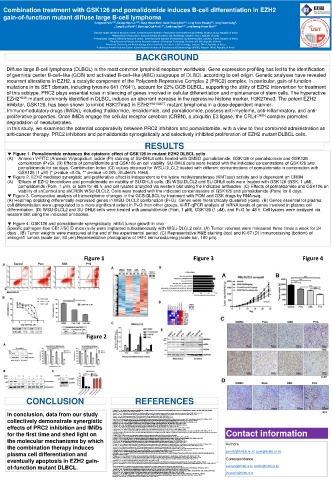
   ▼ Figure 1. Pomalidomide enhances the cytotoxic effect of GSK126 in mutant EZH2 DLBCL cells
   (A)  Annexin V-FITC (Annexin V)/propidium iodide (PI) staining of SU-DHL6 cells treated with DMSO ,pomalidomide, GSK126 or pomalidomide and GSK126
       combination (P+G). (B) Effects of pomalidomide and GSK126 on cell viability. SU-DHL6 cells were treated with the indicated concentrations of GSK126 and
       pomalidomide for six days. Combination Index (CI) values obtained for WSU-DLCL2 treated with different concentrations of pomalidomide in combination with
       GSK126 (1 μM) (* p-value <0.05, ** p-value <0.005, Student's t-test).
   ▼ Figure 2. EZH2 mediated synergistic anti-proliferative effect is independent to the lysine methyltransferase (KMTase) activity and is dependent on CRBN
   (A)  Effects of EZH2 knockdown and pomalidomide on viability of SU-DHL6 cells. (B) WSU-DLCL2 and SU-DHL6 cells were treated with GSK126 (GSK, 1 μM),
       pomalidomide (Pom, 1 μM), or both for 48 h, and cell lysates analyzed via western blot using the indicated antibodies. (C) Effects of pomalidomide and GSK126 on
       viability of shControl and shCRBN WSU-DLCL2. Cells were treated with the indicated concentrations of GSK126 and pomalidomide (Pom) for 6 days.
   ▼ Figure 3. Comparative analysis of transcriptomic changes in the GCB-DLBCL by treatment with POM and GSK drugs by RNA-seq.
   (A) Heatmap depicting differentially expressed genes in WSU-DLCL2 combination (P+G). Genes were hierarchically clustered (rows). (B) Genes essential for plasma
   cell differentiation were upregulated to a more significant extent in P+G than other groups. © RT-qPCR analysis of mRNA levels of genes involved in plasma cell
   differentiation. (D) WSU-DLCL2 and SU-DHL6 cells were treated with pomalidomide (Pom, 1 μM), GSK126 (1 μM), and P+G for 48 h. Cell lysates were analyzed via
   western blot using the indicated antibodies.
   ▼ Figure 4. GSK126 and pomalidomide synergistically inhibit tumor growth in vivo
   Specific pathogen-free CB17/SCID mice (n=6) were implanted subcutaneously with WSU-DLCL2 cells. (A) Tumor volumes were measured three times a week for 24
   days . (B) Tumor weights were measured at the end of the experimental period. (C) Representative H&E staining (top) and Ki-67 (D) immunostaining (bottom) of
   xenograft tumors (scale bar, 50 μm).Representative photographs of IRF4 immunostaining (scale bar, 100 μm).


                            Figure 1                            Figure 3                            Figure 4


                             Figure 2


          CONCLUSION                         REFERENCES

                                      1.Harris, N.L., et al., World Health Organization classification of neoplastic diseases of the hematopoietic and lymphoid tissues: report of the Clinical Advisory Committee meeting-Airlie House, Virginia,
   In conclusion, data from our study   November 1997. J Clin Oncol, 1999. 17(12): p. 3835-49.
                                      2.Hans, C.P., et al., Confirmation of the molecular classification of diffuse large B-cell lymphoma by immunohistochemistry using a tissue microarray. Blood, 2004. 103(1): p. 275-82.
                                      3.Morin, R.D., et al., Somatic mutations altering EZH2 (Tyr641) in follicular and diffuse large B-cell lymphomas of germinal-center origin. Nat Genet, 2010. 42(2): p. 181-5.
                                      4.Vire, E., et al., The Polycomb group protein EZH2 directly controls DNA methylation. Nature, 2006. 439(7078): p. 871-4.
   collectively demonstrate synergistic   5.Aldiri, I. and M.L. Vetter, PRC2 during vertebrate organogenesis: a complex in transition. Dev Biol, 2012. 367(2): p. 91-9.
                                      6.Yap, D.B., et al., Somatic mutations at EZH2 Y641 act dominantly through a mechanism of selectively altered PRC2 catalytic activity, to increase H3K27 trimethylation. Blood, 2011. 117(8): p. 2451-9.
                                      7.Guo, S., et al., EZH2 mutations in follicular lymphoma from different ethnic groups and associated gene expression alterations. Clin Cancer Res, 2014. 20(12): p. 3078-86.
                                      8.Beguelin, W., et al., EZH2 is required for germinal center formation and somatic EZH2 mutations promote lymphoid transformation. Cancer Cell, 2013. 23(5): p. 677-92.
                                      10.McCabe, M.T., et al., EZH2 inhibition as a therapeutic strategy for lymphoma with EZH2-activating mutations. Nature, 2012. 492(7427): p. 108-12.
   effects of PRC2 inhibition and IMiDs  9.Knutson, S.K., et al., A selective inhibitor of EZH2 blocks H3K27 methylation and kills mutant lymphoma cells. Nat Chem Biol, 2012. 8(11): p. 890-6.
                                      11.Qi, W., et al., An allosteric PRC2 inhibitor targeting the H3K27me3 binding pocket of EED. Nat Chem Biol, 2017. 13(4): p. 381-388.
                                      12.Sudo, T., et al., Clinicopathological significance of EZH2 mRNA expression in patients with hepatocellular carcinoma. Br J Cancer, 2005. 92(9): p. 1754-8.
                                      13.Hussain, M., et al., Tobacco smoke induces polycomb-mediated repression of Dickkopf-1 in lung cancer cells. Cancer Res, 2009. 69(8): p. 3570-8.
   for the first time and shed light on   14.Weikert, S., et al., Expression levels of the EZH2 polycomb transcriptional repressor correlate with aggressiveness and invasive potential of bladder carcinomas. Int J Mol Med, 2005. 16(2): p. 349-53.  Contact information
                                      15.Bachmann, I.M., et al., EZH2 expression is associated with high proliferation rate and aggressive tumor subgroups in cutaneous melanoma and cancers of the endometrium, prostate, and breast. J Clin Oncol,
                                      2006. 24(2): p. 268-73.
                                      16.Chen, Z., et al., Expression of EZH2 is associated with poor outcome in colorectal cancer. Oncol Lett, 2018. 15(3): p. 2953-2961.
                                      17.Chanan-Khan, A.A., et al., Pomalidomide: the new immunomodulatory agent for the treatment of multiple myeloma. Blood Cancer J, 2013. 3: p. e143.
   the molecular mechanisms by which   18.Shortt, J., A.K. Hsu, and R.W. Johnstone, Thalidomide-analogue biology: immunological, molecular and epigenetic targets in cancer therapy. Oncogene, 2013. 32(36): p. 4191-202.  Authors
                                      19.Kronke, J., et al., Lenalidomide causes selective degradation of IKZF1 and IKZF3 in multiple myeloma cells. Science, 2014. 343(6168): p. 301-5.
                                      20.Lu, G., et al., The myeloma drug lenalidomide promotes the cereblon-dependent destruction of Ikarosproteins. Science, 2014. 343(6168): p. 305-9.
                                      21.Donovan, K.A., et al., Thalidomide promotes degradation of SALL4, a transcription factor implicated in Duane Radial Ray syndrome. Elife, 2018. 7.
   the combination therapy induces    22.Kang, J.A., et al., Epigenetic regulation of Kcna3-encoding Kv1.3 potassium channel by cereblon contributes to regulation of CD4+ T-cell activation. Proc Natl Acad Sci U S A, 2016. 113(31): p. 8771-6.
                                      23.Chou, T.C., Theoretical basis, experimental design, and computerized simulation of synergism and antagonism in drug combination studies. Pharmacol Rev, 2006. 58(3): p. 621-81.
                                      24.Lee, C.H., et al., Allosteric Activation Dictates PRC2 Activity Independent of Its Recruitment to Chromatin. Mol Cell, 2018. 70(3): p. 422-434 e6.
                                      25.Tellier, J., et al., Blimp-1 controls plasma cell function through the regulation of immunoglobulin secretion and the unfolded protein response. Nat Immunol, 2016. 17(3): p. 323-30.
                                      26.Minnich, M., et al., Multifunctional role of the transcription factor Blimp-1 in coordinating plasma cell differentiation. Nat Immunol, 2016. 17(3): p. 331-43.
   plasma cell differentiation and    27.Manz, R.A., et al., Survival of long-lived plasma cells is independent of antigen. Int Immunol, 1998. 10(11): p. 1703-11.  psrv92@kribb.re.kr, josh@kribb.re.kr
                                      28.Medina, F., et al., The heterogeneity shown by human plasma cells from tonsil, blood, and bone marrow reveals graded stages of increasing maturity, but local profiles of adhesion molecule expression.
                                      Blood, 2002. 99(6): p. 2154-61.
                                      29.Jalkanen, S.T., et al., A lymphoid cell surface glycoprotein involved in endothelial cell recognition and lymphocyte homing in man. Eur J Immunol, 1986. 16(10): p. 1195-202.
   eventually apoptosis in EZH2 gain-  30.de los Toyos, J., S. Jalkanen, and E.C. Butcher, Flow cytometric analysis of the Hermes homing-associated antigen on human lymphocyte subsets. Blood, 1989. 74(2): p. 751-60.  Correspondence
                                      31.Sciammas, R., et al., Graded expression of interferon regulatory factor-4 coordinates isotype switching with plasma cell differentiation. Immunity, 2006. 25(2): p. 225-36.
                                      32.Rajkumar, S.V., Treatment of multiple myeloma. Nat Rev Clin Oncol, 2011. 8(8): p. 479-91.
                                      33.Das, D.S., et al., Synergistic anti-myeloma activity of the proteasome inhibitor marizomib and the IMiD immunomodulatory drug pomalidomide. Br J Haematol, 2015. 171(5): p. 798-812.
   of-function mutant DLBCL.          34.Ntanasis-Stathopoulos, I., E. Terpos, and M.A. Dimopoulos, Optimizing Immunomodulatory Drug With Proteasome Inhibitor Combinations in Newly Diagnosed Multiple Myeloma. Cancer J, 2019. 25(1): p. 2-  sunhong@kribb.re.kr, parkbc@kribb.re.kr,
                                      10.
                                      35.Dimopoulos, M.A., et al., Thalidomide and dexamethasone combination for refractory multiple myeloma. Ann Oncol, 2001. 12(7): p. 991-5.
                                      36.Cavo, M., et al., First-line therapy with thalidomide and dexamethasone in preparation for autologous stem cell transplantation for multiple myeloma. Haematologica, 2004. 89(7): p. 826-31.
                                      37.North, B.J., et al., Enhancement of pomalidomide anti-tumor response with ACY-241, a selective HDAC6 inhibitor. PLoS One, 2017. 12(3): p. e0173507.
                                      38.Cosenza, M., et al., The histone deacetylase inhibitor romidepsinsynergizes with lenalidomide and enhances tumor cell death in T-cell lymphoma cell lines. Cancer Biol Ther, 2016. 17(10): p. 1094-1106.
                                      39.Sievers, Q.L., et al., Defining the human C2H2 zinc finger degrome targeted by thalidomide analogs through CRBN. Science, 2018. 362(6414).  jhoonkim@kribb.re.kr
                                      40.Fionda, C., et al., The IMiDs targets IKZF-1/3 and IRF4 as novel negative regulators of NK cell-activating ligands expression in multiple myeloma. Oncotarget, 2015. 6(27): p. 23609-30.
                                      41.Hernando, H., et al., EZH2 Inhibition Blocks Multiple Myeloma Cell Growth through Upregulation of Epithelial Tumor Suppressor Genes. Mol Cancer Ther, 2016. 15(2): p. 287-98.
                                      42.Kim, K.H. and C.W. Roberts, Targeting EZH2 in cancer. Nat Med, 2016. 22(2): p. 128-34.

