


Page 131 - D. Cancer biology
P. 131
Polyunsaturated fatty acid synthesis pathway regulates Poster D-82
ferroptosis sensitivity in gastric cancer cells
Ji-Yoon Lee¹² , Miso Nam³ , Hye Young Son⁴ , Jong Woo Kim¹⁵, Min Wook Kim , Youngae Jung³, Jaehoon Kim²,
,
1
,#
, ,#
,#
, ,
Yong-Min Huh⁴ ⁶ *, Geum-Sook Hwang³*, Sang Chul Lee¹⁵ *, Eun-Woo Lee¹* ,
,
, ,
¹Metabolic Regulation Research Center, Korea Research Institute of Bioscience and Biotechnology (KRIBB), Daejeon 34141, Korea, ²Department of Biological Sciences, Korea Advanced Institute of Science and Technology
(KAIST), Daejeon 34141, Korea, ³Integrated Metabolomics Research Group, Korea Basic Science Institute (KBSI), Seoul 03760, Korea, ⁴Severance Biomedical Science Institute, Yonsei University College of Medicine, Seoul 03760,
Korea, ⁵Department of Functional Genomics, University of Science and Technology (UST), Daejeon 34141, Korea, ⁶MediBio-Informatics Research Center, Novomics Co., Ltd., Seoul 03760, Korea
BACKGROUND AIM
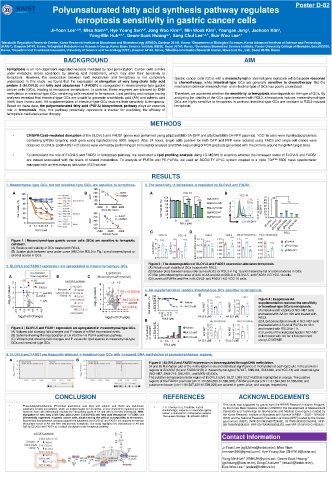
Ferroptosis is an iron-dependent regulated necrosis mediated by lipid peroxidation. Cancer cells survive
under metabolic stress conditions by altering lipid metabolism, which may alter their sensitivity to
ferroptosis. However, the association between lipid metabolism and ferroptosis is not completely Gastric cancer cells (GCs) with a mesenchymal or stromal gene signature exhibit a poor response
understood. In this study, we found that the expression of elongation of very long-chain fatty acid to chemotherapy, while intestinal-type GCs are generally sensitive to chemotherapy. But the
protein 5 (ELOVL5) and fatty acid desaturase 1 (FADS1) is upregulated in mesenchymal-type gastric mechanism between mesenchymal- and intestinal-type of GCs has poorly understood.
cancer cells (GCs), leading to ferroptosis sensitization. In contrast, these enzymes are silenced by DNA
methylation in intestinal-type GCs, rendering cells resistant to ferroptosis. Lipid profiling and isotope tracing Therefore, we wondered whether the sensitivity to ferroptosis also depends on the type of GCs. By
analyses revealed that intestinal-type GCs are unable to generate arachidonic acid (AA) and adrenic acid analyzing the viability of the GCs upon treatment with RSL3, a ferroptosis inducer, mesenchymal-type
(AdA) from linoleic acid. AA supplementation of intestinal-type GCs restores their sensitivity to ferroptosis. GCs are highly sensitive to ferroptosis in contrast, intestinal-type GCs are resistant to RSL3-induced
Based on these data, the polyunsaturated fatty acid (PUFA) biosynthesis pathway plays an essential ferroptosis.
role in ferroptosis; thus, this pathway potentially represents a marker for predicting the efficacy of
ferroptosis-mediated cancer therapy.
METHODS
• CRISPR/Cas9-mediated disruption of the ELOVL5 and FADS1 genes was performed using pSpCas9(BB)-2A-GFP and pSpCas9(BB)-2A-RFP plasmids. YCC-16 cells were transfected plasmids
containing gRNAs targeting each gene using Lipofectamine 3000 reagent. After 24 hours, single cells positive for both GFP and RFP were isolated using FACS and single-cell clones were
obtained. ELOVL5- and FADS1-KO clones were verified by performing an immunoblot analysis and DNA sequencing of PCR products generated with the primers around the gRNA target sites.
• To understand the role of ELOVL5 and FADS1 in ferroptosis pathway, we conducted a lipid profiling analysis using LC-MS/MS to examine whether the increased levels of ELOVL5 and FADS1
are indeed associated with the levels of related metabolites. To analysis of PUFAs and PE-PUFAs, we used an ACQUITY UPLC system coupled to a triple TOF™ 5600 mass spectrometer
equipped with an electrospray ionization (ESI) source.
RESULTS
1. Mesenchymal-type GCs, but not intestinal-type GCs, are sensitive to ferroptosis. 3. The sensitivity to ferroptosis is regulated by ELOVL5 and FADS1.
300
A 120 B 250 r= -0.877 A YCC-16 B YCC-16
P= 0.0657
100 AUC 200 120 *** *** gControl < 1% 70 *** ***
60
150
100
Cell Viability (%) 60 100 -3000 Stem-like Score Cell Viability (%) 80 gELOVL5#2 % Counts 14 % % of oxidized C11 BODIPY 40
gELOVL5#1
57 %
50
80
3000 6000
0
60
22 %
30
40
12 %
20
gFADS1#1
300
40
9 %
10
20
20
P < 0.0001
0.5
200
0 AUC 250 r= -0.937 0 0 RSL3 (μM) 1 gFADS1#2 C11-BODIPY 0
150
0 0.1 0.25 0.5 2
RSL3 (μM) 100 -7500 -5500 -3500 C D
Stromal Score RSL3
n.s.
Figure 1 | Mesenchymal-type gastric cancer cells (GCs) are sensitive to ferroptotic n.s. n.s. n.s. *** gControl
cell death. * n.s. gELOVL5#1
(A) Relative cell viability of GCs treated with RSL3. * *** **
(B) Scatter plots between area under curve (AUC) for RSL3 in Fig.1a and mesenchymal or *** ** gFADS1#1
stromal scores in GCs.
Figure 3 | The downregulation of ELOVL5 and FADS1 expression alleviates ferroptosis.
2. ELOVL5 and FADS1 expression are upregulated in mesenchymal-type GCs. (A) Relative cell viability of GCs treated with RSL3.
(B) Scatter plots between area under curve (AUC) for RSL3 in Fig.1a and mesenchymal or stromal scores in GCs.
Up-regulated Lipidomics (C) Bar plots showing the ratios of AdA to AA and AA to DGLA in ELOVL5- and FADS1-KO YCC-16 cells.
A Down-regulated B C (Mesenchymal/Intestinal) (D) Levels of PUFAs and Pes in ELOVL5- and FADS1-KO YCC-16 cells.
-1.58 +1.58
5 4 ELOVL5 10 - 2 + 2
-log 10 (p-value) 3 2 ELOVL4 p=0.001 -log 10 (p-value) 8 6 4 PE-(18:0/22:4) A 4. AA supplementation renders intestinal-type GCs sensitive to ferroptosis.
FADS1
C
120
Figure 4 | Exogenous AA
100
AdA (C22:4)
LPL
80
p=0.005
40
of intestinal-type GCs to ferroptosis.
AA 2.5 μM
0 1 2 0 AA (C20:4) Cell Viability (%) 60 Vehicle NCI-N87 NCI-N87 supplementation restores the sensitivity
20
-4.5 -3 -1.5 0 1.5 3 4.5 -8 -6 -4 -2 0 2 4 6 8 0 0 1 2 (A) Relative cell viability of NCI-N87 cells
pretreated with AA for 16h and treated with
log 2 (Fold Change) log 2 (Fold Change) 0.05 0.1 0.2 0.5 AA (2.5 μM) - + AA (2.5 μM) - + RSL3.
B RSL3 (μM) (B) Lipid peroxidation levels in NCI-N87 cells
60 pretreated with 2.5 μM of PUFAs for 16 h
Figure 2 | ELOVL5 and FADS1 expression are upregulated in mesenchymal-type GCs. 50 Vehicle and treated with RSL3 for 1 h.
40
(A) Volcano plot showing fold changes and P-values of mRNA expression levels. % of oxidized C11 BODIPY 30 LA 2.5 μM NCI-N87 NCI-N87 (C) Levels of the indicated lipids in NCI-N87
20
(B) Scheme showing the incorporation of LA into the n-6 PUFA synthesis pathway. 10 AA 2.5 μM cells treated with AA for 3 h determined
(C) Volcano plot showing fold changes and P-values for lipid species in mesenchymal-type 0 AA (2.5 μM) - + AA (2.5 μM) - + using LC-MS/MS.
0.5
1
GCs and intestinal-type GCs. 0 RSL3 (μM) 2
5. ELOVL5 and FADS1 are frequently silenced in intestinal-type GCs with increased DNA methylation at promoter/enhancer regions.
A B
Figure 5 | ELOVL5 and FADS1 expression is downregulated through DNA methylation.
(A and B) Manhattan plot of the methylation levels and statistical significance of methylation at each CpG site in the promoter
regions of ELOVL5 (A) and FADS1/2 (B) in mesenchymal-type (Hs746T, SNU484, SNU-668, and YCC-16) and intestinal-type
(NCI-N87, SNU-719, SNU-601, and MKN-45) GCs.
The putative enhancer/promoter region of ELOVL5 (chr6: 53,211,316-53,214,820) is highlighted in orange. The putative
regions of the FADS1 promoter (chr11: 61,584,650-61,586,300), FADS2 promoter (chr11: 61,594,300-61,595,600) and
putative enhancer (chr11: 61,587,300-61,589,000) are colored in green, blue, and orange, respectively
CONCLUSION REFERENCES ACKNOWLEDGEMENTS
This study was supported by grants from the KRIBB Research Initiative Program,
• Phosphatidylethanolamine (PE)-linked arachidonic acid (AA) and adrenic acid (AdA) are well-known J.-H. Cheong et al., Predictive test for
substrates for lipid peroxidation, which are indispensable for ferroptosis, an iron-dependent regulated necrosis. • chemotherapy response in resectable gastric by the Korea Basic Science Institute (C060000), the Development of Measurement
• However, how cells differentially regulate the intracellular pools of AA and AdA is not fully understood. Here, cancer: a multi-cohort, retrospective analysis. Standards and Technology for Biomaterials and Medical Convergence funded by
elongation of very long-chain fatty acid protein 5 (ELOVL5) and fatty acid desaturase 1 (FADS1) are the Korea Research Institute of Standards and Science (KRISS – 2020 – GP2020-
differentially expressed in gastric cancer cells, discriminating the cellular susceptibility to ferroptosis. The Lancet Oncology 19, 629-638 (2018). 0004) and the National Research Foundation of Korea (NRF) funded by the Korean
• Biochemical and lipidomics analyses support the hypothesis that ELOVL5 and FADS1 are required to maintain government (MSIT) (NRF-2015M3A9D7029882, 2017M3A9D5A01052449, NRF-
intracellular levels of AA and AdA and promote ferroptosis. Our study highlights the biosynthesis of AA and 2017M3A9G5083321, NRF-2017M3A9G5083322, and NRF-2019R1C1C1002831).
AdA by ELOVL5 and FADS1 as a critical checkpoint in the ferroptosis pathway
Contact information
Ji-Yoon Lee (sy92rhea@kribb.re.kr), Miso Nam
(msnam065@gmail.com), Hye Young Son (SHY916@yuhs.ac)
Yong-Min Huh* (YMHUH@yuhs.ac), Geum-Sook Hwang *
(gshwang@kbsi.re.kr), Sang Chul Lee * (lesach@kribb.re.kr),
Eun-Woo Lee * (ewlee@kribb.re.kr)

