


Page 23 - A. Aging
P. 23
Development of natural polymer microneedle
to improve skin elasticity
1
1
Da Som Kim , Sung-Min An , Min Jae Kim , Jea Sic Jeong , So Young Kim , Da Hee Kang, Beum-Soo An 1*
1
1
1
¹Department of Biomaterials Science, College of Natural Resources & Life Science/Life and Industry Convergence Research
Institute, Pusan National University, Korea
Intr
oduction
Abstract Introduction
Abstract
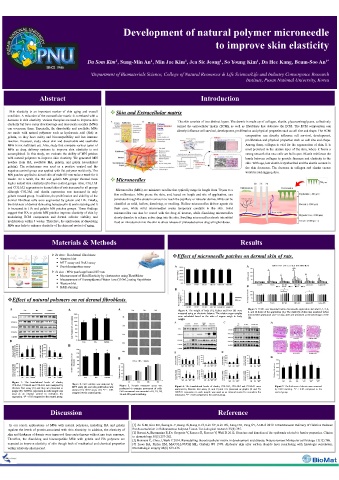
Skin elasticity is an important marker of skin aging and overall Skin and Extracellular matrix
condition. A reduction of the extracellular matrix is correlated with a
decrease in skin elasticity. Various therapies are used to improve skin The skin consists of two distinct layers. The dermis is made up of collagen, elastin, glycosaminoglycans, collectively
elasticity but have many shortcomings and microscale needles (MNs) termed the extracellular matrix (ECM), as well as fibroblasts that elaborate the ECM. The ECM composition can
can overcome them. Especially, the dissolvable and swellable MNs
are made with natural polymers such as hyaluronic acid (HA) or directly influence cell survival, development, proliferation and physical properties such as cell size and shape. The ECM
gelatin, so they have safety and biocompatibility and less immune composition can directly influence cell survival, development,
reaction. However, study about skin and dissolvable and swellable proliferation and physical properties such as cell size and shape.
MNs is not sufficient yet. Also, study that compare various types of Among them, collagen is vital for the regeneration of skin. It is
MNs as drug delivery systems to improve skin elasticity is not most prevalent in the dermis layer of the skin, where it forms a
accomplished. In this study, we evaluate the ability of MN patches strong network that new cells are built upon. Elastin reinforces the
with natural polymers to improve skin elasticity. We generated MN bonds between collagen to provide firmness and elasticity to the
patches from HA, swellable HA, gelatin, and gelpin (crosslinked skin. With age, less elastin is synthesized and the elastin content in
gelatin). The polystyrene was used as a positive control and the the skin decreases. The decrease in collagen and elastin causes
negative control group was applied with flat polymer mold only. The wrinkles and sagging skin.
MN patches applied to dorsal skin of male SD rats twice a week for 4
weeks. As a result, the HA and gelatin MN groups showed more Microneedles
higher instant skin elasticity ratio than control groups. Also, COL1A1
and COL1A2 expression in dermal skin of rats increased in all groups
although COL3A1 and elastin expression was increased in only Microneedles (MNs) are miniature needles that typically range in length from70µm toa
gelatin treated group. In addition, the proliferation and viability of the few millimeters. MNs pierce the skin, and, based on length and site of application, can
dermal fibroblast cells were augmented by gelatin and HA. Finally, penetrate through the stratum corneum to reach the papillary or reticular dermis. MNs can be
the thickness of dermal skin using hematoxylin & eosin staining and it classified as solid, hollow, dissolving, or swelling. Hollow microneedles deliver agents via
is increased in HA and gelatin MN patches groups. These findings their core, while solid microneedles create temporary conduits in the skin. Solid
suggest that HA or gelatin MN patches improve elasticity of skin by microneedles can also be coated with the drug of interest, while dissolving microneedles
modulating ECM components and dermal cellular viability and slowly dissolve to release active drug into the skin. Swelling microneedles absorb interstitial
proliferation within 4 weeks. Therefore, the application of dissolving fluid on introduction into the skin to allow release of preloaded active drug at higher doses.
MNs may help to enhance elasticity of the skin and protect of aging.
Materials & Methods Results
Materials
& Methods
Results
In vitro : Rat dermal fibroblasts Effect of microneedle patches on dermal skin of rats.
Western blot
MTT assay and BrdU assay
Scratch migration assay
In vivo : MNs patch applicated SD rats
Measurement of Skin Elasticity by elastometor using ElastiMeter
Measurement of Transepidermal Water Loss (TEWL) using VapoMeter
Western blot
H&E staining
Effect of natural polymers on rat dermal fibroblasts.
Figure 5. TEWL was measured before microneedle application and after 0, 1, 2, 4,
Figure 4. The weight of body (A), kidney and liver (B) were
measured using an electronic balance. The relative organ weights 8, and 24 hours of the application (A). The elasticity of skin was measured before
were calculated based on the ratio of organs weigh to body microneedle application and 3-4 days after and presented as the percentageof ISE
weight. (B).
Figure 1. The translational levels of elastin,
COL1A1, COL1A2 and COL3A1 were analyzed by Figure 2. Cell viability was analyzed by Figure 3. Scratch migration assay was Figure 6. The translational levels of elastin, COL1A1, COL1A2 and COL3A1 were Figure 7. The thickness of dermis was measured
Western blot assay (A) and they are presented as MTT assay (A) and cell proliferation was performed to examine movement of cells. analyzed by Western blot assay (A and C) and it is presented as graphs (B and D). by H&E staining. *P < 0.05comparedto the
graphs (B). GAPDH expression in each sample was analyzed by BrdU assay. (B) *P <0.05 Cell movement was recorded at 0, 12, 24, GAPDH expression in each sample was used as an internal control to normalizethe control group.
used as an internal control to normalize the compared to the control group. 36 and 48 h post-scratching. expression. *P < 0.05 compared to the control group.
expression. *P < 0.05 compared to the control group.
Reference
Discussion
Discussion Refer e nce
In our result, applications of MNs with natural polymers, including HA and gelatin [1] An S-M, Kim MJ, Seong K-Y, Jeong JS, Kang H-G, Kim SY, Kim DS, Kang DH, Yang SY, An B-S 2019. Intracutaneous Delivery of Gelatins Reduces
regulate the levels of protein-associated with skin elasticity. In addition, the elasticity of Fat Accumulation in Subcutaneous Adipose Tissue. Toxicological research 35(4) 395.
skin and thickness of dermis were improved than control group without any toxic response. [2] Baroni A, Buommino E, De Gregorio V, Ruocco E, Ruocco V, Wolf R 2012. Structure and function of the epidermis related to barrier properties. Clinics
in dermatology 30(3) 257-262.
Therefore, the dissolving and biocompatible MNs with gelatin and HA polymers are [3] Bonnans C, Chou J, Werb Z 2014. Remodelling the extracellular matrix in development and disease. Nature reviews Molecular cell biology 15(12) 786.
expected to improve elasticity of skin though both of mechanical and chemical properties [4] Laws RA, Finley EM, McCOLLOUGH ML, Grabski WJ 1998. Alabaster skin after carbon dioxide laser resurfacing with histologic correlation.
within relatively short period. Dermatologic surgery 24(6) 633-636.

