


Page 21 - A. Aging
P. 21
Long-term administration of red ginseng non-saponin fraction rescues the loss of skeletal muscle mass and function associated with aging in
                                                     mice
                            Da-Eun Cho¹, Gwang-Muk Choi¹, Hyein Song², Mijung Yeom³, Bombi Lee³, Dae Hyun Hahm 1,3,4*
  ¹Department of Biomedical Sciences, Graduate School, Kyung Hee University, Seoul, 02447, Republic of Korea
  ²Department of Medicinal Biosciece, Nonsan Interdisciplinary & Creative Studies Campus, Konyang Univeristy, nonsan-si, Chungcheongnam-do, 32992, Repulic of Korea
  ³Acupuncture and Meridian Science Research Center, Kyung Hee University, Seoul, 02447, Republic of Korea
  ⁴Department of Physiology, College of Medicine, Kyung Hee University, Seoul, 02447, Republic of Korea
                      ABSTRACT                                                 AIM
   Korean red ginseng has been known to relieve fatigue and enhance the physical performance especially in the elderly. Anti-
   sarcopenic effect of its non-saponin fraction (NS) was investigated in 22-month-old mice, administered with 0.08% NS chow  1.  To examine whether red ginseng non-saponin fraction (NS) can alleviate the loss of muscle mass and strength in the aged mice.
   diet for another 4 months. Aging-associated weight loss of hindlimb skeletal muscle such as tibials anterior, extensor  2.  To verify whether NS can alleviate the shift of fast-to slow-twitch muscle type strength in the aged mice.
   digitorum longus (EDL), gastrocnemius and soleus was significantly alleviated by NS treatment. The cross-sectional areas of
   soleus, decreased by 40% in aged mice raised from 22 to 26 months, were mitigated to 12.5%, and a shift of fast-to slow-  3.  To investigate the effects of NS on senescence characteristics such as intracellular lipid accumulation, increased amount of β-
   twitch muscle type, observed in soleus and EDL was also retarded. In order to elicit a senescence in C2C12 myoblasts, the  galactosidase protein from lysosome, and reduced cell proliferative capacity in C2-ceramide-elicited cellular senescence model of
                                                           C2C12 myoblasts.
   cells were treated with C2-ceramide, and NS 1h earlier. NS significantly alleviated C2-ceramide-induced senescence
   indicated by intracellular lipid accumulation, increased amount of lysosomal β-galactosidase, cell cycle retardation, and  4.  To examine whether NS can inhibit C2-ceramide-stimulated mRNA expression of cell cycle-associated genes such as p21 and
   reduced cell proliferative capacity. NS restored C2-ceramide-stimulated expression of p21, p57, p16, MuRF1 and atrogin-1,  p57, and muscle-specific ubiquitin ligases such as MuRF-1 and MAFbx/atrogin-1 in C2C12 myoblasts.
   and the suppression of Pax-7 in a dose dependent manner. NS thus might be invaluable for the development of therapeutic  5.  To examine whether NS can inhibit C2-ceramide-downregulated expression of Pax-7 mRNA in C2C12 myoblast.
   medicines to rescue sarcopenia and its accompanying muscle dysfunction.
                                                METHODS


    •  Laboratory chow diet containing 0.08% NS (800 mg/kg-chow) was manufactured and offered to 22-  •  DMSO: dimethyl sulfoxide. C2-ceramide was dissolved in 0.1% DMSO, Naïve: non-treated
       month-old C57B/L6 mice daily for another 4 months.     myoblast cells, NS: non-saponin fraction of red ginseng treated myoblast cells
    •  26CO: a group of 22-month-old mice fed a standard chew diet during 4 months. 26NS: a group of 22-
       month-oldmice fed a standard chew diet mixed NS during 4 months. 22CO: a group of 18 month-old-mice
       fed a standard chew diet during 4 months.
                                                 RESULTS


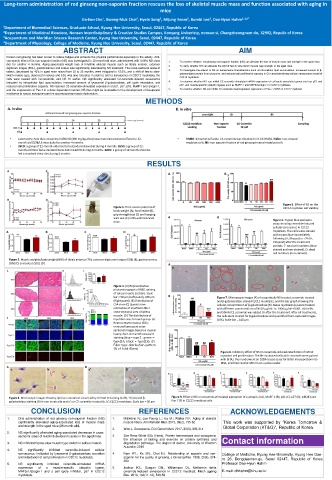
                                                                                             Figure 5. Effect of NS on the
                                      Figure 1. Time-course patterns of                      C2C12 myoblast cell viability.
                                      body weight (A), food intake (B),
                                      grip strength test (C) and hanging
                                      wire test (E) in NS-administrated                   Figure 6. Trypan blue exclusion
                                      mice.
                                                                                          assay showing ceramide-induced
                                                                                          cellular senescence in C2C12
                                                                                          myoblasts. The cells were stained
                                                                                          with trypan blue immediately
                                                                                          following (A, 0h-post) or 72h (B,
                                                                                          72h-post) after the treatment
                                                                                          periods. T: total cell numbers (blue-
                                                                                          stained and non-stained), D: dead
                                                                                          cell numbers (non-stained).
    Figure 2. Muscle weights/body weight (BW) of tibials anterior (TA), extensor digitorum longus (EDL) (B), gastrocnemius
    (GN) (C) and soleus (SOL) (D).
                                      Figure 3. (A) Representative
                                      photomicrograph of H&E staining
                                      of soleus muscle sections. Scale
                                      bar = 50 μm (Left panel), 100 μm   Figure 7. Microscopic images (A) of sequentially NS-treated, ceramide-treated
                                      (Right panel). (B) Distribution of   and β-galactosidase-stained C2C12 myoblasts, and the bar graph showing the
                                      CSA sizes (C) Quantitative        cellular concentration of β-galactosidase (B). Naïve myoblasts (a) were treated
                                      estimation of myofibers fiber     with different concentrations of NS (0 μg/ml-: b; 1000 μg/ml-RGNS : d) for 9h,
                                      cross-sectional area of soleus    and 50mM C2-ceramide was added 1h after the treatment. After all treatments,
                                      muscle. (D) The distribution of   the cells were stained for β-galactosidase and quantified from captured images
                                      myofiber sizes for each group. (E)   (10X). Scale bar = 100 μm
                                      Representative soleus (SOL)
                                      immunofluorescent cross-
                                      sectional images based on myosin   150
                                      heavy chain immunofluorescent
                                      staining (blue = typeⅠ, green =   100
                                      typeⅡA, black = typeⅡX). (F)   Brdu Incorporation  (Abs. at 450 nm)  ##  ##  *
                                      Fiber type distribution pattern
                                      (% of total fibers)  50            Figure 8. Inhibitory effect of NS on ceramide-induced retardation of C2C12
                                                          0              myoblast cell proliferation. The 8h-incubated cells with ceramide were pulsed
                                                           Naive  DMSO  0  100  1000
                                                                         with BrDU, then underwent an ELISA-based assay for BrDU incorporation into
                                                                  NS (µg/ml)  DNA, and then read at 450 nm on a plate reader.
                                                                 C2-ceramide (50 µM)
    Figure 4. Microscopic images showing lipid accumulation visualized by Oil Red O staining (2.0%, 1h) (A) and β-  Figure 9. Effect of NS on ceramide-stimulated expression of a atrogin-1 (A), MuRF-1 (B), p21 (C), p57 (D), p16 (E) and
    galactosidase staining (B) in non-treated (a and a’) or C2-ceramide-treated (b, b’) C2C12 myoblasts. Scale bar = 50 μm  Pax-7 (F) in C2C12 myoblast cells.
           CONCLUSION                         REFERENCES                    ACKNOWLEDGEMENTS
   1.  Oral administration of red ginseng non-saponin fraction (NS)  1.  Miljikovic N.; Jae-Young L.; Iva M.; Walter R.F. Aging of skeletal
       significantly alleviated aging-associated loss of muscle mass  muscle fibers. Ann Rehabil Med. 2015, 39(2), 155-62  This work was supported by “Korea Tomorrow &
       and strength in the aged mice (26-month-old).
                                      2.  Woo J. Sarcopenia. Clin Geriatr Med. 2017, 33(3), 305-314  Global Corporation (KT&G)”, Republic of Korea.
   2.  NS significantly alleviated aging-associated decreases in cross-
       sectional areas of hindlimb skeletal muscles in the aged mice.  3.  Zoe Rene White BSc (Hons). Protein homeostasis and sarcopenia:
                                         the influence of fasting and exercise on protein synthesis and
   3.  NS inhibited fast-to-slow muscle type switch in soleus muscle.  degradation pathways. The degree of doctor, University of Western Contact information
                                         Australia, 2016
   4.  NS  significantly  inhibited  ceramide-induced  cellular
       senescence, indicated by lysosomal β-galactosidase secretion  4.  Nam KY.; Ko SR.; Choi KJ. Relationship of saponin and non-  College of Medicine, Kyung Hee University, Kyung Hee Dae-
       and retardation of cell proliferation in C2C12 myoblasts.  saponin for the quality of ginseng, J Ginseng Res. 1998, 22(4), 274-  ro 26, Dongdaemun-gu, Seoul 02447, Republic of Korea
                                         283
   5.  NS  significantly  inhibited  ceramide-stimulated  mRNA           Professor Dae-Hyun Hahm
       expression  of  a  muscle-specific  ubiquitin  ligase,  5.  Jadhav KS.; Dungan DM.; Williamson DL. Metformin limits
       MAFbx1/atrogin-1 and a cell cycle inhibitor, p57 in C2C12  ceramide-induced senescence in C2C12 myoblast. Mech ageing  E-mail: dhhahm@khu.ac.kr
       myoblasts.                        Dev. 2013, 134(11-12), 548-59

