


Page 19 - A. Aging
P. 19
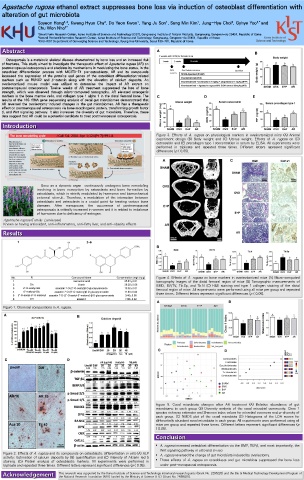
Agastache rugosa ethanol extract suppresses bone loss via induction of osteoblast differentiation with
alteration of gut microbiota
1
3
1
1,3
Soyeon Hong , Kwang Hyun Cha , Do Yeon Kwon , Yang Ju Son , Sang Min Kim , Jung-Hye Choi , Gyhye Yoo 1,* and
1
2
Chu Won Nho 1*
1 Smart Farm Research Center, Korea Institute of Science and Technology (KIST), Gangneung Institute of Natural Products, Gangneung, Gangwon-do 25451, Republic of Korea
2 Natural Product Informatics Research Center, Korea Institute of Science and Technology, Gangneung, Gangwon-do 25451, Republic of Korea
3 KHU-KIST Department of Converging Science and Technology, Kyung Hee University, Seoul 130-701, Republic of Korea
Abstract
Osteoporosis is a metabolic skeletal disease characterized by bone loss and an increased risk
of fractures. This study aimed to investigate the therapeutic effect of Agastache rugosa (AR) on
postmenopausal osteoporosis and elucidate its mechanisms in modulating the bone status. In the
osteoblast differentiation process with MC3T3-E1 pre-osteoblasts, AR and its compounds
increased the expression of the proteins and genes of the osteoblast differentiation-related
markers such as RUNX2 and β-catenin along with the elevation of calcium deposits. An
ovariectomized mouse model was utilized to determine the impact of AR extract on
postmenopausal osteoporosis. Twelve weeks of AR treatment suppressed the loss of bone
strength, which was observed through micro-computed tomography. AR elevated osteogenic
markers in the bone marrow cells, and collagen type 1 alpha 1 in the distal femoral bone. The
results of the 16S rRNA gene sequencing analysis of cecal gut microbiomes demonstrated that
AR reversed the ovariectomy-induced changes in the gut microbiomes. AR has a therapeutic
effect on postmenopausal osteoporosis via bone morphogenic protein, transforming growth factor
β, and Wnt signaling pathway. It also increases the diversity of gut microbiota. Therefore, these
data suggest that AR could be a potential candidate to treat postmenopausal osteoporosis.
Introduction
J Cell Sci. 2011 Apr 1;124(Pt 7):991-8. Figure 3. Effects of A. rugosa on physiological markers in ovariectomized mice (A) Animal
experiment design (B) Body weight and (C) Uterus weight. Effects of A. rugosa on (D)
osteocalcin and (E) procollagen type I concentration in serum by ELISA. All experiments were
performed in triplicate and repeated three times. Different letters represent significant
differences (p < 0.05).
Bone as a dynamic organ continuously undergoes bone remodeling
involving in bone resorption by osteoclasts and bone formation by
osteoblasts, which is strictly modulated by hormones and biomechanical
external stimuli. Therefore, a modulation of the interaction between
osteoblasts and osteoclasts is a crucial point for treating various bone
diseases. After menopause, the occurrence of postmenopausal
osteoporosis is critically increased in women and it is related to imbalance
of hormones due to deficiency of estrogen.
Agastache rugose (Family: Lamiaceae)
Known as having antioxidant, anti-inflammatory, anti-fatty liver, and anti-obesity effects
Results
Figure 4. Effects of A. rugosa on bone markers in ovariectomized mice (A) Micro-computed
tomography images of the distal femoral region of mice (B) Tomographic measurements of
BMD, BV/TV, Tb.Sp, and Tb.N (C) H&E staining and type 1 collagen staining of the distal
femoral region of mice. All experiments were performed using all mice per group and repeated
three times. Different letters represent significant differences (p < 0.05).
Figure 1. Chemical compositions in A. rugosa.
Figure 5. Cecal microbiota changes after AR treatment (A) Relative abundance of gut
microbiome in each group (B) Diversity analysis of the cecal microbial community. Chao 1
species richness estimator and Shannon index values for microbial evenness and α-diversity of
each group. (C) NMDS plot of the cecal microbiota (D) Histograms of the LDA scores for
differentially abundant cecal microbiota in each group. All experiments were performed using all
mice per group and repeated three times. Different letters represent significant differences (p
< 0.05).
Conclusion
A. rugosa increased osteoblast differentiation via the BMP, TGFβ, and most importantly, the
Wnt signaling pathway in vitro and in vivo.
Figure 2. Effects of A. rugosa and its compounds on osteoblastic differentiation in vitro (A) ALP A. rugosa reversed the change of gut microbiota induced by ovariectomy.
activity; Estimation of calcium deposits by (B) quantification and (C) intensity of Alizarin red S
staining. (D) Protein analysis of osteoblastic markers. All experiments were performed in Those effects of A. rugosa on osteoblasts and gut microbiota suppressed the bone loss
triplicate and repeated three times. Different letters represent significant differences (p < 0.05). under post-menopausal osteoporosis.
Acknowledgement This research was supported by the Korea Institute of Science and Technology intramural research grants (Grant No. 2Z06220) and the Bio & Medical Technology Development Program of
the National Research Foundation (NRF) funded by the Ministry of Science & ICT (Grant No. 2N58430).

