


Page 27 - A. Aging
P. 27
A-16

        Identification of HPOB as a potent inhibitor of tyrosinase


                                                             )
                                              )
                                                                                      ),
                                    Hyerim Song¹ , Yun Jeong Hwang¹ , Jae Won Ha¹ , Yong Chool Boo¹ *
                                                                        )
                            Department of Molecular Medicine, Cell and Matrix Research Institute, BK21 Plus KNU Biomedical Convergence Program,
                                        School of Medicine, Kyungpook National University, Daegu, Republic of Korea
    BACKGROUND                             RESULTS
     Dysfunctions associated with melanin synthesis cause clinically relevant
    pigmentation disorders that can be congenital or acquired, cutaneous or
    systemic,  temporary  or  permanent,  and  related  to  hypo-  or
    hyperpigmentation
     Tyrosinase (TYR) is a copper-containing enzyme that catalyzes the
    hydroxylation of L-tyrosine to L-3,4-dihydroxyphenylalanine (DOPA), and the
    oxidation of L-DOPA to its corresponding o-quinone derivative in the melanin
    synthetic pathway. A variety of natural and synthetic compounds are known to
    inhibit the catalytic activity of TYR by multiple mechanisms. For example, β-
    arbutin and kojic acid are known to inhibit the catalytic activity of TYR in a
    competitive manner TYR.
    AIM
    The present study was undertaken to screen an epigenetic drug library to
    identify new drug candidates for pharmacotherapy of hyperpigmentation.
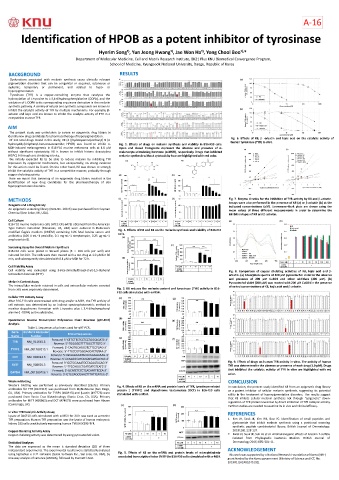
    Of 141 total drugs tested in this study, K8 (4-((hydroxyamino)carbonyl)-N-(2-  Fig. 6. Effects of K8, b -arbutin and kojic acid on the catalytic activity of
    hydroxyethyl)-N-phenyl-benzeneacetamide; HPOB) was found to inhibit α-  Fig. 1. Effects of drugs on melanin synthesis and viability in B16-F10 cells.  human tyrosinase (TYR) in vitro.
    MSH-induced melanogenesis in B16-F10 murine melanoma cells at 1.0 μM  Open and closed histograms represent the absence and presence of α-
    without significant cytotoxicity. K8 is known to inhibit histone deacetylase  melanocyte-stimulating hormone (α-MSH), respectively. Drugs that inhibited
    (HDAC) 6 through zinc chelatingactivity.  melanin synthesis without cytotoxicity how are highlighted with red color.
    We initially expected K8 to be able to reduce melanin by inhibiting TYR
    expression by epigenetic mechanisms, but unexpectedly, no strong evidence
    for this action could be found. On the other hand, K8 was shown to strongly
    inhibit the catalytic activity of TYR in a competitive manner, probably through
    copper chelatingactivity.
    Here we report that screening of an epigenetic drug library resulted in the
    identification of new drug candidates for the pharmacotherapy of skin
    hyperpigmentation disorders.
    METHODS                                                                      Fig. 7. Enzyme kinetics for the inhibition of TYR activity by K8 and b-arbutin.
                                                                                 Assays were also performed in the presence of K8 (a) or b-arbutin (b) at the
    Reagents and a Drug Library                                                  indicated concentrations (μM). Lineweaver-Burk plots are drawn using the
    An epigenetic screening library (Item No. 11076) was purchased from Cayman   mean values of three different measurements in order to determine the
    Chemical (Ann Arbor, MI, USA).
                                                                                 inhibition types of K8 and b-arbutin.
    Cell Culture
    B16-F10 murine melanoma cells (ATCC CRL-6475) obtained from the American
    Type Culture Collection (Manassas, VA, USA) were cultured in Dulbecco’s  Fig. 2. Effects of H4 and K8 on the melanin synthesis and viability of B16-F10
    modified Eagle’s medium (DMEM) containing 10% fetal bovine serum and  cells.
    antibiotics (100 U·mL−1 penicillin, 0.1 mg·mL−1 streptomycin, 0.25 μg·mL−1
    amphotericin B).
    Screening Assay for Overall Melanin Synthesis
    B16-F10 cells were plated in 96-well plates (3 × 10³ cells per well) and
    cultured for 24 h. The cells were then treated with a test drug at 1.0 μM for 60
    min, and subsequently stimulated with 0.1 μM α-MSH for 72 h.
    Cell Viability Assay
    Cell viability was evaluated using 3-(4,5-dimethylthiazol-2-yl)-2,5-diphenyl  Fig. 8. Comparison of copper chelating activities of K8, kojic acid and b-
    tetrazolium bromide (MTT).                                                   arbutin. (a) Absorption spectra of 200 μM pyrocatechol violet in the absence
                                                                                 and presence of 200 μM CuSO4 and other additives (200 μM). (b)
    Melanin Content Assay                                                        Pyrocatechol violet (200 μM) was reacted with 200 μM CuSO4 in the presence
    The intracellular melanin retained in cells and extracellular melanin secreted  of varied concentrations of K8, kojic acid and b-arbutin.
    from cells were separately determined.  Fig. 3. K8 reduces the melanin content and tyrosinase (TYR) activity in B16-
                                          F10 cells stimulated with α-MSH.
    Cellular TYR Activity Assay
    After B16-F10 cells were treated with drug and/or α-MSH, the TYR activity of
    cell extracts was determined by an indirect spectrophotometric method to
    monitor dopachrome formation with L-tyrosine plus L-3,4-dihydroxyphenyl
    alanine (L-DOPA) as the substrates.
    Quantitative Reverse Transcription Polymerase Chain Reaction (qRT-PCR)
    Analysis
           Table 1. Sequences of primers used for qRT-PCR.
     Gene   GenBank Accession
     Name   Number       Primer Sequences
                   Forward: 5ʹ-CTTCTTCTCCTCCTGGCAGATC-3ʹ
     TYR  NM_011661.5
                    Reverse: 5ʹ-TGGGGGTTTTGGCTTTGTC-3ʹ
                   Forward: 5ʹ-CAGTGCAGCGTCTTCCTGAG-3ʹ
     TYRP1  NM_001282015.1
                    Reverse: 5ʹ-TTCCCGTGGGAGCACTGTAA-3ʹ
                   Forward: 5ʹ-GCAAGAGATACACGGAGGAAG-3ʹ
     DCT  NM_010024.3
                   Reverse: 5ʹ-CTAAGGCATCATCATCATCACTAC-3ʹ
                   Forward: 5ʹ-GCTGGAAATGCTAGAATACAG-3ʹ                          Fig. 9. Effects of drugs on human TYR activity in vitro. The activity of human
     MITF  NM_008601.3                                                           TYR was determined in the absence or presence of each drug (1.0 µM). Drugs
                   Reverse: 5ʹ-TTCCAGGCTGATGATGTCATC-3ʹ
                   Forward: 5ʹ-GCATCTCCCTCACAATTTCCA-3ʹ                          that inhibited the catalytic activity of TYR in vitro are highlighted with red
     GAPDH  NM_001289726.1
                   Reverse: 5ʹ-GTGCAGCGAACTTTATTGATGG-3ʹ                         color.
    Western Blotting                                                             CONCLUSION
    Western blotting was performed as previously described [26,35]. Primary  Fig. 4. Effects of K8 on the mRNA and protein levels of TYR, tyrosinase-related  In conclusion, the present study identified K8 from an epigenetic drug library
    antibodies for TYR (#127217) was purchased from MyBioSource (San Diego,  protein 1 (TYRP1) and dopachrome tautomerase (DCT) in B16-F10 cells  as a potent inhibitor of cellular melanin synthesis, suggesting its potential
    CA, USA). Primary antibodies for TYRP1 (#10443) and β-actin (#47778) were  stimulated with α-MSH.  utility in the treatment of hyperpigmentation disorders. The results suggest
    purchased from Santa Cruz Biotechnology (Santa Cruz, CA, USA). Primary       that K8 inhibits cellular melanin synthesis not through “epigenetic” down-
    antibodies for MITF (#20663) and DCT (#74073) were purchased from Abcam      regulation of TYR protein levels but by direct inhibition of TYR catalytic activity.
    (Cambridge, UK).
                                                                                 Further studies are needed to examine its in vivo and clinical efficacy.
    In vitro TYR Catalytic Activity Assay
    Lysate of B16F10 cells stimulated with α-MSH for 24 h was used as a murine   REFERENCES
    TYR preparation. Human TYR preparation was the lysate of human embryonic     1. Kim JH, Seok JK, Kim YM, Boo YC. Identification of small peptides and
    kidney 293 cells constitutively expressing human TYR (HEK293-TYR.              glycinamide that inhibit melanin synthesis using a positional scanning
                                                                                   synthetic peptide combinatorial library. British Journal of Dermatology.
    Copper Chelating Activity Assay                                                2019l;181:128-137.
    Copper chelating activity was determined by using pyrocatechol violet.       2. Kwak JY, Seok JK, Suh HJ et al. Antimelanogenic effects of luteolin 7-sulfate
                                                                                   isolated from Phyllospadix iwatensis Makino. British Journal of
    Statistical Analyses                                                           Dermatology 2016; 175: 501-11.
    The data are expressed as the mean ± standard deviation (SD) of three
    independent experiments. The experimental results were statistically analyzed  ACKNOWLEDGEMENT
    using SigmaStat v. 3.11 software (Systat Software Inc., San Jose, CA, USA), by  Fig. 5. Effects of K8 on the mRNA and protein levels of microphthalmia-  This work was supported by a National Research Foundation of Korea (NRF)
    one-way analysis of variance (ANOVA), followed by Dunnett’s test.  associated transcription factor (MITF) in B16-F10 cells stimulated with α-MSH.  grant funded by the Korea government (Ministry of Science and ICT, No.
                                                                                 2019R1I1A2A01045132).

