


Page 29 - A. Aging
P. 29
Evaluation of inflammation, wound healing, and skin irritation by DM seed
              oil in vitro human skin cells and on reconstructed human epidermis
        Eunsu Song , Jaeyoung Choi , Kyo-Yeon Lee , Sung-Gil Choi , Yun Hee Chang , Jinah Hwang      1
                    1
                                     1
                                                                                      1
                                                                    2
                                                     2
                                             2
  1 Food and Nutrition, Myongji University, Yongin,  Republic of Korea,  Food Science and Technology, Gyeongsang National University, Jinju, Republic of Korea
                   BACKGROUND                                                   AIM
   Dracocephalum moldavica L. (DM), has been consumed     Since cosmetic animal testing has been banned in
   as alternative medicine due to its various functions such  many countries, the importance of alternative methods
   as anti-oxidant and anti-inflammatory effects from its bio-  to animal testing has emerged. This study was carried
   active compounds. Particularly, DM seed oil is rich in ω-3  out to investigate possibility of DM as pharmaceutical
   which may play a critical role in anti-inflammation.   agent using in vitro alternative testing method.

                                                METHODS

                                 I                   II                         III


                                                                                               Skin-reconstructed
                                                                                               human epidermis
                                      HDF     HaCaT         HDF         HaCaT
                                  mRNA expression of                           Cytotoxicity on skin-reconstructed
                     DM seed oil   inflammatory cytokines  Wound healing assay
    Dracocephalum moldavica L.  by supercritical fluid extraction                  human epidermis model
                                                RESULTS

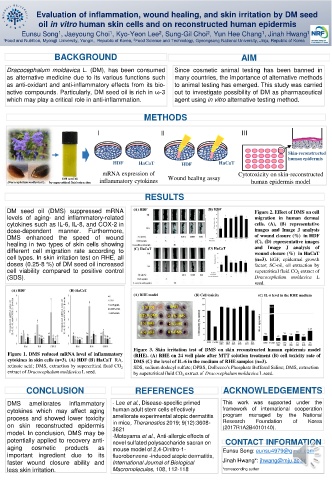
   DM seed oil (DMS) suppressed mRNA        (A) HDF                  (B) HDF        Figure 2. Effect of DMS on cell
   levels of aging- and inflammatory-related                                        migration in human dermal
   cytokines such as IL-6, IL-8, and COX-2 in                                       cells. (A), (B) representative
   dose-dependent   manner.   Furthermore,                                          images and Image J analysis
   DMS enhanced the speed of wound                                                  of wound closure (%) in HDF
   healing in two types of skin cells showing                                       (C), (D) representative images
   different cell migration rate according to  (C) HaCaT             (D) HaCaT      and  Image  J  analysis  of
                                                                                    wound closure (%) in HaCaT
   cell types. In skin irritation test on RHE, all                                  (n=3). EGF, epidermal growth
   doses (0.25-8 %) of DM seed oil increased                                        factor; SC-oil, oil extraction by
   cell viability compared to positive control                                      supercritical fluid CO 2 extract of
   (SDS).                                                                           Dracocephalum moldavica L
                                                                                    seed.
     (A) HDF            (B) HaCaT
                                            (A) RHE model       (B) Cell toxicity    (C) IL-6 level in the RHE medium
                                               5 % SDS  DPBS
                                              0.25 % DMS  0. 5 % DMS
                                               1 % DMS  2 % DMS
                                               4 % DMS  8 % DMS

                                            Figure 3. Skin irritation test of DMS on skin reconstructed human epidermis model
    Figure 1. DMS reduced mRNA level of inflammatory  (RHE). (A) RHE on 24 well plate after MTT solution treatment (B) cell toxicity rate of
    cytokines in skin cells (n=3). (A) HDF (B) HaCaT RA,  DMS (C) the level of IL-6 in the medium of RHE samples (n=3).
    retinoic acid; DMS, extraction by supercritical fluid CO 2  SDS, sodium dodecyl sulfate; DPBS, Dulbecco's Phosphate Buffered Saline; DMS, extraction
    extract of Dracocephalum moldavica L seed.  by supercritical fluid CO 2 extract of Dracocephalum moldavica L seed.

          CONCLUSION                         REFERENCES                   ACKNOWLEDGEMENTS

   DMS     ameliorates  inflammatory  - Lee et al., Disease-specific primed   This work was supported under the
   cytokines which may affect aging   human adult stem cells effectively   framework of international cooperation
   process and showed lower toxicity  ameliorate experimental atopic dermatitis   program  managed  by  the  National
                                                                         Research
                                                                                    Foundation
                                                                                                of
                                                                                                     Korea
   on skin reconstructed epidermis    in mice, Theranostics 2019; 9(12):3608-  (2017R1A2B4010140).
   model. In conclusion, DMS may be   3621
                                      -Motoyama et al., Anti-allergic effects of
   potentially applied to recovery anti-  novel sulfated polysaccharide sacran on   CONTACT INFORMATION
   aging   cosmetic   products   as   mouse model of 2,4-Dinitro-1-      Eunsu Song: eunsu4979@gmail.com
   important ingredient due to its    fluorobenzene -induced atopic dermatitis,
   faster wound closure ability and   International Journal of Biological   Jinah Hwang*: jhwang@mju.ac.kr
   less skin irritation.              Macromolecules, 108, 112-118       *corresponding author

