


Page 43 - ebook
P. 43
Therapeutic Effects of Fermented Lettuce Extract in Mice with Collagen-
                Induced Arthritis and Human Fibroblast-like Synoviocytes

                          Jisu Park , Ji Won Kim , Jaehoon Jung , Ji Hyeon Ryu , Yong-Il Shin 1,2*
                                 1
                                                                      1
                                                         1
                                            1
    1  Research Institute for Convergence of Biomedical Science and Technology, Pusan National University Yangsan Hospital, Yangsan
    2  Department of Korean Medical Science, School of Korean Medicine, Pusan National University, Yangsan
     Abstract
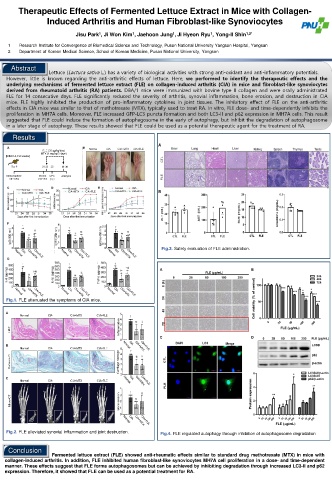
                 Lettuce (Lactuca sativa L.) has a variety of biological activities with strong anti-oxidant and anti-inflammatory potentials.
   However, little is known regarding the anti-arthritic effects of lettuce. Here, we performed to identify the therapeutic effects and the
   underlying mechanisms of fermented lettuce extract (FLE) on collagen-induced arthritis (CIA) in mice and fibroblast-like synoviocytes
   derived from rheumatoid arthritis (RA) patients. DBA/1 mice were immunized with bovine type II collagen and were orally administrated
   FLE for 14 consecutive days. FLE significantly reduced the severity of arthritis, synovial inflammation, bone erosion, and destruction in CIA
   mice. FLE highly inhibited the production of pro-inflammatory cytokines in joint tissues. The inhibitory effect of FLE on the anti-arthritic
   effects in CIA mice was similar to that of methotrexate (MTX), typically used to treat RA. In vitro, FLE dose- and time-dependently inhibits the
   proliferation in MH7A cells. Moreover, FLE increased GFP-LC3 puncta formation and both LC3-II and p62 expression in MH7A cells. This result
   suggested that FLE could induce the formation of autophagosome in the early of autophagy, but inhibit the degradation of autophagosome
   in a later stage of autophagy. These results showed that FLE could be used as a potential therapeutic agent for the treatment of RA.
     Results


                                                      Fig.3. Safety evaluation of FLE administration.


   Fig.1. FLE attenuated the symptoms of CIA mice.


   Fig.2. FLE alleviated synovial inflammation and joint destruction.   Fig.4. FLE regulated autophagy through inhibition of autophagosome degradation

    Conclusion
                  Fermented lettuce extract (FLE) showed anti-rheumatic effects similar to standard drug methotrexate (MTX) in mice with
   collagen-induced arthritis. In addition, FLE inhibited human fibroblast-like synoviocytes MH7A cell proliferation in a dose- and time-dependent
   manner. These effects suggest that FLE forms autophagosomes but can be achieved by inhibiting degradation through increased LC3-II and p62
   expression. Therefore, it showed that FLE can be used as a potential treatment for RA.

