


Page 39 - ebook
P. 39
Poster Number: A-19
         UNIVERSITY OF ULSAN The deubiquitinating enzyme BAP1 regulates

         COLLEGE OF MEDICINE          BIRC5 in gastric tumorigenesis
                                               Jin Kim,  and Peter C. W. Lee
                           Department of Biomedical Sciences, University of Ulsan College of Medicine, Asan Medical Center, Seoul, Korea
  INTRODUCTION
  BAP1 (BRCA1-associated protein1) which belongs to the family of ubiquitin carboxy-terminal hydrolases is related to 26S proteasome to
  removal of ubiquitin chain from target substrates. BIRC5 (also names Survivin) was previously reported to be a member of the inhibitor of
  apoptosis (IAP) gene family. Here, we found that BAP1 and BIRC5 are frequently overexpressed in gastric cancer (GC) patients. BAP1 interacts
  with BIRC5 and trims its ubiquitin chain, stabilizing BIRC5 by interfering apoptosis signaling pathway. Our finding indicated that BAP1 and
  BIRC5 might be a biomarker candidate and therapeutic targets gastric cancer.

   Figure 1. Expression of BAP1 in gastric cancer tissues and Figure 3. BAP1 regulates BIRC5 stability
   differentcancer cell


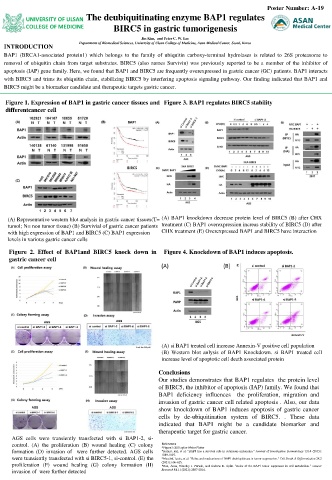
    (A) Representative western blot analysis in gastric cancer tissues(T=  (A) BAP1 knockdown decrease protein level of BIRC5 (B) after CHX
    tumol; N= non tumor tissue) (B) Survivial of gastric cancer patients   treatment (C) BAP1 overexpression increas stability of BIRC5 (D) after
    with high expression of BAP1 and BIRC5 (C) BAP1 expression   CHX treatment (E) Overexpressed BAP1 and BIRC5 have interaction
    levels in various gastric cancer cells
    Figure 2. Effect of BAP1and BIRC5 knock down in   Figure 4. Knockdown of BAP1 induces apoptosis.
    gastric cancer cell


                                                      (A) si BAP1 treated cell increase Annexin-V positive cell population
                                                      (B) Western blot anlysis of BAP1 Knockdown. si BAP1 treated cell
                                                      increase level of apoptotic cell death associated protein

                                                     Conclusions
                                                     Our studies demonstrates that BAP1 regulates the protein level
                                                     of BIRC5, the inhibitor of apoptosis (IAP) family. We found that
                                                     BAP1 deficiency influences  the proliferation, migration and
                                                     invasion of gastric cancer cell related apoptosis . Also, our data
                                                     show knockdown of BAP1 induces apoptosis of gastric cancer
                                                     cells by de-ubiquitination system of BIRC5. . These data
                                                     indicated that BAP1 might be a candidate biomarker and
                                                     therapeutic target for gastric cancer.
     AGS cells were transiently transfected with si BAP1-2, si-
     control. (A) the proliferation (B) wound healing (C) colony  References
                                                      *Figure1.(B) Kaplan-Meier Plotter
     formation (D) invasion of were further detected. AGS cells  *Kumar, Raj, et al. "BAP1 has a survival role in cutaneous melanoma." Journal of Investigative Dermatology 135.4 (2015):
                                                      1089-1097.
     were transiently transfected with si BIRC5-1, si-control. (E) the  *Masclef, Louis, et al. "Roles and mechanisms of BAP1 deubiquitinase in tumor suppression." Cell Death & Differentiation 28.2
     proliferation (F) wound healing (G) colony formation (H)  (2021): 606-625.
                                                      *Han, Anna, Timothy J. Purwin, and Andrew E. Aplin. "Roles of the BAP1 tumor suppressor in cell metabolism." Cancer
     invasion of were further detected                Research 81.11 (2021): 2807-2814.

