


Page 123 - ebook
P. 123
Aberrant role of pyruvate kinase M2 in the regulation of
gamma-secretase and memory deficits in Alzheimer’s disease
1
1*
1
1
1
1
1
3
Jonghee Han 1,2* , Junho Hyun , Jaesang Park , Sunmin Jung , Yoonseo Oh , Youbin Kim , Shin-Hyeon Ryu , Seo-Hyun Kim Eun-Il Jung , Dong-
4
5
Gyu Jo , Sung-Hye Park , and Yong-Keun Jung 1§
2
1 Creative Research Initiative (CRI)-Acceleration Research Laboratory, School of Biological Science, Seoul National University, Dept. of Neuroscience, Interdisciplinary Program in NeuroscienceUniversity of
TexasSouthwestern Medical Center, Interdisciplinary Program in Neuroscience, Seoul National University School of Pharmacy, Sungkyunkwan University, Department of pathology, Seoul National University Medicine
5
4
3
Abstract
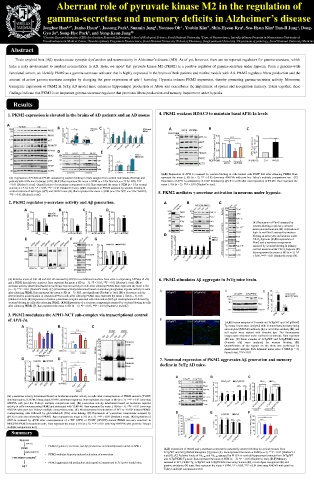
Toxic amyloid beta (Aβ) species cause synaptic dysfunction and neurotoxicity in Alzheimer’s disease (AD). As of yet, however, there are no reported regulators for gamma-secretase, which
links a risky environment to amyloid accumulation in AD. Here, we report that pyruvate kinase M2 (PKM2) is a positive regulator of gamma-secretase under hypoxia. From a genome-wide
functional screen, we identify PKM2 as a gamma-secretase activator that is highly expressed in the brains of both patients and murine models with AD. PKM2 regulates Abeta production and the
amount of active gamma-secretase complex by changing the gene expression of aph-1 homolog. Hypoxia induces PKM2 expression, thereby promoting gamma-secretase activity. Moreover,
transgenic expression of PKM2 in 3xTg AD model mice enhances hippocampal production of Abeta and exacerbates the impairment of spatial and recognition memory. Taken together, these
findings indicate that PKM2 is an important gamma-secretase regulator that promotes Abeta production and memory impairment under hypoxia.
Results
1. PKM2 expression is elevated in the brains of AD patients and an AD mouse 4. PKM2 weakens HDAC3 to maintain basal APH-1a levels
B C A B C
D E
(A,B) Expression of APH-1a assessed by western blotting in cells treated with RGFP-966 after silencing PKM2. Bars
(A) Expression of PKM2 and PKM1 assessed by western blotting in brain samples from control individuals (Normal) and represent the mean ± SD (n = 3). *P < 0.05 (two-way ANOVA with post hoc Tukey's multiple comparisons test . (C)
patients with Alzheimer’s disease (AD). (B,C) Bars represent the mean ± SEM (n = 9 for Normal; n = 13 for AD). **P Expression of APH-1a assessed by X-ChIP followed by qPCR in cells after overexpression of PKM2. Bars represent the
< 0.01 (Student’s t test). Quantification of γ-secretase components in (A). Bars represent the mean ± SEM (n = 5 for normal mean ± SD (n = 3). **P < 0.01 (Student’s t test).
control; n = 5 for AD). *P < 0.05, **P < 0.01 (Student’s t test). (D,E) Expression of PKM2 assessed by western blotting in
cortical extracts of wild-type (WT) and 5xFAD mice (H). Bars represent the mean ± SEM (n = 3 for WT; n = 3 for 5xFAD). 5. PKM2 mediates γ-secretase activation in neurons under hypoxia.
**P < 0.01 (Student’s t test).
2. PKM2 regulates γ-secretase activity and Aβ generation.
(A) Expression of Pkm2 assessed by
western blotting in primary cultured
astrocytes and neurons. (B) Expression of
Aph-1a and Pkm2 assessed by western
blotting in astrocytes and neurons under
1% O hypoxia. (C,D) Expression of
2
Pkm2 and γ-secretase components
assessed by western blotting in primary
cortical neurons under 1% O hypoxia (C).
2
Bars represent the mean ± SD (n = 3). *P
< 0.05, **P < 0.01 (Student’s t test) (D).
(A) Relative levels of Ab1-40 and Ab1-42 assessed by ELISA in conditioned medium from cells co-expressing APPswe-FLAG 6. PKM2 stimulates Aβ aggregate in 3xTg mice brain.
and a PKM2 knockdown construct. Bars represent the mean ± SD (n = 3). *P < 0.05, **P < 0.01 (Student’s t test). (B) γ-
secretase activity determined based on luciferase reporter activity in cells after silencing PKM2. Bars represent the mean ± SD
(n = 3). **P < 0.01 (Student’s t test). (C) β-Secretase activity determined based on alkaline phosphatase reporter activity in cells A C
after silencing PKM2. Bars represent the mean ± SD (n = 3). N.S., not significant (Student’s t test). (D) α-Secretase activity D
determined by quantification of cleaved sAPPα in cells after silencing PKM2. Bars represent the mean ± SD (n = 3). N.S.
(Student’s t test). (E) Expression of native γ-secretase complex assessed with blue-native (BN) gel electrophoresis followed by
western blotting in cells after silencing PKM2. (F,G) Expression of γ-secretase components assessed by western blotting in cells
after silencing PKM2 (F). Bars represent the mean ± SD (n = 3). *P < 0.05, **P < 0.01 (Student’s t test) (G)
3. PKM2 modulates the APH1-NCT sub-complex via transcriptional control
of APH-1a. B
(A,B) Frozen samples of 9-month-old 3xTg/WT and 3xTg/PKM2
Tg mouse brains were analyzed with immunohistochemistry using
anti-amyloid (MOAB) antibody (A) or anti-Gfap antibody (B), and
cell nuclei were stained with Hoechst dye. The fluorescence
images were observed under confocal microscope. Bars represent
100 mm. (C) Brain samples of 3xTg/WT and 3xTg/PKM2 mice
(9-month old) were analyzed by western blotting. (D)
Quantification of the signals on the blots was performed by
densitometric analysis. Bars represent mean value ± SEM (n = 3).
Paired t-test; **P < 0.01.
7. Neuronal expression of PKM2 aggravates Aβ generation and memory
decline in 3xTg AD mice.
(A) γ-secretase activity determined based on luciferase reporter activity in cells after overexpression of PKM2 mutants (Y105F,
dominant active; K367M, kinase dead; R399E, dominant negative). Bars represent the mean ± SD (n = 3). **P < 0.01 (one-way
ANOVA with post hoc Tukey's multiple comparisons test). (B) γ-secretase activity determined based on luciferase reporter
activity in cells overexpressing PKM2 and pretreated with TEPP-46. Bars represent the mean ± SD (n = 3). **P < 0.01 (two-way
ANOVA with post hoc Tukey's multiple comparisons test). (C) Nucleus/cytosol fractionation of WT or Y105F mutant PKM2-
overexpressing cells followed by glutaraldehyde (GA) cross-linking. (D) Expression of γ-secretase components assessed by
qPCR in cells after silencing of PKM2. Bars represent the mean ± SD (n = 3). **P < 0.01 (Student’s t test). (E) Expression of
APH-1a assessed by qPCR after overexpression of a WT (rWT) or Y105F (rY105F) mutant PKM2 recovery construct in
HEK293T/PKM2 knockdown cells. Bars represent the mean ± SD (n = 3). **P < 0.01 (one-way ANOVA with post hoc Tukey's
multiple comparisons test).
Summary
• PKM2 regulates γ-secretase and Aβ production via transcriptional control of APH-1
(A,B) Expression of PKM2 and γ-secretase components assessed by western blotting in cortical extracts from
3xTg/WT and 3xTg/PKM2 transgenic (Tg) mice (A). Bars represent the mean ± SEM (n = 3). **P < 0.01 (Student’s t
• PKM2 mediates hypoxia-induced activation of γ-secretase test) (B). (C) Relative levels of Ab and Ab assessed by ELISA in cortical/hippocampal extracts from 3xTg/WT
1-40
1-42
and 3xTg/PKM2 Tg mice. Bars represent the mean ± SEM (n = 3). *P < 0.05 (Student’s t test). (D-F) Memory
• PKM2 aggravates Aβ production and cognitive impairment in 3xTg AD model mice assessed in WT, PKM2 Tg, 3xTg/WT and 3xTg/PKM2 mice using Y-maze (D), novel object recognition (E) and
passive avoidance (F) tests. Bars represent the mean ± SEM. *P < 0.05, **P < 0.01 (two-way ANOVA with post hoc
Tukey's multiple comparisons test).

