


Page 125 - ebook
P. 125
Secreted matrix metalloproteinase 1 as a marker for assessment of
                         bone marrow cell migration enhanced by tonsil-derived
                                            mesenchymal stem cells

                                           Hee-Yeon Kim, Hee-Soo yoon, and Joo-Won Park*
                             Department of Biochemistry, College of Medicine, Ewha Womans University, Seoul 07084, Republic of Korea
                       INTRODUCTION                                       RESULTS
         Bone marrow transplantation is a procedure to substitute diseased  (A)  (B)
         bone marrow with healthy bone marrow stem cells. Bone marrow
         transplantation is performed to treat several types of cancers
         including hematologic malignancies, and other immune-related
         diseases in which abnormal bone marrow is the pathologic
         mechanism. To achieve optimal bone marrow engraftment, migration  (C)  (D)
         of donor bone marrow cells towards the recipient’s bone marrow is
         critical. Although the enhanced engraftment of bone marrow cells by
         co-administration of tonsil-derived mesenchymal stem cells (TMSCs)
         has been previously reported, the efficiency can be various
         depending on TMSC donors. Conditioned medium from TMSCs
         enhanced bone marrow cell migration in different degrees depending
         on donors. Analyzing transcriptome and proteome profiles of TMSCs
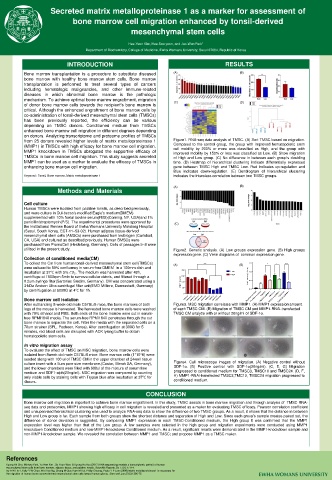
         from 25 donors revealed higher levels of matrix metalloproteinase 1  Figure1. RNA-seq data analysis of TMSC. (A) Sort TMSC based on migration.
         (MMP1) in TMSCs with high efficacy for bone marrow cell migration.  Compared to the control group, the group with improved hematopoietic stem
                                                         cell mobility by 200% or more was classified as High, and the group with
         MMP1 knockdown in TMSCs abrogated the supportive efficacy of  improved mobility by 150% or less was classified as Low. (B) Show migration
         TMSCs in bone marrow cell migration. This study suggests secreted  of High and Low group. (C) No difference in between each group’s doubling
         MMP1 can be used as a marker to evaluate the efficacy of TMSCs in  time. (D) Heatmap of hierarchical clustering indicate differentially expressed
         enhancing bone marrow cell migration.           gene between TMSC High and TMSC Low. Red indicates up-regulation and
                                                         Blue indicates down-regulation. (E) Dendrogram of hierarchical clustering
         Keyword : Tonsil, Bone marrow, Matrix metalloproteinase 1  indicates the interclass correlation between two TMSC groups.
                                                          (A)                  (B)
                    Methods and Materials
         Cell culture
         Human TMSCs were isolated from palatine tonsils, as described previously,
         and were culture in Dul-becco’s modified Eagle’s medium(DMEM)
         supplemented with 10% foetal bovine serum(FBS)(Corning, NY, USA)and 1%
         penicillin/streptomycin(P/S). The experimental procedures were approved by   (C)
         the Institutional Review Board of Ewha Womans University Mokdong Hospital
         (Seoul, South Korea, ECT-11–53-02). Human adipose tissue-derived
         mesenchymal stem cells (AMSCs) were purchased from Invitrogen (Carlsbad,
         CA, USA) and cultured as described previously. Human BMSCs were
         purchased from PromoCell (Heidelberg, Germany). Cells of passages 5–8 were
         utilized in the present study.                  Figure2. Genetic analysis. (A) Low groups expression gene. (B) High groups
                                                         expression gene. (C) Venn diagrams of common expression gene.
         Collection of conditioned media(CM)
         To collect the Cm from human tonsil-derived mesenchymal stem cell(TMSCs)   (A)  * * *  (B)  1 .5  *  *  * * *
         were cultured to 80% confluency in serum-free DMEM  in a 100mm dish and
         incubation at 37℃ with 5%      2 . The medium was harvested after 48h,   2 0 0  L o w  1 .0
         centrifuge at 1000rpm 5min to remove cellular debris, and filtered through a   1 5 0  H ig h  C e ll c o u n t(*1 0 ^ 4 )
         0.2um syringe filter(Sartorius Stedim, Germany). CM was concentrated using a   M M P 1 (n g /m l)  1 0 0  0 .5
         3-kDa Amicon Ultra centrifugal filter unit(EMD Milliore, Darmastadt, Germany)   5 0
         by centrifugation at 5000G at 4℃ for 1h.                                 0 .0
                                                             0                   N g a tiv e  c o n tro l  T M S C 3  T M S C 1 0  T M S C 2 4
         Bone marrow cell isolation                          T M S C 3 T M S C 1 0 T M S C 1 1 T M S C 2 1 T M S C 2 4 T M S C 2 5 T M S C 4 T M S C 9 T M S C 1 8 T M S C 2 2  P o s itiv e  c o n tro l T M S C 3 -s iM M P 1 T M S C 1 0 -s iM M P 1 T M S C 2 4 -s iM M P 1
         After euthanizing 8-week-old male C57BL/6 mice, the bone marrows of both   Figure3. MSC migration correlates with MMP1. (A) MMP1 expression amount
         legs of the mouse is harvested. The harvested bone marrow cells were washed   of each TMSC CM. (B) Migration of TMSC CM and MMP1-RNAi-transfected
         with 70% ethanol and PBS. Both ends of the bone marrow were cut in serum-  TMSC CM analyze with or without 20ng/ml of SDF-1α.
         free RPMI1640 media. The serum-free RPMI1640 penetrates through the cut   A  C  E  G
         bone marrow to separate the cell. Filter the media with the separated cells on a
         70um strainer (SPL, Pocheon, Korea). After centrifugation at 300G for 5
         minutes, red blood cells are disrupted with ACK lysing buffer to obtain
         hematopoietic stem cells.
                                                             B        D        F        H
         In vitro migration assay
         To evaluate the effect of TMSC on MSC migration, bone marrow cells were
         isolated from 8week old male C57BL/6 mice. Bone marrow cells (1*10^6) were
         seeded along with 100 ul of TMSC CM in the upper chamber of 24well tissue
         culture insert with a 5um pore size membrane.(Costar, Merak SA, Germany),   Figure4. Cell microscope images of migration. (A) Negative control without
         and the lower chambers were filled with 600ul of the mixture of serum free   SDF-1α. (B) Positive control with SDF-1α(20ng/ml). (C, E, G) Migration
         medium and SDF1-alph(20ng/ml). MSC migration was compared by counting   progressed to conditioned medium for TMSC3, TMSC10 and TMSC24. (D, F,
         only viable cells by staining cells with Trypan blue after incubation at 37℃ for   H) MMP1-RNAi-transfected TMSC3,TMC10, TMSC24 migration progressed to
         4hours.                                          conditioned medium.
                                                 CONCLUSION
         Bone marrow cell migration is important to achieve bone marrow engraftment. In this study, TMSC assists in bone marrow migration and through analysis of TMSC RNA-
         seq data and proteomics, MMP1 showing high efficacy in cell migration is revealed and presented as a maker for evaluating TMSC efficacy. Pearson correlation coefficient
         and unsupervised hierarchical clustering was used to analyze RNA-seq data to show the difference of two TMSC groups. As a result, it shows that the distance in between
         High and Low group is far. Each sample from both groups show the shortest distance and separation of High and Low. Since each group’s sample creates paired set, the
         difference of donor deviation is suggested. By comparing MMP1 expression in each TMSC-Conditioned medium, the High group It was confirmed that the MMP1
         expression level was higher than that of the Low group. A few samples were selected in the high group and migration experiments were conducted using MMP1
         knockdown Conditioned medium and non-MMP1-knockdown Conditioned medium. As a result, significant results were demonstrated in the MMP1-knockdown sample and
         non-MMP1-knockdown sample. We revealed the correlation between MMP1 and TMSC; and propose MMP1 as a TMSC maker.

   References
   Kyung-Ah Cho, Minhwa Park, Yu-Hee Kim , So-Youn Woo  & Kyung-Ha Ryu (2017) RNA sequencing revelals a transcriptomic portrait of human
   mesenchymal stem cells from bone marrow,  adipose tissue, and palatine tonsils, Scientific Reports, Dc 7;7(1):17114.
   Ivy A W Ho 1, Kelly Y W Chan, Wai-Hoe Ng, Chang M Guo, Kam M Hui, Philip Cheang, Paula Y P Lam (2009) Matrix metalloproteinase1 is necessary for
   the migration of human bone marrow-derived mesenchymal stem cells toward human glioma,  Stem cell, Jun;27(6):1366-75.

