


Page 119 - ebook
P. 119
Metal-Mediated Protein Assembly Using a Genetically
Incorporated Metal-Chelating Amino Acid
Sooin Kim, Sanggil Kim, Hyunjung Yoo, Hyun Soo Lee*
Department of Chemistry, Sogang University, 35 Baekbeomro Mapogu, Seoul 121-742, Republic of Korea
ABSTRACT
The construction of protein assemblies has great potential for biosensors, enzyme catalysis, and
biomedical applications.
Although a few methods are available for this purpose, most of them are dependent on existing
protein−protein interaction PPIs of natural proteins to some extent.
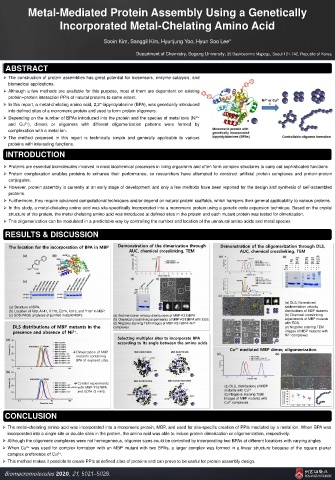
In this report, a metal-chelating amino acid, 2,2''-bipyridylalanine (BPA), was genetically introduced
into defined sites of a monomeric protein and used to form protein oligomers.
Depending on the number of BPAs introduced into the protein and the species of metal ions (Ni 2+
2+
and Cu ), dimers or oligomers with different oligomerization patterns were formed by
complexation with a metal ion.
The method proposed in this report is technically simple and generally applicable to various
proteins with interesting functions.
INTRODUCTION
Proteins are essential biomolecules involved in most biochemical processes in living organisms and often form complex structures to carry out sophisticated functions.
Protein complexation enables proteins to enhance their performance, so researchers have attempted to construct artificial protein complexes and protein-protein
conjugates.
However, protein assembly is currently at an early stage of development and only a few methods have been reported for the design and synthesis of self-assembled
proteins.
Furthermore, they require advanced computational techniques and/or depend on natural protein scaffolds, which hampers their general applicability to various proteins.
In this study, a metal-chelating amino acid was site-specifically incorporated into a monomeric protein using a genetic code expansion technique. Based on the crystal
structure of the protein, the metal-chelating amino acid was introduced at defined sites in the protein and each mutant protein was tested for dimerization.
This oligomerization can be modulated in a predictable way by controlling the number and location of the unnatural amino acids and metal species
RESULTS & DISCUSSION
The location for the incorporation of BPA in MBP Demonstration of the dimerization through Demonstration of the oligomerization through DLS,
AUC, chemical crosslinking, TEM AUC, chemical crosslinking, TEM
(a) DLS, Normalized
(a) Structure of BPA. sedimentation velocity
(b) Location of K83, A141, K179, E274, K313, and Y167 in MBP. distributions of MBP mutants
(c) SDS-PAGE analyses of purified mutant MBPs. (a) Sedimentation velocity distributions of MBP-K313BPA (b) Chemical crosslinking
(b) Chemical crosslinking experiments of MBP-K313BPA with EGS. experiments of MBP mutants
(c) Negative staining TEM images of MBP-K313BPA–Ni 2+ with EGS.
DLS distributions of MBP mutants in the complexes (c) Negative staining TEM
presence and absence of Ni . images of MBP mutants with
2+
2+
Selecting multiples sites to incorporate BPA Ni complexes
according to its angle between the amino acids
Cu 2+ mediated MBP dimer, oligomerization
Dimerization of MBP
mutants containing
BPA at exposed sites.
Control experiments
with MBP-Y167BPA (a) DLS, distributions of MBP
and EDTA (5 mM). mutants with Cu 2+
(b) Negative staining TEM
images of MBP mutants with
Cu 2+ complexes
CONCLUSION
The metal-chelating amino acid was incorporated into a monomeric protein, MBP, and used for site-specific creation of PPIs mediated by a metal ion. When BPA was
incorporated into a single site or double sites in the protein, the amino acid was able to induce protein dimerization or oligomerization, respectively.
Although the oligomeric complexes were not homogeneous, oligomer sizes could be controlled by incorporating two BPAs at different locations with varying angles
When Cu 2+ was used for complex formation with an MBP mutant with two BPAs, a larger complex was formed in a linear structure because of the square planar
complex preference of Cu .
2+
This method makes it possible to create PPIs at defined sites of proteins and can prove to be useful for protein assembly design.
Biomacromolecules 2020, 21, 5021–5028.

