


Page 117 - ebook
P. 117
Human microbiome derived SCFAs coordinates a proteasomal
degradation for targeting EHMT2 in colorectal cancer
1
1,2
1, 2
1 2
1
1,2
1,2
Tae Young Ryu , Kwangho Kim , Tae-Su Han , Jinkwon Lee , Mooseung Lee , Dae-Soo Kim , Mi-Young Son , Hyun-Soo Cho 1, 2
2
Korea Research Institute of Bioscience and Biotechnology (KRIBB), KRIBB School of Bioscience, Korea University of Science and Technology (UST)
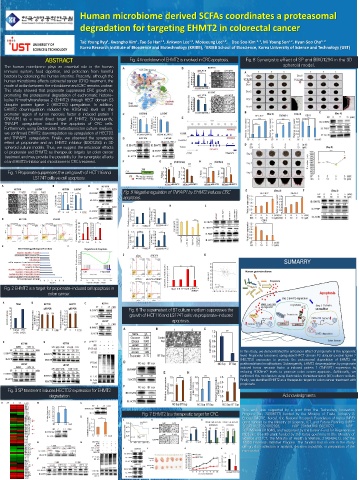
ABSTRACT Fig. 4 Knockdown of EHMT2 is involved in CRC apoptosis. Fig. 8 Synergistic effect of SP and BIX01294 in the 3D
spheroid model.
The human microbiome plays an essential role in the human
immune system, food digestion, and protection from harmful
bacteria by colonizing the human intestine. Recently, although the
human microbiome affects colorectal cancer (CRC) treatment, the
mode of action between the microbiome and CRC remains unclear.
This study showed that propionate suppressed CRC growth by
promoting the proteasomal degradation of euchromatic histone-
lysine N-methyltransferase 2 (EHMT2) through HECT domain E3
ubiquitin protein ligase 2 (HECTD2) upregulation. In addition,
EHMT2 downregulation reduced the H3K9me2 level on the
promoter region of tumor necrosis factor α-induced protein 1
(TNFAIP1) as a novel direct target of EHMT2. Subsequently,
TNFAIP1 upregulation induced the apoptosis of CRC cells.
Furthermore, using Bacteroides thetaiotaomicron culture medium,
we confirmed EHMT2 downregulation via upregulation of HECTD2
and TNFAIP1 upregulation. Finally, we observed the synergistic
effect of propionate and an EHMT2 inhibitor (BIX01294) in 3D
spheroid culture models. Thus, we suggest the anticancer effects
of propionate and EHMT2 as therapeutic targets for colon cancer
treatment and may provide the possibility for the synergistic effects
of an EHMT2 inhibitor and microbiome in CRC treatment.
Fig. 1 Propionate suppresses the cell growth of HCT116 and
LS174T cells via cell apoptosis.
Fig. 5 Negative regulation of TNFAIP1 by EHMT2 induces CRC
apoptosis.
SUMARRY
Fig. 2 EHMT2 is a target for propionate-induced cell apoptosis in
colon cancer.
Fig. 6 The supernatant of BT culture medium suppresses the
growth of HCT116 and LS174T cells via propionate-induced
apoptosis.
In this study, we demonstrated the anticancer effect of propionate at the epigenetic
level. Propionate treatment upregulated HECT domain E3 ubiquitin protein ligase 2
(HECTD2) expression to promote the proteasomal degradation of EHMT2 via
posttranslational modifications. Subsequently, EHMT2 downregulation by propionate
induced tumor necrosis factor α-induced protein 1 (TNFAIP1) expression by
reducing H3K9me2 levels to promote colon cancer apoptosis. Additionally, we
confirmed this mechanism using Bacteroides thetaiotaomicron (BT) culture medium.
Finally, we identified EHMT2 as a therapeutic target for colon cancer treatment with
propionate.
Fig. 3 SP treatment induces HECTD2 expression for EHMT2
degradation Acknowledgments
This work was supported by a grant from the Technology Innovation
Fig. 7 EHMT2 is a therapeutic target for CRC. Program (No. 20008777) funded by the Ministry of Trade, Industry &
Energy (MOTIE, Korea), the National Research Foundation of Korea (NRF)
grant funded by the Ministry of Science, ICT, and Future Planning (NRF-
2020R1A2B5B01002028, NRF-2018M3A9H3023077/ NRF-
2021M3A9H3016046), and supported by the Korean Fund for Regenerative
Medicine (KFRM) grant funded by the Korea government (the Ministry of
Science and ICT, the Ministry of Health & Welfare, 21A0404L1), and the
KRIBB Research Initiative Program. The funders had no role in the study
design, data collection or analysis, decision to publish, or preparation of the
manuscript.

