


Page 105 - ebook
P. 105
Perilla heading date gene, PfHd3a, regulate flowering time in short day condition
Jee Hye Kim and Jae Bok Heo *
Department of Molecular Genetic Engineering, Dong-A University, Busan 604-714, Korea
Abstract
Perilla (Perilla frutescens) is an annual plant and grown in Asia. As one of important oil crops, its seeds are used to make a product and
leaves are used as a vegetable, nevertheless, much is unknown about research of perilla. we already found a gene in RNA-seq results which
may play a role in flowering time, and it was identified to be an ortholog of OsHd3a in rice. Hd3a promote heading under short-day
conditions. Here, we focused on function of pfHd3a. Since tissue culture system using agrobacterium was developed, we made a pfHd3a-
overexpressing plant in perilla using agrobacterium-mediated transformation. Also, we constructed knock-out mutant using CRISPR/Cas9
genome editing system. A reproducible shoot was induced from hypocotyl explants on MS basal medium supplemented with 3.0 mg/l 6-
Benzylaminopurine (BA), 0.01mg/l indole-3-acetic acid (IAA), 250mg/l cefotaxime, 500mg/l carbenicillin and 1.2 mg/l PPT and candidates
were selected. Rooting was induced on half-strength hormone-free MS medium. The transformants were confirmed by PCR of PPT resistance
region. Next generation seeds were used for flowering phenotype check compared wild type under daylength condition.
Results
(A) (B) (C) (G)
(D) (E) (F)
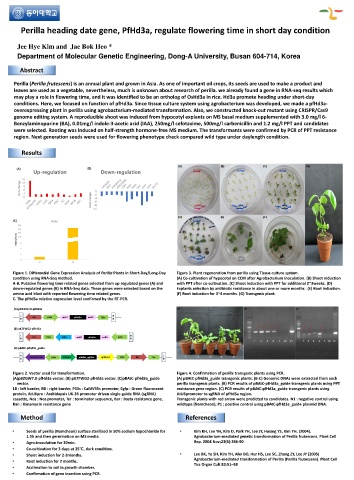
Figure 1. Differential Gene Expression Analysis of Perilla Plants in Short-Day/Long-Day Figure 3. Plant regeneration from perilla using Tissue culture system.
condition using RNA-Seq method. (A) Co-cultivation of hypocotyl on CCM after Agrobacterium inoculation. (B) Shoot induction
A-B. Putative flowering time related genes selected from up-regulated genes (A) and with PPT after co-cultivation. (C) Shoot induction with PPT for additional 2~3weeks. (D)
down-regulated genes (B) in RNA-Seq data. These genes were selected based on the Explants selection by antibiotic resistance in about one or more months . (E) Root induction.
amino acid blast with reported flowering time related genes. (F) Root induction for 3~4 months. (G) Transgenic plant.
C. The pfHd3a relative expression level confirmed by the RT-PCR.
(A) pB2GW7,0-pfHd3a (A) (B) (C)
L Bar p35s R
B attR1 pfHd3a attR2 T35s B
(B) pK7FWG2-pfHd3a
500bp
L R
B Kan T35s Egfp attR2 pfHd3a attR1 p35s B
1 2 3 4 5 N1 P1
1 2 3 4 5 N1 P1 1 2 3 4 5 N1 P1
(C) pBAtC-pfHd3a_guide
R Cas9:NLS:HA AtU6pro pfHd3a_sgRNA sgRNA-B NOS Bar Ter L 1 2 3 4 5
B p35s B
Figure 2. Vector used for transformation. Figure 4. Confirmation of perilla transgenic plants using PCR.
(A)pB2GW7.0-pfHd3a vector. (B) pK7FWG2-pfHd3a vector. (C)pBAtC-pfHd3a_guide (A) pBAtC-pfHd3a_guide transgenic plants. (B-C) Genomic DNAs were extracted from each
vector. perilla transgenic plants. (B) PCR results of pBAtC-pfHd3a_guide transgenic plants using PPT
LB : left border, RB : right border, P35s : CaMV35s promoter, Egfp : Green fluorescent resistance gene region. (C) PCR results of pBAtC-pfHd3a_guide transgenic plants using
protein, AtU6pro : Arabidopsis U6-26 promoter driven single-guide RNA (sgRNA) AtU6promoter to sgRNA of pfHd3a region.
cassette, Nos : Nos promoter, Ter : terminator sequence, Bar : Basta resistance gene, Transgenic plants with red arrow were predicted to candidates. N1 : negative control using
Kan : Kanamycin resistance gene wildtype (Namcheon), P1 : positive control using pBAtC-pfHd3a_guide plasmid DNA.
Method References
• Seeds of perilla (Namcheon) surface sterilized in 50% sodium hypochloride for • Kim KH, Lee YH, Kim D, Park YH, Lee JY, Hwang YS, Kim YH. (2004).
1.5h and then germination on MS media. Agrobacterium-mediated genetic transformation of Perilla frutescens. Plant Cell
• Agro-inoculation for 30min. Rep. 2004 Nov;23(6):386-90
• Co-cultivation for 3 days at 25℃, dark condition.
• Shoot induction for 2-3months. • Lee BK, Yu SH, Kim YH, Ahn BO, Hur HS, Lee SC, Zhang ZY, Lee JY (2005)
• Root induction for 2 months. Agrobacterium-mediated transformation of Perilla (Perilla frutescens). Plant Cell
Tiss Organ Cult 83:51–58
• Acclimation to soil in growth chamber.
• Confirmation of gene insertion using PCR.

