


Page 107 - ebook
P. 107
Traumatic brain injury induces cognitive dysfunction through
decrease of brain O-GlcNAcylation in adult zebrafish
Ngan An Bui¹#, Duong Tran Thi Thuy¹#, Dong Yeol Kim¹, Jiwon Park¹, Sang-Min Kim¹, Hyun Jae Sung¹, Quynh Nguyen Thi Nhu¹, Inn Oc Han¹*
Program in Biomedical Science and Engineering, Inha University, 100 Inha Ro, Michuholgu, Incheon 22212, South Korea
Abstract A B
Traumatic brain injury (TBI) is known as functional corruption of the brain, which is caused by a bump or blast to
the head when an object hits suddenly or pierces the skull and penetrates brain tissues. The knowledge of
pathophysiology following TBI is essentially in need as TBI is still leading in morbidity and mortality causes
worldwide. In this study, we used a novel model of adult zebrafish to search for the underlying molecular and
physiological changes following TBI. Using T-maze, at the 3rd day post stab lesion injury (dpi), learning and
memory deficit and poor social response was observed. Results from mirror biting and novel tank test also
provided us insight into their defective mobility, exploration rate, and territorial instincts. Severe brain
inflammation was also observed at 3 dpi. In our previous studies, a decrease of O-GlcNAcylation flux inducing
cognitive impairment was proved, but little is known about whether it applied to TBI model. Upon injury, a notable
decrease of O-GlcNAc level was remarked at 3dpi. To further investigate this correlation, after TBI exposure,
zebrafish were recovered 3 days in glucosamine (GlcN) diluted in water, which increase O-GlcNAc level. Under C
the treatment of GlcN, the inflammation level reduced significantly. TBI-induced O-GlcNAc deficiency, as well as
L/M capability, were rescued by GlcN. As the result, regulation of brain O-GlcNAcylation may hold a potential
1 .5 4 ** 1 . 5 ** *
role over TBI’s recuperation. C o n
**
3 3 d
) ) )
l d 1 .0 l d l d 1 . 0 7 d
o o
F F o
( 2 ( 2 F ( 1 4 d
Materials and Methods - L R 0 .5 A G T G 0 . 5 3 0 d
O
1 O
∆ Zebrafish ∆ Stab Lesion Injury ∆ Behavior test 0 .0 C o n 3 d 7 d 1 4 d 3 0 d 0 C o n 3 d 7 d 1 4 d 3 0 d 0 . 0 C o n 3 d 7 d 1 4 d 3 0 d
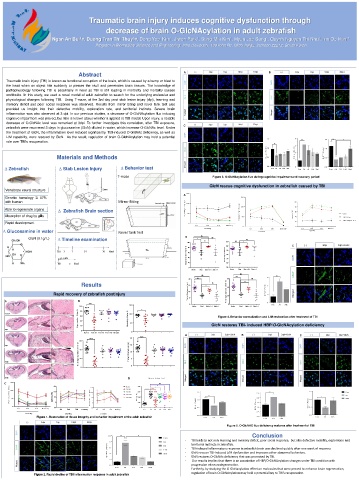
T-maze Figure 3. O-GlcNAcylation flux during cognitive impairment and recovery period
GlcN rescue cognitive dysfunction in zebrafish caused by TBI
x
Vertebrate neural structure 2mm
1 5 0
Genetic homology ≧ 87% 1 5 0
with human Mirror Biting ) s 1 0 0
( 1 0 0 )
e ( s
t im e 1 0 0 C o n 8 0
Able to regenerate organs ∆ Zebrafish Brain section g in t im ) C o n
n n 5 0 g tin T B I 3 d p i ( % y 6 0 T B I 3 d p i C o n
Absorption of drug by gills u R c a 5 0 T B I 3 d p i + 0 . 1 c n te 4 0 T B I 3 d p i + 0 . 1
t e r a L T B I 3 d p i
I n T B I 3 d p i + 0 . 1
Rapid development 0 2 0
1 s t 2 n d 3 r d M e m o r y
0 0
L e a r n i n g
2 n d
∆ Glucosamine in water Novel Tank Test N ovel tank test N ovel tank test 1 s t L e a r n i n g 3 r d M e m o r y 1 s t L e a r n i n g 3 r d M e m o r y
2 n d
GlcN (0.1g/ L) ∆ Timeline examination B * ns ns ns
100 ** 110 ns *
100 C
% 80
te a te % 90
TBI 3 7 14 30 (day) a R 60
n 80
tio ility R
+/- GlcN r a 40 b 70
lo o
p 20 M
TBI 3 (day) x E 60
N o vel tan k test
0 50
N aiv e N o vel tan k test 3dpi + 1 N aiv e 3dpi 3dpi + 0.1 3dpi + 1
3dpi
3dpi + 0.1
ns
ns
*** 6 **
20 *** /s ) 60 ns C o n
Results ) c e (m 15 ** ns m (m 40 ** ) l d o 4 3 d
3 d G
is ta n 10 e e d ( F P
Rapid recovery of zebrafish postinjury e s p A F 2
ta l D G
o 5 v e ra g 20
A B N o v e l ta n k te s t N o v e l ta n k te s t T A
**** 0 0 0 C o n 3 d 3 d G
1 0 0 1 5 0 N aiv e 3dpi 3dpi + 0.1 3dpi + 1 N aiv e 3d p i 3d p i + 0.1 3d p i + 1
% 8 0 *
te %
Control a te 1 0 0
R 6 0 a Figure 4. Behavior normalization and L/M restoration after treatment of TBI
n R
tio ility
ra 4 0
lo b 5 0
p o GlcN restores TBI- induced HBP/O-GlcNAcylation deficiency
x 2 0 M
E
3dpi
0
N
N a iv e T B I 3 d o v e l ta n k te s t 0 N o v e l ta n k te s t
T B I 7 d
T B I 1 4 d T B I 3 0 d
T B I 3 d
2 0 N a iv e **** T B I 7 d T B I 1 4 d T B I 3 0 d B C
****
6 0
/s ) )
7dpi m (m e 1 5
(m 4 0 c n
d ta
e is 1 0
e
p l D
e s ta
g 2 0 o 5
14dpi ra T
e
v
A 0
0
N a iv e T B I 3 d T B I 7 d T B I 1 4 d T B I 3 0 d N a iv e T B I 3 d T B I 7 d T B I 1 4 d T B I 3 0 d
D M i r r o r b i t i n g t e s t
30dpi
C 1 5 0 N a iv e ns
T B I 3 d
) *
c N a iv e 4 0 0 *
e T B I 7 d 1 5 0 ***
( s ) T B I 3 d ****
e 1 0 0 T B I 1 4 d c e T B I 7 d 3 0 0 1 . 5 * 1 . 5 C o n
t i m T B I 3 0 d ( s e 1 0 0 T B I 1 4 d ) ( s 2 . 5
g t i m g ** * 3 d
i n n 5 0 T B i 3 0 d 2 0 0 2 . 0
n 5 0 i t t i n ) ) 1 . 0 3 d G
n t i o B l d 1 . 0 ) l d
u c o l d o
R r a 0 1 0 0 o 1 . 5 ( F
t e ( F ( F T
I n - 2
0 L A G 0 . 5
- 5 0 0 0 . 5 G 1 . 0 O
1 s t 2 n d 3 r d M e m o r y R
1 s t 2 n d 3 r d M e m o r y ( - ) ( - ) 3 d 7 d 1 4 d 3 0 d O
0 . 5
L e a r n in g L e a r n in g
Figure 1. Restoration of tissue integrity and behavior impairment of the adult zebrafish 0 . 0 C o n 3 d 3 d G 0 . 0 0 . 0 C o n 3 d 3 d G
C o n 3 d 3 d G
Figure 5. O-GlcNAC flux deficiency restores after treatment of TBI
1 0 ** * Conclusion
C o n
- TBI leads to not only learning and memory deficit, poor social response, but also defective mobility, exploration and
8 3 d
) territorial instincts in zebrafish.
l d 7 d
o 6
F - TBI-induced inflammatory response in zebrafish brain was declined quickly after one week of recovery.
( 1 4 d
P - GlcN rescues TBI-induced L/M dysfunction and improves other abnormal behaviors.
A 4 3 0 d
F
G - GlcN restores O-GlcNAc deficiency that was promoted by TBI.
2
- Our results implies that there is an association of HBP/O-GlcNAcylation changes under TBI condition with
0 progression of neurodegeneration.
C o n 3 d 7 d 1 4 d 3 0 d
- Furtherly, by studying the O-GlcNacylation effect on molecules that were proved to enhance brain regeneration,
Figure 2. Rapid decline of TBI inflammation response in adult zebrafish regulation of brain O-GlcNAcylation may hold a potential key to TBI’s recuperation.

