


Page 7 - X. Stem cell biology
P. 7
Advanced Strategy for Production of Urine Stem Cells (USCs) and
                      iPSC-Derived Immune Cells

                      Kyeongseok Kim¹, Ahmed Dayem Abdal¹, Soo Bin Lee¹, Geun‐Ho Kang¹, Kyung Min Lim¹, Se Jong Kim¹, Jaekwon Seok¹, Hee Jeong Kwak¹,
                      Soo Bin Jang¹, Yu Jin Choi¹, Yoon Joo Lee¹, Polash Kumar Biswas¹, Ssang-Goo Cho¹*
                      1 Department of Stem Cell and Regenerative Biotechnology, Molecular & Cellular Reprogramming Center (MCRC), Konkuk University, 120
                      Neungdong-ro, Gwangjin-gu, Seoul 05029, Republic of Korea


   •  The availability of autologous adult stem cells is one of the essential prerequisites for human stem cell  1.  To find efficient cell isolation, expansion and differentiation methods to increase the availability
      therapy. Urine-derived stem cells (USCs) are considered as desirable cell sources for cell therapy  of USC.
      because donor-specific USCs are easily and non-invasively obtained from urine.
                                                              2.  To find a natural compounds that can enhance the proliferation and differentiation potential of hi
   •  Urine-derived stem cells (USCs) are subpopulations of cells isolated from the urine, which share  PSC.
      similar biological properties with other adult mesenchymal stem cells (MSCs) such as ADSCs and
      BMSCs

    1.  Cell Culture (adipose-derived stem cells (ADSC), Wharton’s jelly-derived MSCs (WJ-MSCs),  4.  Kidney Organoid Differentiation
        peripheral blood mononuclear cells (PBMCs) and Urine-derived stem cells (USCs) )
                                                              5.  Immunocytofluorescence Staining
    2.  Characterization analysis of Urine-derived stem cells (USCs)
                                                              6.  Hematopoietic progenitor cells (HPC) Differentiation
        2-1 Wound Healing Cell Migration Assay
                                                              7.  RNA Extraction and Quantitative Real‐Time Reverse Transcriptase‐Polymerase Chain Reaction
        2-2 Colony Forming Unit Fibroblast (CFU-F) Assay          (RT-PCR)
        2-3 3 lineage (bone, fat, cartilage) differentiation  8.  FreSHtracer Analysis for Detecting the Intracellular GSH Level of hiPSCs
        2-4 Oil Red O, Alizarin Red S, and Alcian blue staining  9.  Fluorescence‐Activated Cell Sorting (FACS) for GSH Level High Cells
    3.  Generation of iPSCs from USCs and PBMCs               10.  Differentiation of hiPSCs into HPCs and NKCs


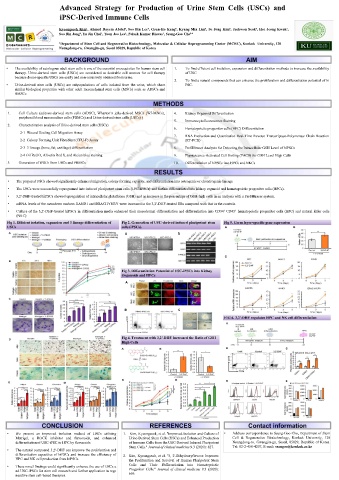
    •  The prepared USCs showed significantly enhanced migration, colony forming capacity, and differentiation into osteogenic or chondrogenic lineage
    •  The USCs were successfully reprogramed into induced pluripotent stem cells (USC-iPSCs) and further differentiated into kidney organoid and hematopoietic progenitor cells (HPCs).
    •  3,2′‐DHF‐treated hiPSCs showed upregulation of intracellular glutathione (GSH) and an increase in the percentage of GSH‐high cells in an analysis with a FreSHtracer system.
    •  mRNA levels of the mesoderm markers HAND1 and BRACHYURY were increased in the 3,2′‐DHF‐treated EBs compared with that in the controls.
    •  Culture of the 3,2′‐DHF‐treated hiPSCs in differentiation media enhanced their mesodermal differentiation and differentiation into CD34 + CD45 + hematopoietic progenitor cells (HPC) and natural killer cells
       (NKC)
    Fig 1. Efficient isolation, expansion and 3 lineage differentiation of   Fig 2. Generation of USC-derived induced pluripotent stem   Fig 5. Germ layer‐specific gene expression
    USCs                                    cells (iPSCs).
                                             A                 B


                                            Fig 3. Differentiation Potential of USC-iPSCs into Kidney
                                            Organoids and HPCs
                                             A


                                             B                  C
                                                                                FIG 6. 3,2′‐DHF regulates HPC and NK cell differentiation


                                            Fig 4. Treatment with 3,2′‐DHF Increased the Ratio of GSH
                                            High Cells


    •  We present an improved isolation method of USCs utilizing  1.  Kim, Kyeongseok, et al. "Improved Isolation and Culture of  •  Address correspondence to Ssang-Goo Cho, Department of Stem
       Matrigel, a ROCK inhibitor and flavonoids, and enhanced  Urine-Derived Stem Cells (USCs) and Enhanced Production  Cell & Regenerative Biotechnology, Konkuk University, 120
       differentiation of USC-iPSC to HPC by flavonoids  of Immune Cells from the USC-Derived Induced Pluripotent  Neungdong-ro, Gwangjin-gu, Seoul, 05029, Republic of Korea.
                                              Stem Cells." Journal of clinical medicine 9.3 (2020): 827.  Tel: 82-2-450-4207, E-mail: ssangoo@konkuk.ac.kr
    •  The natural compound 3,2′‐DHF can improve the proliferation and
       differentiation capacities of hiPSCs and increase the efficiency of
                                            2. Kim, Kyeongseok, et al. "3, 2′-Dihydroxyflavone Improves
       HPC and NK cell production from hiPSCs.  the Proliferation and Survival of Human Pluripotent Stem
                                              Cells  and  Their  Differentiation  into  Hematopoietic
    •  These novel findings could significantly enhance the use of USCs a
                                              Progenitor Cells." Journal of clinical medicine 9.3 (2020):
       nd USC-iPSCs for stem cell research and further application in rege
       nerative stem cell-based therapies.    669.

