


Page 5 - X. Stem cell biology
P. 5
Immunomodulatory effect and maintenance of differentiation via

           PD1/PDL-1 axis in osteoblasts differentiated from hADMSCs

   Seung-Cheol Lee, Min Kyoung Shin and Jung-Suk Sung*

   Department of Life Science, Dongguk University-Seoul, Dongguk-ro 32, Ilsandong-gu, Goyang-si,
   Gyeonggi-do, South Korea

                   BACKGROUND                                                  AIM

    Human adipose derived mesenchymal stem cells are known as promising candidates in  It is the first investigation on demonstrating the differential expression of PD1 on
   stem cell therapy due to their immunomodulatory effects and high potential for  cell surfaces elucidating the immunomodulatory function and maintenance of
   differentiating into various organs. The study on the adaptability of stem cells using  differentiation at osteoblasts differentiated from hADMSCs. Our study may provide
   immunomodulatory agents are a basic study to pass over the limitation of stem cell  basic information on the PD1/PDL-1 axis having a potential in regulating cellular
   therapy and it provides in-depth infrastructure information. PD1 (Programed cell death  functions in osteoblasts at the condition with hADMSC. Research for the interaction
   protein 1) is known for the immunomodulatory function in immune cells and the anti-  between osteoblasts and hADMSCs with their immunomodulatory functions and
   tumor activity in various organs. It is also known that MSCs express PD1 and inhibit  inhibition of osteoclastogenesis may provide insights in therapeutic strategy to
   lymphocyte proliferation by activation of the PD1 pathway. However, functions and the  overcome the limitation of stem cell therapy.
   molecular mechanism underlying PD1/PDL-1 axis in differentiated cells from hADMSCs
   remained unknown. Paracrine activity of cells via various molecular mechanisms at the
   condition for the transplantation of MSCs can lead to increased efficacy on stem cell
   therapy.
                                                RESULTS

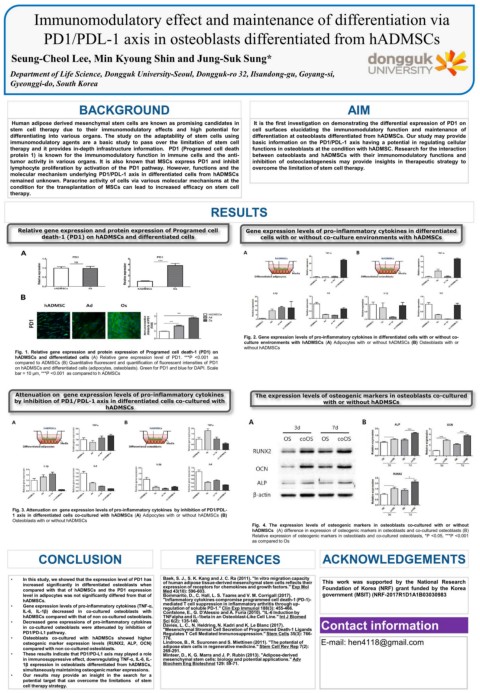
     Relative gene expression and protein expression of Programed cell   Gene expression levels of pro-inflammatory cytokines in differentiated
          death-1 (PD1) on hADMSCs and differentiated cells  cells with or without co-culture environments with hADMSCs


                                                        Fig. 2. Gene expression levels of pro-inflammatory cytokines in differentiated cells with or without co-
                                                        culture environments with hADMSCs (A) Adipocytes with or without hADMSCs (B) Osteoblasts with or
                                                        without hADMSCs
    Fig. 1. Relative gene expression and protein expression of Programed cell death-1 (PD1) on
    hADMSCs and differentiated cells (A) Relative gene expression level of PD1. ***P <0.001  as
    compared to ADMSCs (B) Quantitative fluorescent and quantification of fluorescent intensities of PD1
    on hADMSCs and differentiated cells (adipocytes, osteoblasts). Green for PD1 and blue for DAPI. Scale
    bar = 10 μm, ***P <0.001 as compared to h ADMSCs
    Attenuation on  gene expression levels of pro-inflammatory cytokines    The expression levels of osteogenic markers in osteoblasts co-cultured
    by inhibition of PD1/PDL-1 axis in differentiated cells co-cultured with   with or without hADMSCs
                         hADMSCs


    Fig. 3. Attenuation on gene expression levels of pro-inflammatory cytokines by inhibition of PD1/PDL-
    1 axis in differentiated cells co-cultured with hADMSCs (A) Adipocytes with or without hADMSCs (B)
    Osteoblasts with or without hADMSCs
                                                          Fig. 4. The expression levels of osteogenic markers in osteoblasts co-cultured with or without
                                                          hADMSCs (A) difference in expression of osteogenic markers in osteoblasts and co-cultured osteoblasts (B)
                                                          Relative expression of osteogenic markers in osteoblasts and co-cultured osteoblasts, *P <0.05, ***P <0.001
                                                          as compared to Os
          CONCLUSION                         REFERENCES                   ACKNOWLEDGEMENTS

   •  In this study, we showed that the expression level of PD1 has  Baek, S. J., S. K. Kang and J. C. Ra (2011). "In vitro migration capacity   This work was supported by the National Research
      increased significantly in differentiated osteoblasts when  of human adipose tissue-derived mesenchymal stem cells reflects their
                                      expression of receptors for chemokines and growth factors." Exp Mol
      compared with that of hADMSCs and the PD1 expression  Med 43(10): 596-603.  Foundation of Korea (NRF) grant funded by the Korea
      level in adipocytes was not significantly differed from that of  Bommarito, D., C. Hall, L. S. Taams and V. M. Corrigall (2017).   government (MSIT) (NRF-2017R1D1A1B03030983
      hADMSCs.                        "Inflammatory cytokines compromise programmed cell death-1 (PD-1)-
   •  Gene expression levels of pro-inflammatory cytokines (TNF-α,  mediated T cell suppression in inflammatory arthritis through up-
                                      regulation of soluble PD-1." Clin Exp Immunol 188(3): 455-466.
      IL-6, IL-1β) decreased in co-cultured osteoblasts with  Confalone, E., G. D'Alessio and A. Furia (2010). "IL-6 Induction by
      hADMSCs compared with that of non co-cultured osteoblasts.  TNFalpha and IL-1beta in an Osteoblast-Like Cell Line." Int J Biomed
                                      Sci 6(2): 135-140.
   •  Decreased gene expressions of pro-inflammatory cytokines  "Mesenchymal Stromal Cell Secretion of Programmed Death-1 Ligands  Contact information
      in co-cultured osteoblasts were attenuated by inhibition of  Davies, L. C., N. Heldring, N. Kadri and K. Le Blanc (2017).
      PD1/PD-L1 pathway.              Regulates T Cell Mediated Immunosuppression." Stem Cells 35(3): 766-
   •  Osteoblasts co-cultured with hADMSCs showed higher  776.
      osteogenic marker expression levels (RUNX2, ALP, OCN)  Lindroos, B., R. Suuronen and S. Miettinen (2011). "The potential of   E-mail: hen4118@gmail.com
      compared with non co-cultured osteoblasts.  adipose stem cells in regenerative medicine." Stem Cell Rev Rep 7(2):
   •  These results indicate that PD1/PD-L1 axis may played a role  269-291.
                                      Minteer, D., K. G. Marra and J. P. Rubin (2013). "Adipose-derived
      in immunosuppressive effect, downregulating TNF-α, IL-6, IL-  mesenchymal stem cells: biology and potential applications." Adv
      1β expression in osteoblasts differentiated from hADMSCs,  Biochem Eng Biotechnol 129: 59-71.
      simultaneously maintaining osteogenic marker expressions.
   •  Our results may provide an insight in the search for a
      potential target that can overcome the limitations of stem
      cell therapy strategy.

