


Page 1 - X. Stem cell biology
P. 1
Exosomes derived from feline adipose tissue

          mesenchymal stem cells reduce inflammation factors

     Soo-Eun Sung , Kyung-Ku Kang , Joo-Hee Choi, Si-Joon Lee , MinKyoung Sung , Kil-Soo Kim, Min-Soo Seo*
                  1
      Laboratory animal center, Daegu Gyeongbuk Medical Innovation Foundation, Daegu 41061, Republic of Korea
           Abstract                                              Results

    Adipose tissue derived mesenchymal stem cells (AD-MSCs) release
    extracellular  vesicles  such as exosomes  and microparticles.
    Particularly, exosomes are formed inward a cell, throughout multi-
    vesicular bodies (MVB), so the contents protein, DNA, and RNA are
    similar to the parent cells. The exosomes research is rapidly
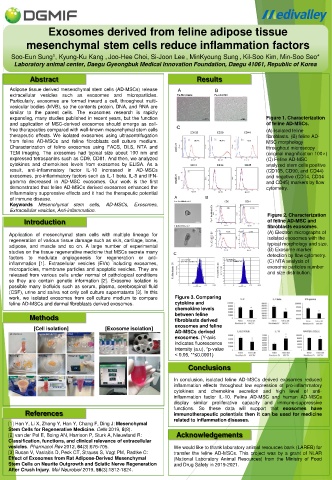
    expanding, many studies published in recent years, but the function                 Figure 1. Characterization
    and application of MSC-derived exosomes should emerge as cell-                      of feline AD-MSCs.
    free therapeutics compared with well-known mesenchymal stem cells                   (A) Isolated feline
    therapeutic effects. We isolated exosomes using ultracentrifugation                 fibroblasts. (B) feline AD-
    from feline AD-MSCs and feline fibroblasts cell culture medium.                     MSC morphology
    Characterization of feline exosomes using FACS, DLS, NTA and                        throughout microscopy
    TEM imaging. The exosomes had typical size about 100 nm and                         (original magnification 100×)
    expressed tetraspanins such as CD9, CD81. And then, we analyzed                     (C) Feline AD-MSC
    cytokines and chemokines levels from exosomes by ELISA. As a                        analyzed stem cells positive
    result,  anti-inflammatory factor  IL-10  increased  in  AD-MSCs                    (CD105, CD90, and CD44)
    exosomes, pro-inflammatory factors such as IL-1 beta, IL-8 and IFN-                 and negative (CD14, CD34
    gamma decreased in AD-MSC exosomes. Our work is the first                           and CD45) markers by flow
    demonstrated that feline AD-MSCs derived exosomes enhanced the                      cytometry.
    inflammatory suppressive effects and it had the therapeutic potential
    of immune disease.
    Keywords  Mesenchymal  stem  cells,  AD-MSCs,  Exosomes,
    Extracellular vesicles, Anti-inflammation.
                                                                                        Figure 2. Characterization
         Introduction                                                                   of feline AD-MSC and
                                                                                        fibroblasts exosomes.
    Application of mesenchymal stem cells with multiple lineage for                     (A) Electron micrographs of
    regeneration of various tissue damage such as skin, cartilage, bone,                isolated exosomes with the
    adipose, and muscle and so on. A large number of experimental                       typical morphology and size.
    studies on the tissue regenerative medicine that MSCs secrete many                  (B) Exosome marker
    factors  to  modulate  angiogenesis  for  regeneration  or  anti-                   detection by flow cytometry.
    inflammation [1]. Extracellular vesicles (EVs) including exosomes,                  (C) NTA analysis of
    microparticles, membrane particles and apoptotic vesicles. They are                 exosome particles number
    released from various cells under normal of pathological conditions                 and size distribution.
    so they are contain genetic information [2]. Exosome isolation is
    possible many biofluids such as serum, plasma, cerebrospinal fluid
    (CSF), urine and saliva not only cell culture supernatants [3]. In this
    work, we isolated exosomes from cell culture medium to compare  Figure 3. Comparing
    feline AD-MSCs and dermal fibroblasts derived exosomes.  cytokine and
                                                          chemokine levels
           Methods                                        between feline
                                                          fibroblasts derived
            [Cell isolation]       [Exosome isolation]    exosomes and feline
                                                          AD-MSCs derived
                                                          exosomes. (Y-axis
                                                          indicates fluorescence
                                                          intensity (a.u), *p-value
                                                          < 0.05, **≤0.0001)

                                                              Conclusions
                                                          In conclusion, isolated feline AD-MSCs derived exosomes reduced
                                                          inflammation effects throughout low expression of pro-inflammatory
                                                          cytokines and chemokine secretion and high level of anti-
                                                          inflammation factor IL-10. Feline AD-MSC and human AD-MSCs
                                                          display similar  proliferative  capacity and  immune-suppressive
                                                          functions. So these data will support that exosomes have
         References                                       immunotherapeutic potentials then it can be used for medicine
                                                          related to inflammation diseases.
    [1] Han Y, Li X, Zhang Y, Han Y, Chang F, Ding J: Mesenchymal
    Stem Cells for Regenerative Medicine. Cells 2019, 8(8).
    [2] van der Pol E, Boing AN, Harrison P, Sturk A, Nieuwland R:   Acknowledgements
    Classification, functions, and clinical relevance of extracellular
    vesicles. Pharmacol Rev 2012, 64(3):676-705.          We would like to thank laboratory animal resources bank (LAREB) for
    [3] Bucan V, Vaslaitis D, Peck CT, Strauss S, Vogt PM, Radtke C:   transfer the feline AD-MSCs. This project was by a grant of NLAR
    Effect of Exosomes from Rat Adipose-Derived Mesenchymal  (National Laboratory Animal Resources) from the Ministry of Food
    Stem Cells on Neurite Outgrowth and Sciatic Nerve Regeneration   and Drug Safety in 2019-2021.
    After Crush Injury. Mol Neurobiol 2019, 56(3):1812-1824.

