


Page 19 - N. Metabolism and metabolic diseases
P. 19
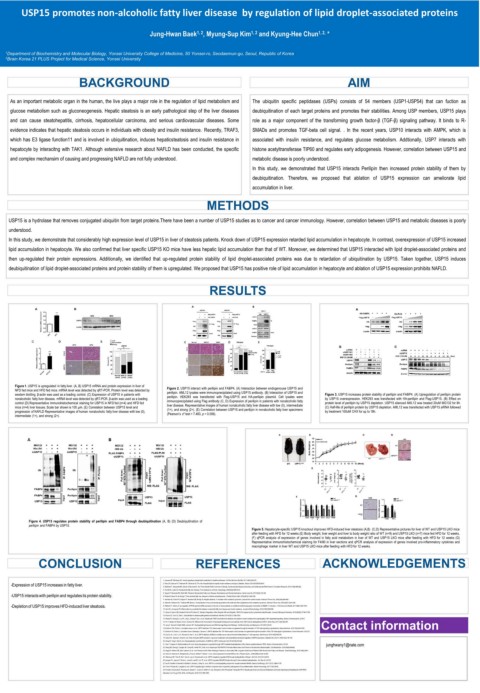
USP15 promotes non-alcoholic fatty liver disease  by regulation of lipid droplet-associated proteins

                                   Jung-Hwan Baek , Myung-Sup Kim 1, 2  and Kyung-Hee Chun 1, 2,  *
                                             1, 2
  1 Department of Biochemistry and Molecular Biology, Yonsei University College of Medicine, 50 Yonsei-ro, Seodaemun-gu, Seoul, Republic of Korea
  2 Brain Korea 21 PLUS Project for Medical Science, Yonsei University
                   BACKGROUND                                                  AIM


   As an important metabolic organ in the human, the live plays a major role in the regulation of lipid metabolism and  The ubiquitin specific peptidases (USPs) consists of 54 members (USP1-USP54) that can fuction as
   glucose metabolism such as gluconeogenesis. Hepatic steatosis is an early pathological step of the liver diseases  deubiquitination of each target proteins and promotes their stabilities. Among USP members, USP15 plays
   and can cause steatohepatitis, cirrhosis, hepatocellular carcinoma, and serious cardiovascular diseases. Some  role as a major component of the transforming growth factor-β (TGF-β) signaling pathway. It binds to R-
   evidence indicates that hepatic steatosis occurs in individuals with obesity and insulin resistance. . Recently, TRAF3,  SMADs and promotes TGF-beta cell signal. . In the recent years, USP10 interacts with AMPK, which is
   which has E3 ligase function11 and is involved in ubiquitination, induces hepaticsteatosis and insulin resistance in  associated with insulin resistance, and regulates glucose metabolism. Addtionally, USP7 interacts with
   hepatocyte by interacitng with TAK1. Although extensive research about NAFLD has been conducted, the specific  histone acetyltransferase TIP60 and regulates early adipogenesis. However, correlation between USP15 and
   and complex mechansim of causing and progressing NAFLD are not fully understood.  metabolic disease is poorly understood.
                                                          In this study, we demonstrated that USP15 interacts Perilipin then increased protein stability of them by
                                                          deubiquitination. Therefore, we proposed that ablation of USP15 expression can ameliorate lipid
                                                          accumulation in liver.
                                                METHODS
   USP15 is a hydrolase that removes conjugated ubiquitin from target proteins.There have been a number of USP15 studies as to cancer and cancer immunology. However, correlation between USP15 and metabolic diseases is poorly
   understood.
   In this study, we demonstrate that considerably high expression level of USP15 in liver of steatosis patients. Knock down of USP15 expression retarded lipid accumulation in hepatocyte. In contrast, overexpression of USP15 increased
   lipid accumulation in hepatocyte. We also confirmed that liver specific USP15 KO mice have less hepatic lipid accumulation than that of WT. Moreover, we determined that USP15 interacted with lipid droplet-associated proteins and
   then up-regulated their protein expressions. Additionally, we identified that up-regulated protein stability of lipid droplet-associated proteins was due to retardation of ubiquitination by USP15. Taken together, USP15 induces
   deubiquitination of lipid droplet-associated proteins and protein stability of them is upregulated. We proposed that USP15 has positive role of lipid accumulation in hepatocyte and ablation of USP15 expression prohibits NAFLD.

                                                RESULTS


    Figure 1. USP15 is upregulated in fatty liver. (A, B) USP15 mRNA and protein expression in liver of   Figure 2. USP15 interact with perilipin and FABP4. (A) Interaction between endogenouse USP15 and
    NFD fed mice and HFD fed mice. mRNA level was detected by qRT-PCR. Protein level was detected by
    western blotting. β-actin was used as a loading control. (C) Expression of USP15 in patients with   perilipin. AML12 lysates were immunoprecipitated using USP15 antibody. (B) Interaction of USP15 and  Figure 3. USP15 increases protein stability of perilipin and FABP4. (A) Upregulation of perilipin protein
    nonalcoholic fatty liver disease. mRNA level was detected by qRT-PCR. β-actin was used as a loading   perilipin. HEK293 was transfected with Flag-USP15 and HA-perilipin plasmid. Cell lysates were  by USP15 overexpression. HEK293 was transfected with HA-perilipin and Flag-USP15. (B) Effect on
    control (D) Representative immunohistochemical staining for USP15 in NFD fed (n=4) and HFD fed   immunoprecipitated using Flag antibody (C, D) Expression of perilipin in patients with nonalcoholic fatty  protein level of perilipin by USP15 depletion. USP15 silenced AML12 was treated 20uM MG132 for 8h.
                                       liver disease. Representative images of human nonalcoholic fatty liver disease with low (0), intermediate
    mice (n=4) liver tissues. Scale bar shown is 100 µm. (E) Correlation between USP15 level and   (1+), and strong (2+). (E) Correlation between USP15 and perilipin in nonalcoholic fatty liver specimens  (C) Half-life of perilipin protein by USP15 depletion. AML12 was transfected with USP15 siRNA followed
    progression of NAFLD Representative images of human nonalcoholic fatty liver disease with low (0),   by treatment 100uM CHX for up to 18h.
    intermediate (1+), and strong (2+).  (Pearson’s x 2 test = 7.483, p = 0.006).


       Figure 4. USP15 regulates protein stability of perilipin and FABP4 through deubiquitination (A, B) (D) Deubiquitination of
       perilipin and FABP4 by USP15.
                                                          Figure 5. Hepatocyte-specific USP15 knockout improves HFD-induced liver steatosis (A,B) (C,D) Representative pictures for liver of WT and USP15 LKO mice
                                                          after feeding with HFD for 12 weeks.(E) Body weight, liver weight and liver to body weight ratio of WT (n=9) and USP15 LKO (n=7) mice fed HFD for 12 weeks.
                                                          (F) qPCR analysis of expression of genes involved in fatty acid metabolism in liver of WT and USP15 LKO mice after feeding with HFD for 12 weeks (G)
                                                          Representative immunohistochemical staining for F4/80 in liver sections and qPCR analysis of expression of genes involved pro-inflammatory cytokines and
                                                          macrophage marker in liver WT and USP15 LKO mice after feeding with HFD for 12 weeks.
          CONCLUSION                         REFERENCES                   ACKNOWLEDGEMENTS
                                      1. Leavens KF, Birnbaum MJ. Insulin signaling to hepatic lipid metabolism in health and disease. Crit Rev Biochem Mol Biol. 2011;46(3):200-215.
   -Expression of USP15 increases in fatty liver.  2. Perry RJ, Samuel VT, Petersen KF, Shulman GI. The role of hepatic lipids in hepatic insulin resistance and type 2 diabetes. Nature. 2014;510(7503):84-91.
                                      3. Rankinen T, Sarzynski MA, Ghosh S, Bouchard C. Are There Genetic Paths Common to Obesity, Cardiovascular Disease Outcomes, and Cardiovascular Risk Factors? Circulation Research. 2015;116(5):909-922.
                                      4. Farrell GC, Larter CZ. Nonalcoholic fatty liver disease: From steatosis to cirrhosis. Hepatology. 2006;43(2):S99-S112.
   -USP15 interacts with perilipinand regulates its protein stability.  5. Angulo P, Machado MV, Diehl AM. Fibrosis in Nonalcoholic Fatty Liver Disease: Mechanisms and Clinical Implications. Semin Liver Dis. 2015;35(2):132-145.
                                      6. Penke M, Kiess W, de Giorgis T. Non-alcoholic fatty liver disease in children and adolescents. J Pediatr Endocr Met. 2016;29(12):1329-1330.
                                      7. den Boer M, Voshol PJ, Kuipers F, Havekes LM, Romijn JA. Hepatic steatosis: A mediator of the metabolic syndrome. Lessons from animal models. Arterioscl Throm Vas. 2004;24(4):644-649.
                                      8. Adiels M, Olofsson SO, Taskinen MR, Boren J. Overproduction of very low-density lipoproteins is the hallmark of the dyslipidemiain the metabolic syndrome. Arterioscl Throm Vas. 2008;28(7):1225-1236.
   -Depletion of USP15 improves HFD-induced liver steatosis.  9. Pettinelli P, Videla LA. Up-regulation of PPAR-gamma mRNA expression in the liver of obese patients: an additional reinforcing lipogenic mechanism to SREBP-1c induction. J Clin Endocrinol Metab. 2011;96(5):1424-1430.
                                      10. Asrih M, Jornayvaz FR. Inflammation as a potential link between nonalcoholic fatty liver disease and insulin resistance. Journal of Endocrinology. 2013;218(3):R25-R36.
                                      11. Sanjo H, Zajonc DM, Braden R, Norris PS, Ware CF. Allosteric Regulation of the Ubiquitin: NIK and Ubiquitin: TRAF3 E3 Ligases by the Lymphotoxin-beta Receptor. Journal of Biological Chemistry. 2010;285(22):17148-17155.
                                      12. Popovic D, Vucic D, Dikic I. Ubiquitination in disease pathogenesis and treatment. Nat Med. 2014;20(11):1242-1253.
                                      13. Wang PX, Zhang XJ, Luo PC, Jing X, Zhang P, Guo J, et al. Hepatocyte TRAF3 promotes liver steatosis and systemic insulin resistance through targeting TAK1-dependent signalling. Nature Communications. 2016;7.
                                      14. Ye Y, Akutsu M, Reyes-Turcu F, Enchev RI, Wilkinson KD, Komander D. Polyubiquitin binding and cross-reactivity in the USP domain deubiquitinase USP21. Embo Rep. 2011;12(4):350-357.  Contact information
                                      15. Jacq X, Kemp M, Martin NMB, Jackson SP. Deubiquitylating Enzymes and DNA Damage Response Pathways. Cell Biochemistry and Biophysics. 2013;67(1):25-43.
                                      16. Eichhorn PJA, Rodon L, Gonzalez-Junca A, et al. USP15 stabilizes TGF-beta receptor I and promotes oncogenesis through the activation of TGF-beta signaling in glioblastoma. Nature Medicine. 2012;18(3):429-U192.
                                      17. Eichhorn PJ, Rodon L, Gonzalez-Junca A, Baselga J, Seoane J. USP15 stabilizes the TGF-beta receptor I and promotes oncogenesis through the activation of the TGF-beta signal in glioblastoma. Cancer Research. 2012;72.
                                      18. Zou Q, Jin J, Hu H, Li H, Romano S, Xiao Y, et al. USP15 stabilizes MDM2 to mediate cancer-cell survival and inhibit antitumor T cell responses. Nat Immunol. 2014;15(6):562-570.
                                      19. Viana AYI, Sakoda H, Anai M, et al. Role of hepatic AMPK activation in glucose metabolism and dexamethasone-induced regulation of AMPK expression. Diabetes Res Clin Pr. 2006;73(2):135-142.
                                      20. Deng M, Yang X, Qin B, et al. Deubiquitination and Activation of AMPK by USP10. Molecular Cell. 2016;61(4):614-624.
                                      21. Gao Y, Koppen A, Rakhshandehroo M, et al. Early adipogenesis is regulated through USP7-mediated deubiquitination of the histone acetyltransferase TIP60. Nature Communications. 2013;4.  junghwany1@nate.com
                                      22. Wang XB, Zheng Z, Caviglia JM, Corey KE, Herfel TM, Cai B, et al. Hepatocyte TAZ/WWTR1 Promotes Inflammation and Fibrosis in Nonalcoholic Steatohepatitis. Cell Metabolism. 2016;24(6):848-862.
                                      23. Angulo P, Kleiner DE, Dam-Larsen S, et al. Liver Fibrosis, but No Other Histologic Features, Is Associated With Long-term Outcomes of Patients With Nonalcoholic Fatty Liver Disease. Gastroenterology. 2015;149(2):389-+.
                                      24. Greco D, Kotronen A, Westerbacka J, Puiq O, Arkkila P, Kiviluto T, et al. Gene expression in human NAFLD. Am J Physiol-Gastr L. 2008;294(5):G1281-G1287.
                                      25. Villeneuve NF, Tian W, Wu T, Sun Z, Lau A, Champman E, et al. USP15 negatively regulates Nrf2 through deubiquitination of Keap1. Mol Cell. 2013;51(1):68-79.
                                      26. Iyengar PV, Jaynes P, Rodon L, Lama D, Law KP, Lim YP, et al. USP15 regulates SMURF2 kinetics through C-lobe mediated deubiquitination. Sci Rep-Uk. 2015;5.
                                      27. Inui M, Manfrin A, Mamidi A, Martello G, Morsut L, Soliqo S, et al. USP15 is a deubiquitylating enzyme for receptor-activated SMADs. Nature Cell Biology. 2011;13(11):1368-U1187.
                                      28. Torre S, Polyak MJ, Langlais D, et al. USP15 regulates type I interferon response and is required for pathogenesis of neuroinflammation. Nature Immunology. 2017;18(1):54-63.
                                      29. Forand A, Koumakis E, Rousseau A, Sassier Y, Journe C, Merlin JF, et al. Disruption of the Phosphate Transporter Pit1 in Hepatocytes Improves Glucose Metabolism and Insulin Signaling by Modulating the USP7/IRS1
                                      Interaction (vol 16, pg 2736, 2016). Cell Reports. 2016;17(7):1905-1905.

