


Page 47 - M. Immunology
P. 47
Investigation of Anti-viral effect of SCOTIN and its derivatives

                  on Human Immunodeficiency Virus-1(HIV-1) production
                                   Ga-Na Kim , Kyung-Lee Yu, and Ji-Chang You
                 National Research Laboratory for Molecular Virology, Department of Pathology, School of Medicine, The Catholic University of Korea, Seoul.

                   BACKGROUND                                                  AIM


   Recently, many drug delivery system being  development is important to  Using a Drug Delivery System(DDS) is expected to increase
   approach to delivering drugs on their effect site and achieving a   significantly the effect of drugs. Cell Penetrating-Peptide(CPP) is
   therapeutic outcome. Cell Penetrating-Peptide(CPP) is one of drug   one of DDS that can be applied such purpose.
   delivery system facilitate cellular uptake of various molecular equipment.   Lately, Unpublished Advanced Cell penetrating-Peptide(ACP) that
   SCOTIN expressed in the SHISA5 gene was first identified as a direct
   target gene of the p53 transcription factor. SCOTIN has also been   is studying in our laboratory has established a novel CPP, named
                                                          as ACP, which has a better cellular delivery activity than a well-
   reported to interferes with HCV replication.
                                                          known CPP such as Tat of HIV-1. Also, it has been demonstrated
   In the present study, we demonstrated anti-viral activity of SCOTIN   thus far that SCOTIN expressed in the SHISA5 gene has anti-virus
   against HIV-1 production and that could be enhanced using an   effect against HCV. In this study, we have examined whether anti-
   Advanced Cell penetrating-Peptide(ACP) that has established a novel   viral activity of SCOTIN against HIV-1 production could be
   CPP in our laboratory.                                 enhanced and delivered by fusing our ACP.
                                                METHODS

   We have made various expression vectors of SCOTIN and ACP fusion SCOTIN. 293T cell was transfected with each of expression vectors. The
   protein expression level of each recombinant vectors was verified by western blot assay. Next, they were co-transfected with NL4-3_GFP DNA
   to 293T cells, and viral production level was measured by Western blot assay and enzyme-linked immunosorbent assay. Viral infectivity was
   determined by GFP signaling. The same volume of virus containing each culture supernatants was used to infect MT4 cells.

                                                RESULTS


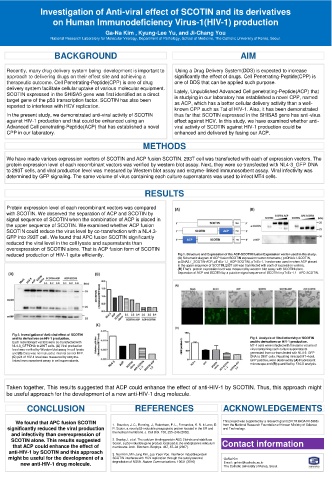
   Protein expression level of each recombinant vectors was compared
   with SCOTIN. We observed the separation of ACP and SCOTIN by
   signal sequence of SCOTIN when the combination of ACP is placed in
   the upper sequence of SCOTIN. We examined whether ACP fusion
   SCOTIN could reduce the virus level by co-transfection with a NL4.3-
   GFP into 293T cell. We found that APC fusion SCOTIN significantly
   reduced the viral level in the cell lysate and supernatants than
   overexpression of SCOTIN alone. That is ACP fusion form of SCOTIN
   reduced production of HIV-1 quite efficiently.          Fig 1. Structure and Expression of the ACP-SCOTIN fusion Expression vector used in the study.
                                                           (A) Schematic diagram of ACP fusion SCOTIN expression vector constructs ( pcDNA3.1-SCOTIN,
                                                           pcDNA3.1_SCOTIN-ACP, pTriEx-1.1_ACP-SCOTIN). pTriEx-1.1 vector was used in when ACP placed
                                                           in the upper sequence of SCOTIN. 293T cell was transfected with each of expression vectors.
                                                           (B) That’s  protein expression level was measured by western blot assay with SCOTIN alone.
                                                           Separation of ACP and SCOTIN by a putative signal sequence of SCOTIN in pTriEx-1.1_ APC-SCOTIN.


     Fig 2. Investigation of Anti-viral effect of SCOTIN
     and its derivatives on HIV-1 production.                                     Fig 3. Analysis of Viral infectivity of SCOTIN
     Each recombinant vectors were co-transfected with                            and its derivatives on HIV-1 production.
     NL4-3_GFP DNA to 293T cells. (A) Viral production                            MT-4 cells were infected with the same volume of
     level was verified by Western blot assay in cell lysate                      virus containing each culture supernatants
     and (B) Data was normalized to internal control RFP.                         generated from co-transfected with NL4-3_GFP
     (C) p24 of HIV-1 level was measured by enzyme-                               DNA to 293T cells. Resulting infected MT-4 cell,
     linked immunosorbent assay in cell supernatants.                             GFP positive, were observed by (A) Fluorescent
                                                                                  microscope and (B) quantified by FACS analysis.
   Taken together, This results suggested that ACP could enhance the effect of anti-HIV-1 by SCOTIN. Thus, this approach might
   be useful approach for the development of a new anti-HIV-1 drug molecule.

          CONCLUSION                         REFERENCES                   ACKNOWLEDGEMENTS

      We found that APC fusion SCOTIN   1.  Bourdon, J. C., Renzing, J., Robertson, P. L., Fernandes, K. N. & Lane, D.   This project was supported by a research grant (2017R1AOA1015366)
                                                                          from the National Research Foundation of Korean Ministry of Science
   significantly reduced the viral production   P. Scotin, a novel p53-inducible proapoptotic protein located in the ER and   and Technology.
     and infectivity than overexpression of   the nuclear membrane. J. Cell Biol. 158, 235–246 (2002).
     SCOTIN alone. This results suggested   2. Draeby, I. et al. The calcium binding protein ALG-2 binds and stabilizes   Contact information
                                      Scotin, a p53-inducible gene product localized at the endoplasmic reticulum
     that ACP could enhance the effect of   membrane. Arch. Biochem. Biophys. 467, 87–94 (2007).
    anti-HIV-1 by SCOTIN and this approach   3. Nari Kim, Min-Jung Kim, Joo-Yeon Yoo. Interferon-inducible protein
    might be useful for the development of a   SCOTIN interferes with HCV replication through the autolysosomal   GaNa Kim
        new anti-HIV-1 drug molecule.  degradation of NS5A. Nature Communications. 10631 (2016)  Email : gnkim@catholic.ac.kr
                                                                          The Catholic University of Korea, Seoul.

