


Page 5 - L. Genetics and genomics
P. 5
Molecular study of Olfactory Receptor
1,
1,2
Young Kun Shim , and Jun-Ho Lee *
1 Department of Biotechnology, Chonnam National University, Gwangju, Korea
2 Microzyme corporation, Damyang Samanli 234, Jeonmam, Korea
ABSTRACT Concept of Experiments
The olfactory nervous system recognizes and distinguishes many different chemicals in
the general living environment. Insects have evolved a group of odorant-gated ion
channels composed of highly-developed olfactory receptors capable of distinguishing and
distribution between various chemicals with symbolic or evasive specificities. Recently,
aphid genomes related to olfaction, including olfactory receptors and proteins, have been
identified and olfactory receptors have been reported that are differentially differentiated
from Drosophila. The genome of the olfactory receptor has a very conservative sequence
and a systematic signaling system. A representative receptor, odorant-gated ion channels
comprised of a highly conserved co-receptor (Orco) has a homotetramer channel structure
with four subunits arranged symmetrically around the central hole. It has a very similar
structure to the 7-transmembrane receptor present in the human body and has a very
similar structural form and gating mechanism to receptors of neurotransmitters.
In this study, whole cell voltage clamp recording was performed with cell expression
system of OR65 gene, which is a subtype of olfactory receptor isolated from Drosophila.
After the successful expression of this receptor, microbial culture extract of
microorganism, a harmful insect inducer, was used to investigate whether olfactory
receptor activity was regulated. The activity of the receptor was confirmed in the
recording media diluted 10,000 times with the microbial culture extract.
Therefore, it is possible to identify attractant or repellent substance using the olfactory
receptor activity regulating system of insects. Through this study, new attractant shows
the attracting phenomenon by activating insect receptor OR65, The results of the
scientific analysis of the performance of the extracts are presented.
Key words: olfactory nervous system, insect attractants, olfactory receptors, odorant-
gated ion channels Adopted from The Journal of Experimental Biology (2009) 212, 1973-1979
MATERIALS AND METHODS Molecular docking studies
Autodock Tools (version 1.5.6) by The Scripps Research Institute (La Jolla, CA)
Cell preparation Odorant receptor of Apocrypta bakeri, Protein Data Bank (ID code B0FAQ4, 3.5A resolution)
Xenopus laevis (Xenopus I, Ann Arbor, MI, USA) 3D structure of the ligand (Compound A) was obtained from Pubchem
In vitro transcription and expression RESULTS
In vitro transcription kit (mMessage mMachine; Ambion)
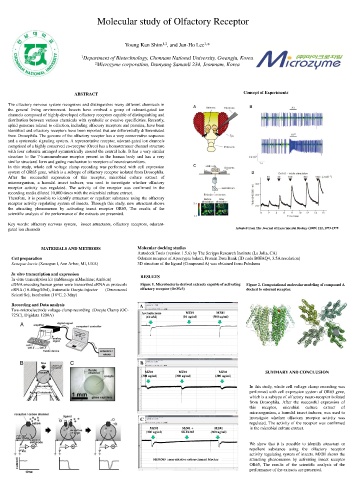
cDNA encoding human genes were transcribed cRNA as protocols Figure 1. Microbacteria-derived extracts capable of activating Figure 2. Computational molecular modeling of compound A
cRNA (10-40ng/40nl), Automatic Oocyte injector (Drummond olfactory receptor (Or35c3) docked to odorant receptor.
Scientific), Incubation (18℃, 2-3day)
Recording and Data analysis A
Two-microelectrode voltage-clamp recording (Oocyte Clamp (OC-
MZ01
MZ01
725C), Digidata 1200A) Acetophenone (10 ug/ml) (500 ug/ml)
(10 uM)
B
MZ01 MZ01 MZ01 SUMMARY AND CONCLUSION
(300 ug/ml) (300 ug/ml) (300 ug/ml)
In this study, whole cell voltage clamp recording was
performed with cell expression system of OR65 gene,
which is a subtype of olfactory neuro-receptor isolated
from Drosophila. After the successful expression of
this receptor, microbial culture extract of
microorganism, a harmful insect inducer, was used to
C investigate whether olfactory receptor activity was
regulated. The activity of the receptor was confirmed
MZ01 MZ01 + MZ01 in the microbial culture extract.
(300 ug/ml) SKF6365 (300 ug/ml)
We show that it is possible to identify attractant or
repellent substance using the olfactory receptor
activity regulating system of insects. MZ01 shows the
SKF6365 : non-selective cation channel blocker attracting phenomenon by activating insect receptor
OR65, The results of the scientific analysis of the
performance of the extracts are presented.

