


Page 9 - K. Development and regeneration
P. 9
YAP s ignaling regulations  in C VP morphogenesis
                                                                   1
                                                                                   1
                                                                                                   2
                                                       1
               1
                           2
                                           1
  Tae-Young Kim , Ji-Youn Kim , Yam Prasad Ayral , Eui-Seon Lee , Elina Pokharel , Chang-Hyeon An , Hitoshi Yamamoto , Wern-Joo
                   1
  Sohn , Jae-Young Kim , Jae-Kwang Jung 1
      4
                                                             2
  1 School of Dentistry, IHBR, Kyungpook National University, Daegu , Korea, Department of Dental Hygiene, Gachon University, Incheon,
                                                                     4
  3 Department of Histology and Developmental Biology, Tokyo Dental College, Tokyo, Japan, Division of Biotechnology and Convergence, Daegu
  Haany University, Gyeongsan Korea
                   BACKGROUND                                                  AIM
           Tongue is centrally located in oral cavity with its    In this study, we examined the precise
    dorsal surface covered with plenty of the specialized papillae,  expression pattern and developmental function of YAP
    which accommodate the taste sensation including fungiform,  to define the fundamental signaling regulations in CVP
    foliate, and circumvallate. Though circumvallate papillae  morphogenesis.  Particularly,  we  examined  the
    have been extensively studied to determine the regulatory  involvement of YAP in development and homeostasis of
    mechanisms during histomorphogenesis and homeostasis, it  taste bud by clarifying the immunohistochemistry
    still remains to be elucidated the principle mechanisms of  localization patterns of YAP and the related markers in
    signaling regulations on morphogenesis. Yes-associated  taste buds within circumvallate papillae. Overall, we
    protein 1 (YAP1) is the key regulator of the Hippo pathway,  establish the reciprocal mechanisms in regulating the
    which is mainly involved in regulations of tissue homeostasis,  formation and maintenance of taste bud by comparing
    organogenesis, regeneration and tumorigenesis.         the localizations of YAP with those signaling effectors.
                                               METHODS

     Animal: The adult ICR mice were housed by group under given condition including room temperature 22 ± 2 °C, humidity of 55 ± 5 %, and artificial
     illumination which lights on from 05:00 to 17:00 hours. The day on which a vaginal plug was confirmed was designated as E0. Mouse embryos at E16 and
     male mouse (8 weeks old) were used in this study.
     Tissue preparation: The preparation were performed as previously described (Adhikari et al.,2018). The sections were prepared for hematoxylin and
     eosin (H&E) and immunohistochemistry staining.
     Immunohistochemistry: Immunohistochemistry were performed as previously described (Adhikari et al.,2018). Following primary antibodies: Rabbit
     polyclonal antibodies against Ki67, YAP, β-catenin, Cytokeratin (CK8) 8 and CK14, Rabbit monoclonal to p-YAP and non-phospho (Active) β-catenin,
     and mouse monoclonal PGP9.5.
                                                RESULTS


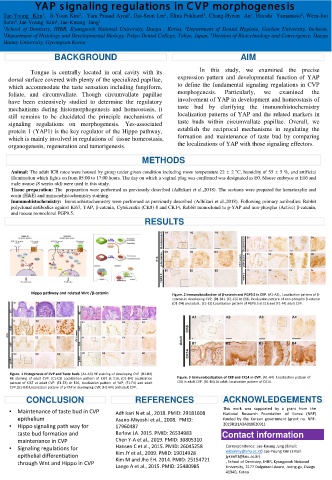
           Hippo pathway and related Wnt /β-catenin      Figure. 2 Immunolocalization of β-catenin and PGP9.5 in CVP. (A1-A3) , Localization pattern of β-
                                                         catenin in developing CVP, (B1-B4). (C1-C3) At E16, localization pattern of non-phospho β-catenin
                                                         (D1-D4) and adult.. (E1-E3) Localization pattern of PGP9.5 at E16 and (F1-F4) adult CVP.


    Figure. 1 Histogenesis of CVP and Taste buds. (A1-A3) HE staining of developing CVP. (B1-B4)
    HE staining of adult CVP. (C1-C3) Localization pattern of Ki67 at E16, (D1-D4) Localization  Figure. 3 Immunolocalization of CK8 and CK14 in CVP. (A1-A4) Localization pattern of
    pattern of Ki67 at adult CVP. (E1-E3) At E16, localization pattern of YAP, (F1-F4) and adult  CK8 in adult CVP. (B1-B4) At adult, localization pattern of CK14.
    CVP.(G1-G3) Localization pattern of p-YAP in developing CVP, (H1-H4) and adult CVP.
          CONCLUSION                         REFERENCES                   ACKNOWLEDGEMENTS

    •  Maintenance of taste bud in CVP   Adhikari N et al., 2018. PMID: 29181608  This work was supported by a grant from the
                                                                          National Research Foundation of Korea (NRF)
       epithelium                      Asano-Miyoshi et al., 2008.  PMID:   funded by the Korean government (grant no. NRF-
    •  Hippo signaling path way for    17960487                           2019R1I1A3A01062091).
       taste bud formation and         Barlow LA. 2015. PMID: 26534983   Contact information
       maintenance in CVP              Chen Y-A et al., 2019. PMID: 30805310
    •  Signaling regulations for       Hansen C et al., 2015. PMID: 26045258  Correspondence: Jae-Kwang Jung (Email:
                                                                          widenmy@knu.ac.kr) Jae-Young Kim (Email:
       epithelial differentiation      Kim JY et al., 2009. PMID: 19014928  jykim91@knu.ac.kr)
                                       Kim M and Jho EH. 2014. PMID: 25154721
       through Wnt and Hippo in CVP    Lange A et al., 2015. PMID: 25480985  , School of Dentistry, IHBR, Kyungpook National
                                                                          University, 2177 Dalgubeol-daero, Joong-gu, Daegu
                                                                          41940, Korea

