


Page 11 - K. Development and regeneration
P. 11
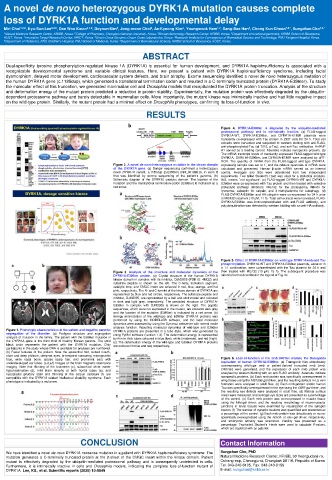
A novel de novo heterozygous DYRK1A mutation causes complete
  loss of DYRK1A function and developmental delay
  Miri Choi 1,2,# , Kyu-Sun Lee 3,4,# , Dae Woo Kwon 3,4,# , Doyoun Kim 5 , Jong-moon Choi 6 , Ae-Kyeong Kim 3 , Youngwook Ham 1,2 , Sang-Bae Han 2 , Chong Kun Cheon 7,8,* , Sungchan Cho 1,9,*
  1 Natural Medicine Research Center, KRIBB, Korea.  2 College of Pharmacy, Chungbuk National University, Korea.  3 Bionanotechnology Research Center, KRIBB, Korea.  4 Department of functional genomics, KRIBB School of Bioscience,
  KUST, Korea.  5 Innovative Target Research Center, KRICT, Korea.  6 Green Cross Genome, Green Cross Laboratories, Korea. 7 Research Institute for Convergence of Biomedical Science and Technology, PNU Yangsan Hospital, Korea.
  8 Department of Pediatrics, PNU Children’s Hospital, PNU School of Medicine, Korea.  9 Department of Biomolecular Science, KRIBB School of Bioscience, KUST, Korea.
                                               ABSTRACT

   Dual-specificity tyrosine phosphorylation-regulated kinase 1A (DYRK1A) is essential for human development, and DYRK1A haploinsufficiency is associated with a
   recognizable developmental syndrome and variable clinical features. Here, we present a patient with DYRK1A haploinsufficiency syndrome, including facial
   dysmorphism, delayed motor development, cardiovascular system defects, and brain atrophy. Exome sequencing identified a novel de novo heterozygous mutation of
   the human DYRK1A gene (c.1185dup), which generated a translational termination codon and resulted in a C-terminally truncated protein (DYRK1A-E396ter). To study
   the molecular effect of this truncation, we generated mammalian cell and Drosophila models that recapitulated the DYRK1A protein truncation. Analysis of the structure
   and deformation energy of the mutant protein predicted a reduction in protein stability. Experimentally, the mutation protein was effectively degraded by the ubiquitin-
   dependent proteasome pathway and barely detectable in mammalian cells. More importantly, the mutant kinase was intrinsically inactive and had little negative impact
   on the wild-type protein. Similarly, the mutant protein had a minimal effect on Drosophila phenotypes, confirming its loss-of-function in vivo.
                                                 RESULTS


                                                                         Figure 4. DYRK1A-E396ter is degraded by the ubiquitin-mediated
                                                                         proteasomal pathway and is intrinsically inactive. (a) FLAG-tagged
                                                                         DYRK1A-WT, DYRK1A-E396ter, and DYRK1A-K188R plasmids were
                                                                         transiently co-expressed with Tau protein in 293T cells for 24 h. Total cell
                                                                         extracts were harvested and subjected to western blotting with anti-FLAG,
                                                                         anti-phosphorylated-Tau (at T212, p-Tau), and anti-Tau antibodies. HnRNP
                                                                         A1 served as a loading control. Asterisks indicate nonspecific proteins. (b)
                                                                         The mRNA transcript levels of transiently expressed FLAG-tagged wild-type
                                                                         DYRK1A, DYRK1A-E396ter, and DYRK1A-K188R were analyzed by qRT-
                                                                         PCR. The quantity of mRNA from the FLAG-tagged wild-type DYRK1A-
                                      Figure 2. A novel de novo heterozygous mutation in the kinase domain  expressing sample was set to 1, and the relative quantities of mRNA were
                                      of the DYRK1A gene. (a) Sanger sequencing confirmed a heterozygous  calculated and presented. Human β-actin mRNA served as an internal
                                      novel DYRK1A variant, c.1185dup (p.E396ter) (NM_001396.3), in exon 8  control. Averages and SDs were determined from two independent
                                      that was identified by exome sequencing of the patient’s genome. (b)  experiments. Two-tailed Student’s t-test was used for a statistical analysis.
                                      Schematic diagram of the DYRK1A catalytic domain. The location of the  N.S. means ‵not significant’. (c) FLAG-tagged DYRK1A-WT and DYRK1A-
                                      mutation and the translational termination codon (E396ter) is indicated as a  E396ter were co-expressed with Tau protein and then treated with selective
                                      red arrow.                         proteolytic pathway inhibitors: MG132 for the proteasome, NH4Cl for
                                                                         lysosome, calpeptin for calpain, and 3-methyladenine for autophagy. (d)
                                                                         FLAG-DYRK1A-E396ter and HA-ubiquitin were co-expressed for 24 h prior
                                                                         to MG132 treatment (10 μM, 11 h). Total cell extracts were harvested, FLAG-
                                                                         DYRK1A-E396ter was immunoprecipitated with anti-FLAG antibody, and
                                                                         polyubiquitination was detected by western blotting with an anti-HA antibody.


                                                                         Figure 5. Effect of DYRK1A-E396ter on wild-type DYRK1A-induced Tau
                                                                         phosphorylation. DYRK1A-WT and DYRK1A-E396ter plasmids, alone or in
                                                                         a 1:1 combination, were co-transfected with the Tau plasmid for 24 h and
                                      Figure 3. Analysis of the structure and molecular dynamics of the  then treated with MG132 (10 μM, 15 h). The subsequent procedure was
                                      DYRK1A-E396ter protein. (a) Crystal structure of the human DYRK1A  identical to that described in the legend of Fig. 4c.
                                      kinase domain in complex with its inhibitor, DJM2005 (PDB ID: 4MQ2) and
                                      substrate peptide is shown on the left. The C-helix, activation segment,
                                      catalytic loop, and CMGC insert are coloured in red, blue, orange, and hot
                                      pink, respectively. The N- and C-termini of the kinase domain of DYRK1A are
                                      represented by blue and red circles, respectively. The substrate peptide and
                                      inhibitor, DJM2005, are represented by a ball and stick model and coloured
                                      in dark and light grey, respectively. The predicted structure of DYRK1A-
                                      E396ter in complex with DJM2005 is shown on the right. The peptide
                                      sequences, which were not expressed in the mutant, are coloured dark grey
                                      and the location of the mutation (E396ter) is indicated by a red arrow. (b)
                                      Energy minimization of the wild-type and E396ter DYRK1A proteins was
                                      performed by using the MODELLER software, and the local molecular
                                      dynamics were assessed by using the Dynamut webserver with normal mode
                                      analysis function. Resulting molecular dynamics of wild-type and E396ter
   Figure 1. Phenotypic characteristics in the patient and negative parental  DYRK1A proteins are presented in a tube style, which was generated by
   segregation of the disorder. (a) Pedigree structure and segregation  using PyMol software (version 1.3). The deformation energy is represented
   analysis of mutation in the family. The patient with the E396ter mutation in  by thin to thick tubes coloured in blue (low), white (moderate), and red (high).
   the DYRK1A gene is the third child of healthy Korean parents. The solid  (c) The deformation energy of the wild-type and E396ter DYRK1A proteins
   black circle represents the patient with the DYRK1A mutation. Only  are coloured in blue and red, respectively.
   participants in the study whose DNA is available for analyses are numbered.
   (b) Facial features of the patient. Note the epicanthal fold, tented mouth,
   short and deep philtrum, deep-set eyes, bi-temporal narrowing, micrognathic
   face, wide nasal bone, sparse scalp hair, and prominent ears with     Figure 6. Loss-of-function of the mnb-D401ter mutant, the Drosophila
   underdeveloped ear lobes. (c,d,e,f) Images of the brain magnetic resonance  equivalent of human DYRK1A-E396ter. (a) Transgenic flies ubiquitously
   imaging. Note that thinning of the brainstem (c), subcortical white matter  overexpressing wild-type mnb or patient-derived truncated mnb (mnb-
   hypomyelination (d), mild brain atrophy at both frontal lobes (e), and  D401ter) were generated, and the expression of each mnb protein was
   hypoplastic pituitary stalk and thinning of the corpus callosum (f) are  analysed by western blotting with an anti-FLAG antibody. Asterisks indicate
   compatible with the DYRK1A-related intellectual disability syndrome. Each  nonspecific proteins. (b) Each mnb protein was specifically overexpressed in
   phenotype is indicated by a red arrow.                                wing tissue using the MS1096-gal driver, and the resulting defects in L5 vein
                                                                         formation were analysed in adult flies. (c) Each mnb protein and/or human
                                                                         Tau was specifically overexpressed in the eye using the GMR-gal driver, and
                                                                         the resulting eye defects were analysed in adult flies. (d) Retinal surface
                                                                         areas were measured, and average eye sizes are presented as a percentage
                                                                         of the control. (e) Each mnb protein was overexpressed in muscle tissue
                                                                         using the Mhc-gal driver, and the resulting morphology of neuromuscular
                                                                         junctions in larval tissues were examined by visualization of the synaptic
                                                                         bouton. (f) The number of synaptic boutons was quantified and presented as
                                                                         a percentage of the control. (g) Each mnb protein was ubiquitously or neuro-
                                                                         specifically overexpressed using the Actin5- or elav-gal driver, respectively,
                                                                         and embryonic lethality was examined. Viability was presented as a
                                                                         percentage. Two-tailed Student’s t-tests were used to calculate P-values,
                                                                         which are depicted with an asterisk.
                           CONCLUSION                                    Contact information
   We have identified a novel de novo DYRK1A nonsense mutation in a patient with DYRK1A haploinsufficiency syndrome. The  Sungchan Cho, PhD
   mutation generates a C-terminally truncated protein at the β-sheet of the CMGC insert within the kinase domain. Patient  Natural Medicine Research Center, KRIBB, 30 Yeongudanji-ro,
   mutant is effectively degraded by the ubiquitin-mediated proteasomal pathway and is consequently undetected in cells.  Ochang-eup, Cheongju-si, Chungbuk 28116, Republic of Korea
   Furthermore, it is intrinsically inactive in cells and Drosophila models, indicating the complete loss-of-function mutant of  Tel: 043-240-6105, Fax: 043-240-6159
   DYRK1A. Lee, KS., et al. Scientific reports (2020) 10:9849            E-mail: sungchan@kribb.re.kr

