


Page 13 - K. Development and regeneration
P. 13
Development and Evaluation of Triple Layer Skin Phantom Model for
Continuous Glucose Monitoring System
Seoku Bae, YeonJae Baek, Subin Bak, Sun ju Lee, Jiyun Kim, Min Woo Lee, Jeongsu Choi, Unchul Shin, Suhng Wook Kim*.
School of Health and Environmental Science, College of Health Sciences, Korea University, Seoul, Korea
BACKGROUND AIM
Continuous glucose measurement system (CGMS) is actively To develop a triple layer artificial skin phantom for evaluation
researched for preventing hypoglycemic shock of patients with of sensor insertion ability and physical characteristics of
type 1 diabetes by real-time glucose monitoring in interstitial fluid CGMS sensor
using by fine needle-type glucose sensor
METHODS
Synthesis
process
RESULTS
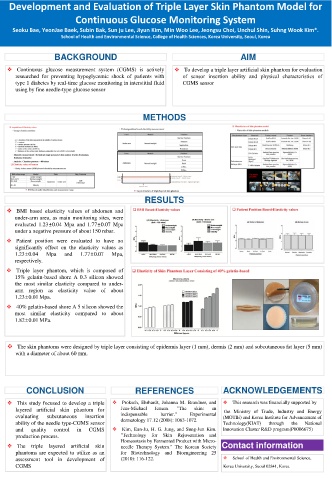
BMI based elasticity values of abdomen and
under-arm area, as main monitoring sites, were
evaluated 1.23±0.04 Mpa and 1.77±0.07 Mpa
under a negative pressure of about 150 mbar.
Patient position were evaluated to have no
significantly effect on the elasticity values as
1.23±0.04 Mpa and 1.77±0.07 Mpa,
respectively.
Triple layer phantom, which is composed of
15% gelatin-based shore A 0.3 silicon showed
the most similar elasticity compared to under-
arm region as elasticity value of about
1.23±0.01 Mpa.
40% gelatin-based shore A 5 silicon showed the
most similar elasticity compared to about
1.82±0.01 MPa.
The skin phantoms were designed by triple layer consisting of epidermis layer (1 mm), dermis (2 mm) and subcutaneous fat layer (5 mm)
with a diameter of about 60 mm.
CONCLUSION REFERENCES ACKNOWLEDGEMENTS
This study focused to develop a triple Proksch, Ehrhardt, Johanna M. Brandner, and This research was financially supported by
layered artificial skin phantom for Jens‐Michael Jensen. "The skin: an the Ministry of Trade, Industry and Energy
evaluating subcutaneous insertion indispensable barrier." Experimental (MOTIE) and Korea Institute for Advancement of
ability of the needle type-CGMS sensor dermatology 17.12 (2008): 1063-1072. Technology(KIAT) through the National
and quality control in CGMS Kim, Eun-Ju, H. G. Jung, and Sung-Jun Kim. Innovation Cluster R&D program(P0006675)
production process. "Technology for Skin Rejuvenation and
Homeostasis by Fermented Product with Micro-
The triple layered artificial skin needle Therapy System." The Korean Society Contact information
phantoms are expected to utilize as an for Biotechnology and Bioengineering 25
assessment tool in development of (2010): 116-122. School of Health and Environmental Science,
CGMS Korea University, Seoul 02841, Korea

