


Page 81 - I. Chemical biology and drug discovery
P. 81
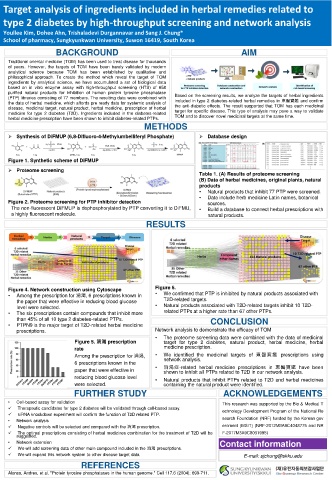
Target analysis of ingredients included in herbal remedies related to
type 2 diabetes by high-throughput screening and network analysis
Youllee Kim, Dohee Ahn, Trishaladevi Durgannavar and Sang J. Chung*
School of pharmacy, Sungkyunkwan University, Suwon 16419, South Korea
BACKGROUND AIM
Traditional oriental medicine (TOM) has been used to treat disease for thousands
of years. However, the targets of TOM have been barely validated by modern
analytical science because TOM has been established by qualitative and
philosophical approach. To create the method which reveal the target of TOM
ingredients by analytical science, we have accumulated a set of biological data
based on in vitro enzyme assay with high-throughput screening (HTS) of 658
purified natural products for inhibition of human protein tyrosine phosphatase Based on the screening results, we analyze the targets of herbal ingredients
(PTP) libraries consisting of 77 members. The resulting data were combined with
the data of herbal medicine, which affords pre ready data for systemic analysis of included in type 2 diabetes-related herbal remedies in 東醫寶鑑 and confirm
disease, medicinal target, natural product, herbal medicine, prescription of herbal the anti-diabetic effects. The result supported that TOM has each medicinal
medicine for type 2 diabetes (T2D). Ingredients included in the diabetes-related target for specific disease. This type of analysis may pave a way to validate
herbal medicine prescription have been shown to inhibit diabetes-related PTPs. TOM and to discover novel medicinal targets at the same time.
METHODS
Synthesis of DiFMUP (6,8-Difluoro-4-Methylumbelliferyl Phosphate) Database design
Figure 1. Synthetic scheme of DiFMUP
Proteome screening
Table 1. (A) Results of proteome screening
(B) Data of herbal medicines, original plants, natural
products
• Natural products that inhibit 77 PTP were screened.
• Data include herb medicine Latin names, botanical
Figure 2. Proteome screening for PTP inhibitor detection sources.
The non-fluorescent DiFMUP is dephosphorylated by PTP converting it to DiFMU, • Build a database to connect herbal prescriptions with
a highly fluorescent molecule. natural products.
RESULTS
Figure 4. Network construction using Cytoscape Figure 6.
• Among the prescription for 消渴, 6 prescriptions known in • We confirmed that PTP is inhibited by natural products associated with
the paper that were effective in reducing blood glucose T2D-related targets.
level were selected. • Natural products associated with T2D-related targets inhibit 10 T2D-
• The six prescriptions contain compounds that inhibit more related PTPs at a higher rate than 67 other PTPs.
than 45% of all 10 type 2 diabetes-related PTPs. CONCLUSION
• PTPN9 is the major target of T2D-related herbal medicine
prescriptions. Network analysis to demonstrate the efficacy of TOM
• The proteome screening data were combined with the data of medicinal
Figure 5. 消渴 prescription target for type 2 diabetes, natural product, herbal medicine, herbal
rate medicine prescription.
Among the prescription for 消渴, • We identified the medicinal targets of 東醫寶鑑 prescriptions using
6 prescriptions known in the network analysis.
paper that were effective in • 消渴症-related herbal medicine prescriptions in 東醫寶鑑 have been
shown to inhibit all PTPs related to T2D in our network analysis.
reducing blood glucose level • Natural products that inhibit PTPs related to T2D and herbal medicines
were selected. containing the natural product were identified.
FURTHER STUDY ACKNOWLEDGEMENTS
• Cell-based assay for validation This research was supported by the Bio & Medical T
Therapeutic candidates for type 2 diabetes will be validated through cell-based assay. echnology Development Program of the National Re
siRNA knockdown experiment will confirm the function of T2D related PTP.
• Network analysis search Foundation (NRF) funded by the Korean gov
Negative controls will be selected and compared with the 消渴 prescription. ernment (MSIT) (NRF-2012M3A9C4048775 and NR
The optimal prescriptions consisting of herbal medicines combination for the treatment of T2D will be F-2017M3A9C8031995)
suggested.
• Network extension Contact information
We will add screening data of other main compound included in the 消渴 prescriptions.
We will expand this network system to other disease target data. E-mail: sjchung@skku.edu
REFERENCES
Alonso, Andres, et al. "Protein tyrosine phosphatases in the human genome." Cell 117.6 (2004): 699-711.

