


Page 85 - I. Chemical biology and drug discovery
P. 85
Production process development  of an Engineered EGF (Epidermal growth factor) protein
                                    Young-Jae Jeon , Hyun-Tak Jin , Yun-Sik Choi 1
                                                 1
                                                             2
                             1 Research Institute, SLBiGen, Inc., Yeonsu-gu, Incheon, Korea
                          2 Research Institute, ProGen, Inc., Seongnam-si, Gyeonggi-do, Korea
              BACKGROUND & AIM

   EGF (epidermal growth factor) was generally known to be one of
   the major factors for maintaining the skin homeostasis and
   recovering injured states of skin. Therefore, recombinant human
   EGF have for a long time been applied to cosmetics or medical
   device for improving skin conditions. However, there are still a few
   limitations for EGF to be used with an expected efficacy in vivo, in
   which recombinant human EGF is known to be not stable in a
   solution and its commercial price is relatively very expensive. To
   solve these limitations, we made a cell line expressing the
   engineering EGF (EGF-hyFc).

                       RESULTS

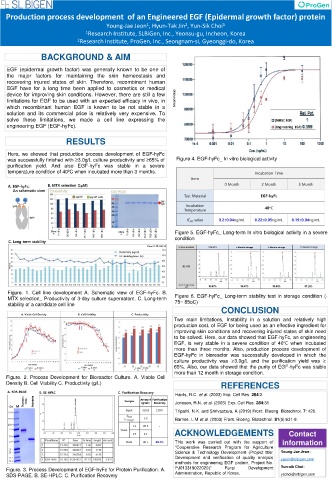
    Here, we showed that production process development of EGF-hyFc
    was successfully finished with ≥3.0g/L culture productivity and ≥65% of  Figure 4. EGF-hyFc_ In vitro biological activity
    purification yield. And also EGF-hyFc was stable in a severe
    temperature condition of 40ºC when incubated more than 3 months.


                                                          Figure 5. EGF-hyFc_ Long-term In vitro biological activity in a severe
                                                          condition


    Figure. 1. Cell line development A. Schematic view of EGF-hyFc. B.  Figure 6. EGF-hyFc_ Long-term stability test in storage condition (-
    MTX selection_ Productivity of 3-day culture supernatant. C. Long-term
    stability of a candidate cell line                    75~ 85oC)
                                                                         CONCLUSION
                                                          Two main limitations, Instability in a solution and relatively high
                                                          production cost, of EGF for being used as an effective ingredient for
                                                          improving skin conditions and recovering injured states of skin need
                                                          to be solved. Here, our data showed that EGF-hyFc, an engineering
                                                          EGF, is very stable in a severe condition of 40℃ when incubated
                                                          more than three months. Also, production process development of
                                                          EGF-hyFc in bioreactor was successfully developed in which the
                                                          culture productivity was ≥3.0g/L and the purification yield was ≥
                                                          65%. Also, our data showed that the purity of EGF-hyFc was stable
                                                          more than 12 month in storage condition.
   Figure. 2. Process Development for Bioreactor Culture. A. Viable Cell
   Density B. Cell Viability C. Productivity (g/L)                       REFERENCES

                                                          Harris, R.C. et al. (2003) Exp. Cell Res. 284:2.
                                                          Jorissen, R.N. et al. (2003) Exp. Cell Res. 284:31.
                                                          Tripathi, N.K. and Shrivastava, A (2019) Front. Bioeng. Biotechnol. 7: 420.
                                                          Barnes. L.M et al. (2003) Front. Bioeng. Biotechnol. 81(6):631-9.
                                                          ACKNOWLEDGEMENTS                     Contact
                                                          This work was carried out with the support of  information
                                                          “Cooperative Research Program for Agriculture
                                                          Science & Technology Development (Project title:  Young-Jae Jeon:
                                                          Development and verification of quality analysis  yjjeon@slbigen.com
                                                          methods for engineering EGF protein, Project No.
   Figure. 3. Process Development of EGF-hyFc for Protein Purification. A.  PJ013319022020)”  Rural  Development  Yun-sik Choi:
   SDS-PAGE. B. SE-HPLC. C. Purification Recovery         Administration, Republic of Korea.  yschoi@slbigen.com

