


Page 61 - I. Chemical biology and drug discovery
P. 61
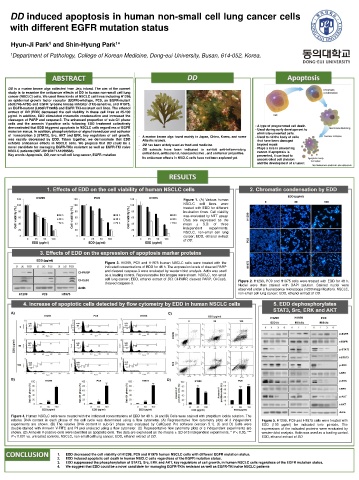
DD induced apoptosis in human non-small cell lung cancer cells
with different EGFR mutation status
Hyun-Ji Park and Shin-Hyung Park *
1
1
1 Department of Pathology, College of Korean Medicine, Dong-eui University, Busan, 614-052, Korea.
DD is a marine brown alga collected from Jeju island. The aim of the current
study is to examine the anticancer effects of DD in human non-small cell lung
cancer (NSCLC) cells. We used three kinds of NSCLC cell lines including H1299,
an epidermal growth factor receptor (EGFR)-wildtype, PC9, an EGFR-mutant
(delE746-A750) and EGFR tyrosine kinase inhibitor (TKI)-sensitive, and H1975,
an EGFR-mutant (L858R/T790M) and EGFR TKI-resistant cell lines. The ethanol
extract of DD (EDD) decreased the cell viability in these cell lines at 25-100
µg/ml. In addition, EDD stimulated chromatin condensation and increased the
cleavages of PARP and caspase-3. The enhanced proportion of sub-G1 phase
cells and the annexin V-positive cells following EDD treatment collectively
demonstrated that EDD triggered apoptosis in NSCLC cells regardless of EGFR - A type of programmed cell death.
mutation status. In addition, phosphorylation of signal transducer and activator - Used during early development to
eliminate unwanted cells.
of transcription 3 (STAT3), Src, AKT and ERK, key regulators of cell growth, - A marine brown alga found mainly in Japan, China, Korea, and some - Used to rid the body of cells
was rapidly decreased by EDD. Taken together, we demonstrate that EDD Atlantic islands. that have been damaged
exhibits anticancer effects in NSCLC cells. We propose that DD could be a - DD has been widely used as food and medicine. beyond repair.
novel candidate for managing EGFR-TKIs resistant as well as EGFR-TKI naive - Plays a role in preventing
NSCLC patients (NRF-2019R1F1A1059588). - DD extracts have been indicated to exhibit anti-inflammatory, cancer. If apoptosis is
Key words: Apoptosis, DD, non-small cell lung cancer, EGFR mutation antioxidant, antibacterial, neuroprotective , and antitumor properties. prevented, it can lead to
- Its anticancer effects in NSCLC cells have not been explored yet. uncontrolled cell division
and the development of a tumor.
https://www.genome.gov/genetics-glossary/apoptosis
Figure 1. (A) Various human
NSCLC cell lines were
treated with EDD for different
incubation times. Cell viability
was evaluated by MTT assay.
Data are expressed as the
mean ± S.D. of three
independent experiments.
NSCLC, non-small cell lung
cancer; EDD, ethanol extract
of DD.
Figure 3. H1299, PC9 and H1975 human NSCLC cells were treated with the
indicated concentrations of EDD for 48 h. The expression levels of cleaved PARP
and cleaved caspase-3 were evaluated by western blot analysis. Actin was used
as a loading control. Representative blot images were shown. NSCLC, non-small
cell lung cancer; EDD, ethanol extract of DD; Cl-PARP, cleaved PARP; Cl-Cas3,
cleaved caspase-3. Figure 2. H1299, PC9 and H1975 cells were treated with EDD for 48 h.
Nuclei were then stained with DAPI solution. Stained nuclei were
observed under a fluorescence microscope (x200 magnification). NSCLC,
non-small cell lung cancer; EDD, ethanol extract of DD.
Figure 4. Human NSCLC cells were treated with the indicated concentrations of EDD for 48 h. (A and B) Cells were stained with propidium iodide solution. The
relative DNA content in each phase of the cell cycle was determined using a flow cytometer. (A) Representative flow cytometry plots of 3 independent Figure 5. H1299, PC9 and H1975 cells were treated with
experiments are shown. (B) The relative DNA content in sub-G1 phase was evaluated by CellQuest Pro software (version 5.1). (C and D) Cells were EDD (100 μg/ml) for indicated time periods. The
double-stained with Annexin V-FITC and PI and analyzed using a flow cytometer. (C) Representative flow cytometry plots of 3 independent experiments are expressions of the indicated proteins were evaluated by
shown. (D) Annexin V-positive cells were identified as apoptotic cells. The data are expressed as the means ± SD of 3 independent experiments. * P < 0.05, *** western blot analysis. Actin was used as a loading control.
P < 0.001 vs. untreated controls. NSCLC, non-small cell lung cancer; EDD, ethanol extract of DD. EDD, ethanol extract of DD.
1. EDD decreased the cell viability of H1299, PC9 and H1975 human NSCLC cells with different EGFR mutation status.
2. EDD induced apoptotic cell death in human NSCLC cells regardless of the EGFR mutation status.
3. EDD suppressed the phosphorylation of STAT3, Src, ERK and AKT, key regulators of cell growth, in human NSCLC cells regardless of the EGFR mutation status.
4. We suggest that EDD could be a novel candidate for managing EGFR-TKIs resistant as well as EGFR-TKI naive NSCLC patients

