


Page 63 - I. Chemical biology and drug discovery
P. 63
Anti-cancer effects of the root of TK in human non-small cell
lung cancer cells with resistance to epidermal growth factor
receptor-tyrosine kinase inhibitors
Hyun-Ji Park and Shin-Hyung Park 1*
1
1 Department of Pathology, College of Korean Medicine, Dong-eui University, Busan, 47227, Korea.
Although epidermal growth factor receptor tyrosine kinase inhibitor (EGFR TKI) has - In up to 60%–80% of
become the standard treatment for non-small cell lung cancer (NSCLC), acquired patients treated with
resistance to these drugs remains a major obstacle for managing NSCLC. This study an EGFR TKI, there is
explored the anti-cancer effects of the root of TK in NSCLC cells with EGFR TKIs a meaningful tumor
resistance. We first established erlotinib-resistant PC9 (PC9/ER) and gefitinib-resistant regression.
PC9 (PC9/GR) cell lines using a dose-escalating maintenance of drugs in PC9 cells. - After 9–12 months, all
We also used H1975 cell line (L858R/T790M) as the EGFR-TKI resistant cell line. Our patients develop
results showed that ethanol extract of TK (ETK) suppressed the cell proliferation in acquired resistance.
EGFR-TKI resistant cell lines. In addition, ETK enhanced the sub-G1 DNA content,
annexin V-positive cell population as well as chromatin condensation. The expression - Among the different
of cleaved PARP and cleaved caspase-3 was also increased by ETK. These findings mechanisms of
demonstrate that ETK induced apoptosis in EGFR TKI-resistant NSCLC cell lines. - Widely used as a medicinal plant in Oriental medicine acquired resistance, a
Furthermore, the activities of general activators of cancer cell proliferation were for the treatment of lung diseases accompanied by secondary mutation,
T790M, in the exon 20
significantly decreased by ETK in H1975 cells. In conclusion, the current study dry cough, fever and thirst. of the EGFR gene is
suggests the potential use of TK for managing the advanced NSCLC with EGFR-TKIs - It is also applied to injury, abscess, and hemorrhoids. the most frequent
resistance (NRF-2019R1F1A1059588). - Have anticancer, antibacterial, antiviral, antidiabetic Appl Clin Genet. 2017 Jul 26;10:49-56. event, occurring in
and immunomodulating activities.
Key words: Apoptosis, TK, EGFR-TKI resistance, NSCLC ~50%–60% of cases.
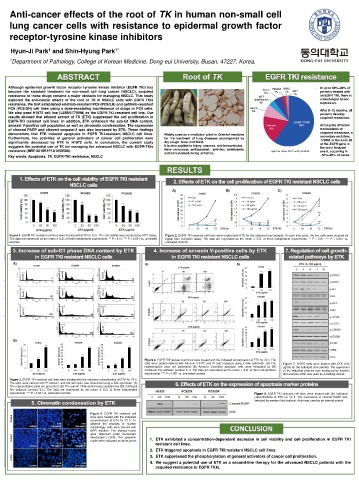
Figure 1. EGFR TKI resistant cell lines were treated with ETK for 72 h. The cell viability was measured by MTT assay. Figure 2. EGFR TKI resistant cell lines were treated with ETK for the indicated time periods. At each time point, the live cells were counted by
The data are expressed as the mean ± S.D. of three independent experiments. ** P < 0.01, *** P < 0.001 vs. untreated trypan blue exclusion assay. The data are expressed as the mean ± S.D. of three independent experiments. ** P < 0.01, *** P < 0.001 vs.
controls. untreated controls
Figure 4. EGFR TKI resistant cell lines were treated with the indicated concentration of ETK for 72 h. The
cells were double-stained with Annexin V-FITC and PI and analyzed using a flow cytometer. (A) The Figure 7. H1975 cells were treated with ETK (100
representative plots are presented. (B) Annexin V-positive apoptotic cells were evaluated by BD μg/ml) for the indicated time periods. The expression
CellQuest Pro software (version 5.1). The data are expressed as the mean ± S.D. of three independent of the indicated proteins was measured by western
experiments. *** P < 0.001 vs. untreated controls. blot analysis. Actin was used as a loading control.
Figure 3. EGFR TKI resistant cell lines were treated with the indicated concentration of ETK for 72 h.
The cells were stained with PI solution, and the cell cycle was measured using a flow cytometer. (A)
The representative plots are presented. (B) The sub-G1 DNA content was evaluated by BD CellQuest
Pro software (version 5.1). The data are expressed as the mean ± S.D. of three independent
experiments. *** P < 0.001 vs. untreated controls. Figure 6. EGFR TKI resistant cell lines were treated with the indicated
concentrations of ETK for 72 h. The expression of cleaved PARP was
detected by western blot analysis. Actin was used as an internal control.
Figure 5. EGFR TKI resistant cell
lines were treated with the indicated
concentrations of ETK for 72 h. To
observe the changes of nuclear
morphology, cells were stained with
DAPI solution. The stained nuclei
were observed under fluorescent
microscope (×200). The apoptotic 1. ETK exhibited a concentration-dependent decrease in cell viability and cell proliferation in EGFR TKI
nuclei were indicated as white arrow.
resistant cell lines.
2. ETK triggered apoptosis in EGFR TKI resistant NSCLC cell lines.
3. ETK suppressed the phosphorylation of general activators of cancer cell proliferation.
4. We suggest a potential use of ETK as a second-line therapy for the advanced NSCLC patients with the
acquired resistance to EGFR TKIs.

