


Page 53 - I. Chemical biology and drug discovery
P. 53
Pharmacokinetics and biodistribution study of miRNA-497 using
      capillary electrophoresis with laser induced fluorescence detector.

                                                         1
                                                                            1
                                Haejin Kwon , Eunmi Ban and Eun Joo Song *
                                            1
  1 College of Pharmacy and Graduate School of Pharmaceutical Sciences, Ewha Womans University, Seoul 03760, Korea.
                    BACKGROUND                                                  AIM
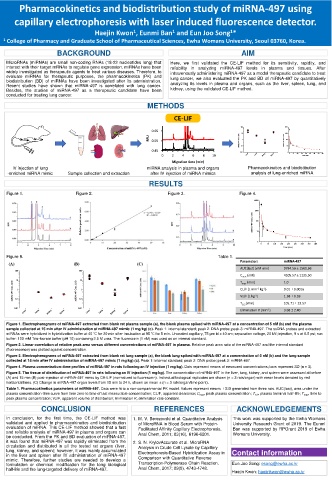
   MicroRNAs (miRNAs) are small non-coding RNAs (18-22 nucleotides long) that  Here, we first validated the CE-LIF method for its sensitivity, rapidity, and
   interact with their target mRNAs to regulate gene expression. miRNAs have been  reliability in analyzing miRNA-497 levels in plasma and tissues. After
   widely investigated as therapeutic agents to treat various diseases. Therefore, to  intravenously administering miRNA-497 as a model therapeutic candidate to treat
   evaluate miRNAs for therapeutic purposes, the pharmacokinetics (PK) and  lung cancer, we also evaluated the PK and BD of miRNA-497 by quantitatively
   biodistribution (BD) of miRNAs have been investigated after its administration.
   Recent studies have shown that miRNA-497 is correlated with lung cancer.  analyzing its levels in plasma and organs, such as the liver, spleen, lung, and
   Besides, the studies of miRNA-497 as a therapeutic candidate have been  kidney, using the validated CE-LIF method.
   conducted for treating lung cancer.
                                                 METHODS

                                                          CE-LIF

                                                                               100            10000
                                                  0.65                          10            1000
                                                 RFU  0.55                     miRNA-497 Conc. (nM)  1  miRNA-497 Conc. (nM)  100
                                                  0.45                         0.01 0.1       10 1
                                                                                                    200
                                                      0  2  4   6  8  10         Liver  Lung  Kidney  Spleen  0  50  100  150 Time (min)  250  300  350  400

                                                         Migration time (min)
     IV injection of lung                        miRNA analysis in plasma and organs  Pharmacokinetics and biodistibution
   -enriched miRNA mimic  Sample collection and extraction  after IV injection of miRNA mimics  analysis of lung-enriched miRNA
                                                 RESULTS
   Figure 1.              Figure 2.                     Figure 3.              Figure 4.
                                                                                    10000
                                                                                    1000
                                                                                   miRNA-497 Conc. (nM)  100 10


                                                                                     1
                                                                                      0  50  100  150  200  250  300  350  400
                                                                                             Time (min)
   Figure 5.                                                            Table 1.
                                                                               Parameters    miRNA-497
    (A)                  (B)                  (C)
                                                                               AUC(last) (nM min)  9784.56 ± 1561.66
      100                  100
                                                                               C max (nM)    4105.57 ± 1135.50
      10                   10                                                  T max (min)   1.0
     miRNA-497 Conc. (nM)  1  miRNA-497 Conc. (nM)  1                          CL/F (L min -1 kg -1 )  0.01 ± 0.0016
                                                                                             1.58 ± 0.59
                                                                               Vz/F (L kg -1 )
                           0.1
      0.1
                                                                               T 1/2 (min)   105.71 ± 23.57
      0.01                 0.01                                                Elimination K (min -1 )  3.68 ± 2.40
        Liver  Lung  Kidney  Spleen  Liver  Lung  Kidney  Spleen

   Figure 1. Electropherograms of miRNA-497 extracted from blank rat plasma sample (a), the blank plasma spiked with miRNA-497 at a concentration of 5 nM (b) and the plasma
   sample collected at 15 min after IV administration of miRNA-497 mimic (1 mg/kg) (c). Peak 1: internal standard; peak 2: DNA probe; peak 3: miRNA-497. The ssDNA probes and extracted
   miRNAs were hybridized in hybridization buffer at 40 ℃ for 20 min after incubation at 95 ℃ for 5 min. Uncoated capillary, 75 μm id x 40 cm; separation voltage, 20 kV; injection, 9 s at 0.5 psi; run
   buffer: 100 mM Tris–borate buffer (pH 10) containing 2.5 M urea. The fluorescein (1 nM) was used as an internal standard.
   Figure 2. Linear correlation of relative peak area versus different concentrations of miRNA-497 in plasma. Relative peak area ratio of the miRNA-497 and the internal standard
   (fluorescence) was plotted against concentration.
   Figure 3. Electropherograms of miRNA-497 extracted from blank rat lung sample (a), the blank lung spiked with miRNA-497 at a concentration of 5 nM (b) and the lung sample
   collected at 15 min after IV administration of miRNA-497 mimic (1 mg/kg) (c). Peak 1: internal standard; peak 2: DNA probe; peak 3: miRNA-497.
   Figure 4. Plasma concentration–time profiles of miRNA-497 in rats following an IV injection (1 mg/kg). Dots represent means of measured concentrations; bars represent SD (n = 3).
   Figure 5. The tissue of distribution of miRNA-497 in rats following an IV injection (1 mg/kg). The concentration of miRNA-497 in the liver, lung, kidney, and spleen were assessed at before
   (A) and 15 min (B) post-injection of miRNA-497 mimic by CE-LIF (normalized to fluorescein). Individual biological replicates are shown (n = 3 rats/organ) with mean levels denoted by red
   horizontal lines. (C) Change in miRNA-497 organ levels from 15 min to 24 h, shown as mean ± (n = 3 rats/organ/time point).
   Table 1. Pharmacokinetics parameters of miRNA-497. Data were fit to a non-compartmental PK model. Values represent means ± S.D generated from three rats. AUC(last), area under the
   plasma concentration-time curve from time zero to time of last measurable concentration; CL/F, apparent clearance; C max , peak plasma concentration; T 1/2 , plasma terminal half-life; T max , time to
   peak plasma concentration; Vz/F, apparent volume of distribution; Elimination K, elimination rate constant.
              CONCLUSION                           REFERENCES                 ACKNOWLEDGEMENTS
   In conclusion, for the first time, the CE-LIF method was  1. M. V. Berezovski et al. Quantitative Analysis   This work was supported by the Ewha Womans
   validated and applied to pharmacokinetics and biodistribution  of MicroRNA in Blood Serum with Protein-  University Research Grant of 2019. The Eunmi
   evaluation of miRNA. This CE-LIF method showed that a fast  Facilitated Affinity Capillary Electrophoresis.   Ban was supported by RPGrant 2019 of Ewha
   and reliable analysis of miRNA-497 in plasma and organs can  Anal Chem, 2011; 83(16), 6196-6201.  Womans University.
   be conducted. From the PK and BD evaluation of miRNA-497,
   it was found that miRNA-497 was rapidly eliminated from the  2. S. N. KrylovAccurate et al. MicroRNA
   circulation and distributed in all the tested rat organs (liver,  Analysis in Crude Cell Lysate by Capillary
   lung, kidney, and spleen); however, it was mainly accumulated  Electrophoresis-Based Hybridization Assay in  Contact information
   in the liver and spleen after IV administration of miRNA-497  Comparison with Quantitative Reverse
   mimic. Therefore, further studies are needed to develop a
   formulation or chemical modification for the long biological  Transcription-Polymerase Chain Reaction.   Eun Joo Song: esong@ewha.ac.kr
   half-life and the lung-targeted delivery of miRNA-497.  Anal Chem, 2017; 89(8), 4743-4748.
                                                                            Haejin Kwon: haejinkwon@ewha.ac.kr

