


Page 13 - G. Cell differentiation. division. and death
P. 13
Autophagy regulates formation of primary cilia in ginsenoside Rk1 treated
neuroblastoma cell
Jung-Mi Oh , Sun Young Park , and Sungkun Chun 1,2
1,2
1,2
1 Department of Physiology, Jeonbuk National University Medical School, Jeonju, Korea
2 Brain Korea 21 Plus Program, Jeonbuk National University Medical School, Jeonju, Korea
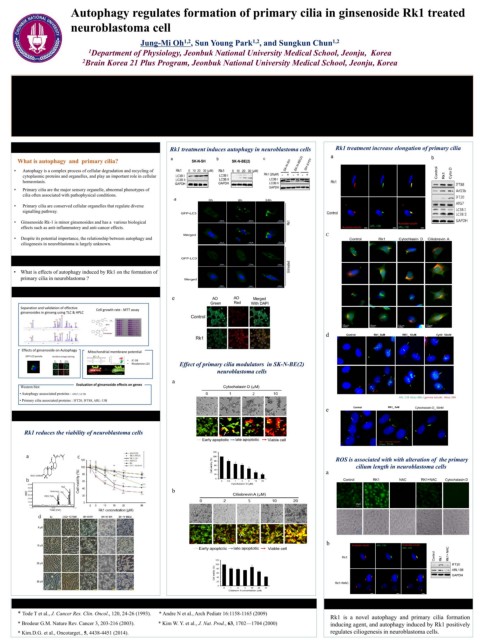
Autophagy is a complex process of cellular degradation and recycling of cytoplasmic proteins and organelles, and play an important role in cellular homeostasis.
Primary cilia are conserved cellular organelles that regulate diverse signalling pathway. Despite its potential importance, the relationship between autophagy and
ciliogenesis in neuroblastoma is largely unknown. In this study, we investigated the effect of autophagy induced by Rk1on the formation of primary cilia in
neuroblastoma cells. Rk1 treatment on neuroblastoma cells increased the number of LC3-puncta and LC3-II protein conversion. In addition, treatment of Rk1 resulted
strong elongation of primary cilium and increased the number of ciliated cells in neuroblastoma cells. Taken together, our results suggest that autophagy induced by Rk1
positively regulates ciliogenesis in neuroblastoma cells.
Key words : Neuroblastoma, Autophagy, Rk1, Primary cilia
Introduction Rk1 treatment induces autophagy in neuroblastoma cells Rk1 treatment increase elongation of primary cilia
What is autophagy and primary cilia?
• Autophagy is a complex process of cellular degradation and recycling of
cytoplasmic proteins and organelles, and play an important role in cellular
homeostasis.
• Primary cilia are the major sensory organelle, abnormal phenotypes of
cilia often associated with pathophysical conditions.
• Primary cilia are conserved cellular organelles that regulate diverse
signalling pathway.
• Ginsenoside Rk-1 is minor ginsenosides and has a various biological
effects such as anti-inflammatory and anti-cancer effects.
C
• Despite its potential importance, the relationship between autophagy and
ciliogenesis in neuroblastoma is largely unknown.
Objective
• What is effects of autophagy induced by Rk1 on the formation of
primary cilia in neuroblastoma ?
Methods
e AO AO Merged
Green Red With DAPI
Separation and validation of effective Cell growth rate : MTT assay
ginsenosides in ginseng using TLC & HPLC
Control
d
Rk1
Effects of ginsenoside on Autophagy Mitochondrial membrane potential
GFP-LC3 puncta Acridine orange staining
• JC-1&
• Rhodamine 123 Effect of primary cilia modulators in SK-N-BE(2)
neuroblastoma cells
a
Evaluation of ginsenoside effects on genes
Western blot
• Autophagy asssociated proteins : ATG7, LC3B
• Primary cilia associated proteins : IFT20, IFT88, ARL-13B
e
Results
Rk1 reduces the viability of neuroblastoma cells
ROS is associated with with alteration of the primary
cilium length in neuroblastoma cells
a
b
b
References Conclusion
* Tode T et al., J. Cancer Res. Clin. Oncol., 120, 24-26 (1993). * Andre N et al., Arch Pediatr 16:1158-1165 (2009)
Rk1 is a novel autophagy and primary cilia formation
* Brodeur G.M. Nature Rev. Cancer 3, 203-216 (2003). * Kim W. Y. et al., J. Nat. Prod., 63, 1702—1704 (2000) inducing agent, and autophagy induced by Rk1 positively
* Kim.D.G. et al., Oncotarget., 5, 4438-4451 (2014). regulates ciliogenesis in neuroblastoma cells.

