


Page 11 - G. Cell differentiation. division. and death
P. 11
G. Cell differentiation, division, and death

           Silk sericin and 4-hexylresorcinol differentiate endothelial

                   cells via different mechanism in diabetic model
                                   Yei-Jin Kang¹, Seong-Gon Kim¹
             ¹Oral and Maxillofacial Surgery, Gangneung-Wonju National University, Gangneung 25457, Korea


             4-hexyl resorcinol (4HR) elevates vascular endothelial growth factor (VEGF) in RAW264.7 cells via hypoxia inducible factor (HIF) independent
              pathway. As endothelial cells are important in angiogenesis, we treated the human umbilical vein endothelial cells (HUVECs) with 4HR and
           investigated protein expressional changes by immunoprecipitation high-performance liquid chromatography (IP-HPLC) using 96 antisera. Here, we
             found that 4HR upregulated transforming growth factor-βs (TGF-βs)/SMADs/ vascular endothelial growth factors (VEGFs) signaling, RAF-B/ERK
             and p38 signaling, and M2 macrophage polarization pathways. 4HR also increased expression of caspases and subsequent cellular apoptosis.
              Knockdown with small interfering RNA (siRNA) targeting to TGF-β1 and the selective chemical inhibition (A83-01) to ALK5 confirmed the
              involvement of TGF-β signaling pathway in the 4-HR mediated VEGFs expression. Mechanistically, 4HR increased TGF-β1 production and
              subsequent activation of SMADs/VEGFs, RAF-B/ERK and p38 signaling, and M2 macrophage polarization. 4HR application on burn model of
              diabetic rats demonstrated increased level of angiogenic proteins with active capillary regeneration and wound healing. Collectively, 4HR
                                    activates TGF-βs/SMADs/VEGFs signaling in endothelial cells.


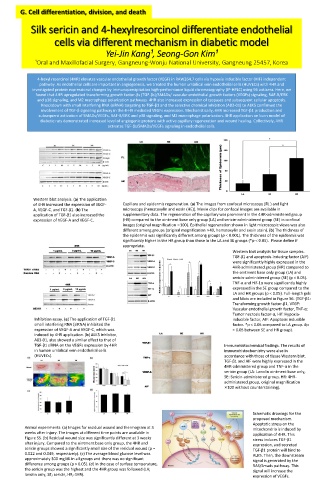
            Western blot analysis. (a) The application
            of 4HR increased the expression of VEGF-  Capillary and epidermis regeneration. (a) The images from confocal microscopy (FL ) and light
            A, VEGF-C, and TGF-β1. (b) The   microscopy (hematoxylin and eosin (HE)). Movie clips for confocal images are available in
            application of TGF-β1 also increased the   supplementary data. The regeneration of the capillary was prominent in the 4HR-administered group
            expression of VEGF-A and VEGF-C.  (HR) compared to the ointment base only group (LA) and sericin-administered group (SE) in confocal
                                         images (original magnification ×100). Epithelial regeneration shown in light microscopic views was also
                                         different among groups (original magnification ×40, hematoxylin and eosin stain). (b) The thickness of
                                         the epidermis was significantly different among groups (p < 0.001). The thickness of the epidermis was
                                         significantly higher in the HR group than those in the LA and SE groups (*p < 0.05). Please define if
                                         appropriate.
                                                                             Western blot analysis for tissue samples.
                                                                             TGF-β1 and apoptosis-inducing factor (AIF)
                                                                             were significantly highly expressed in the
                                                                             4HR-administered group (HR) compared to
                                                                             the ointment base only group (LA) and
                                                                             sericin-administered group (SE) (p < 0.05).
                                                                             TNF-α and Hif-1α were significantly highly
                                                                             expressed in the SE group compared to the
                                                                             LA and HR groups (p < 0.05). Full-length gels
                                                                             and blots are included in Figure S6. (TGF-β1:
                                                                             Transforming growth factor-β1, VEGF:
                                                                             Vascular endothelial growth factor, TNF-α:
                                                                             Tumor necrosis factor-α, Hif: Hypoxia-
            Inhibition assay. (a) The application of TGF-β1                  inducible factor, AIF: Apoptosis inducible
            small interfering RNA (siRNA) inhibited the                      factor. *p < 0.05 compared to LA group. #p
            expression of VEGF-A and VEGF-C, which was                       < 0.05 between SE and HR group).
            induced by 4HR application. (b) ALK5 inhibitor,
            A83-01, also showed a similar effect to that of
            TGF-β1 siRNA on the VEGFs expression by 4HR                   Immunohistochemical findings. The results of
            in human umbilical vein endothelial cells                     immunohistochemistry were also in
            (HUVECs).                                                     accordance with those of tissue Western blot.
                                                                          TGF-β1 and AIF were highly expressed in the
                                                                          4HR-administered group and TNF-α in the
                                                                          sericin group (LA: Lanolin ointment base only,
                                                                          SE: Sericin-administered group, HR: 4HR-
                                                                          administered group, original magnification
                                                                          ×100 without counterstaining).


                                                                                   Schematic drawings for the
                                                                                   proposed mechanism.
                                                                                   Apoptotic stress on the
         Animal experiments. (a) Images for residual wound and thermogram at 3     mitochondria is induced by
         weeks after injury. The images at different time points are available in
                                                                                   application of 4HR. This
         Figure S5. (b) Residual wound size was significantly different at 3 weeks   stress induces TGF-β1
         after injury. Compared to the ointment base only group, the 4HR and       expression, and secreted
         sericin groups showed a significantly small size of the residual wound (p =   TGF-β1 protein will bind to
         0.022 and 0.049, respectively). (c) The average blood glucose level was   ALK5. Then, the downstream
         approximately 300 mg/dL in all groups and there was no significant        signal is generated by the
         difference among groups (p > 0.05). (d) In the case of surface temperature,   RAS/Smads pathway. This
         the sericin group was the highest and the 4HR group was followed (LA;     signal will increase the
         lanolin only, SE; sericin, HR; 4HR).
                                                                                   expression of VEGFs.

